Situation Summary
Georgia remains a low-threat country globally (rank #92, composite score 14) but faces material sub-national risk concentration in conflict-affected and border-adjacent territories. The past 48 hours have seen a significant nationwide power outage linked to hydroelectric facility operations, concurrent anti-narcotics enforcement activity, and border-security incidents involving Iranian nationals with forged documents. These developments, while individually manageable, reflect ongoing vulnerabilities in critical infrastructure resilience and transnational smuggling networks that merit duty-of-care attention for organizations with personnel or assets in-country.
Key Developments
- Tbilisi International Airport | 2026-08-07: Georgian police arrested three Iranian nationals attempting to cross the state border using forged documents, signaling continued irregular-migration and document-fraud activity at a major transportation hub.
- Georgia countrywide | 2026-08-07: Interior Ministry announced dismantling of a ₾53.8 million narcotics-trafficking scheme and arrested 17 people in a coordinated anti-drug operation, indicating either increased enforcement tempo or expanded supply-chain disruption.
- Tbilisi | 2026-08-07: Three individuals—including one foreign national—arrested on suspicion of illegally purchasing, possessing, and distributing narcotic drugs, pointing to multinational involvement in retail drug distribution.
- Georgia countrywide | 2026-08-06: Georgian State Electrosystem reported a nationwide power outage affecting metropolitan Tbilisi, regional transmission, and public transit (metro and rail services). The incident was linked to equipment testing at the Inguri hydroelectric facility, highlighting critical-infrastructure interdependencies and operational risk.
- Abkhazia | 2026-08-07: Fuel shortages reported at Rosneft stations with per-vehicle purchase limits (20 liters) and extended queues, indicating supply-chain stress in the de facto territory and potential knock-on effects on regional mobility and logistics.
Highest-Risk Areas
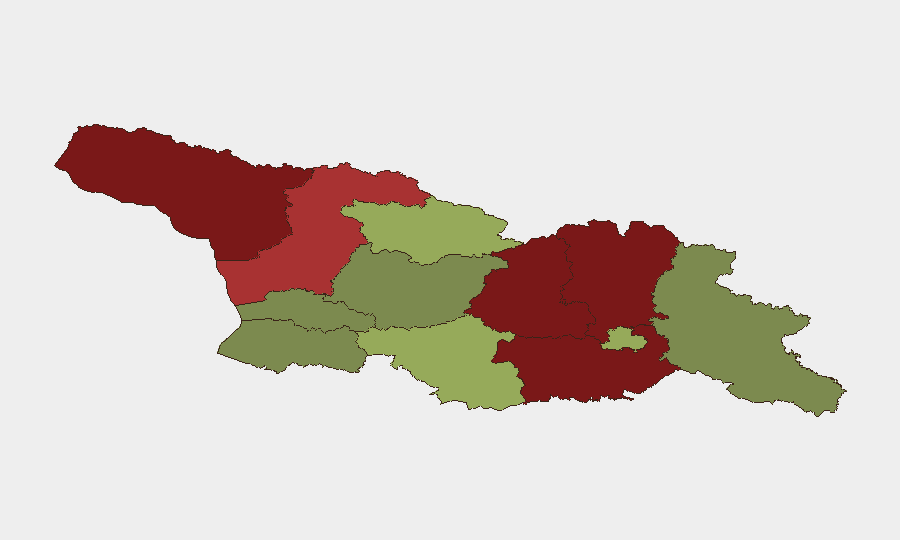
Abkhazia (risk 95), Shida Kartli (88), and Lower Kartli (85) dominate the sub-national ranking, driven by unresolved territorial disputes, limited state control, and proximity to Russia-backed de facto administrations. Samegrelo-Upper Svaneti (78) and Samtskhe-Javakheti (48) remain exposed to border instability and irregular cross-border activity. By contrast, Tbilisi (45) and western regions (Imereti, Guria, Adjara) score substantially lower, reflecting stronger state presence and law-enforcement capacity. Organizations with staff or operations in the occupied territories or northern/southern border zones should treat these rankings as persistent structural risk, not acute escalation.
How GeoBit Would Assist
Security teams should leverage AOI Monitoring & Early Warning to establish persistent watch on Abkhazia, South Ossetia, and the Enguri/Inguri hydroelectric nexus—critical infrastructure with demonstrated outage potential. Network & Actor Analysis paired with OSINT Sweep (Telegram, X, regional media, Shodan) would provide early signal on narcotics-trafficking networks, border-crossing trends, and document-fraud operations before they impact personnel. Conflict & Military mapping and Regime Stability assessment tools will flag any escalation or administrative changes in the de facto territories that could affect transit or supply chains.
7-Day Outlook
No acute escalation is anticipated over the next 7 days. However, the combination of critical-infrastructure vulnerabilities (demonstrated by the power outage), active transnational smuggling networks, and chronic sub-national instability in the north and south suggest a steady-state risk environment requiring continuous monitoring rather than episodic response. Organizations should review backup power, supply-chain routing, and personnel communication protocols for both Tbilisi and provincial operations.
Highest-Risk Areas — Ranked
| # | State / Region | Risk |
|---|---|---|
| 1 | Autonomous Republic of Abkhazia | 95 |
| 2 | Shida Kartli | 88 |
| 3 | Lower Kartli | 85 |
| 4 | Mtskheta-Mtianeti | 82 |
| 5 | Samegrelo-Upper Svaneti | 78 |
| 6 | Samtskhe-Javakheti | 48 |
| 7 | Tbilisi | 45 |
| 8 | Racha-Lechkhumi and Kvemo Svaneti | 42 |
| 9 | Kakheti | 38 |
| 10 | Autonomous Republic of Adjara | 35 |
| 11 | Imereti | 32 |
| 12 | Guria | 28 |
Sources
Previous Daily Briefs
A new Georgia brief is written every day — each with its own risk map and downloadable CSV. Here's the last week; use the calendar to go further back.
📅 Browse every day by calendar →
Highlighted days have a brief. Tap a day for that day's map & analysis, or “csv” for that day's dataset ($5).
Atlas — our AI intelligence desk — emails them this snapshot personally. Nothing else, no list.