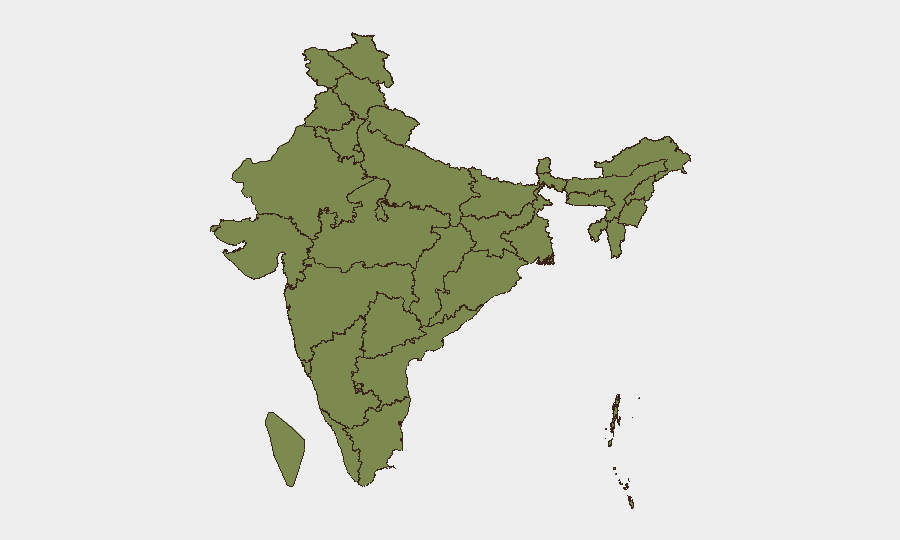
Situation Summary
India's composite threat profile remains moderate (rank 41 globally; 39/100 composite score), but activity is concentrated and volatile. Delhi dominates the national risk picture with a score of 34.1—more than double the second-highest state (Maharashtra, 16)—driven by a convergence of political detention, student unrest over exam irregularities, and civil demonstrations in the past 48 hours. Wider incidents spanning counterterrorism operations, industrial accidents, and regional security tightening indicate fragmented but persistent pressure across multiple threat vectors and geography.
Key Developments
- Delhi, July 22: Delhi Police detained opposition leaders Rahul Gandhi, Priyanka Gandhi, and Akhilesh Yadav at a protest site near the Prime Minister's residence amid ongoing political demonstrations and exam-related civil unrest, escalating tensions in the capital.
- Central Delhi, July 21–22: Violent student protests over competitive-examination irregularities erupted, with confrontations between demonstrators and security forces contributing to a sharp spike in civil unrest in the capital over the past 48 hours.
- Namchi district, Sikkim, July 22: A suspected methane gas explosion in a tunnel at NHPC's Teesta river hydro project caused a tunnel collapse, killing at least 10 workers and trapping 17 others; rescue operations are ongoing and hampered by toxic gases.
- Katra town and Vaishno Devi route, Jammu & Kashmir, July 22: Security forces elevated alertness and deployed enhanced checkpoints along the pilgrimage route and in Katra town in response to elevated security concerns.
- Bengaluru, Karnataka, July 21–22: The Enforcement Directorate executed searches at eight locations as part of an NIA-linked money-laundering probe tied to alleged ISIS recruitment and terror-funding networks, signaling active counterterrorism operations.
- North 24 Parganas district, West Bengal, July 20–21: West Bengal CID arrested a woman and recovered multiple firearms, approximately 200 rounds of ammunition, 12 magazines, and cash, suggesting a significant illegal arms and organized-crime nexus.
- Noida, Uttar Pradesh, July 20–21: Police discovered an unidentified deceased male (approximately 40 years old) near a green belt; the discovery triggered investigation into cause and circumstances.
- Gwalior, Madhya Pradesh, July 22: A structural wall collapse resulted in one fatality and two injuries; rescue and investigative teams responded.
Highest-Risk Areas
Delhi's risk score (34.1) reflects acute political volatility, civil unrest, and high-profile detention activity, positioning the capital as the primary concern zone for the next reporting cycle. Maharashtra (16) and Uttar Pradesh (14.1) follow distantly but remain elevated, reflecting broader regional instability and criminal/militant activity. Jammu & Kashmir (8.8) and the northeastern tier (Manipur, 7.7) retain endemic conflict and security pressures. The concentration of risk in Delhi and the NCR suggests that national-level political and civil tensions are the primary drivers; companies and NGOs with operations or personnel in the capital should prioritize situational awareness in real time.
How GeoBit Would Assist
Security teams monitoring India should deploy AOI Monitoring & Early Warning on Delhi, the NCR, and Jammu & Kashmir to capture protest activity, security deployments, and political developments in real time. Intel Sweep (Twitter/Telegram OSINT, sentiment analysis, and multi-language feeds) would provide 24-hour detection of emerging civil unrest, extremist narratives, and government statements. Risk & Threat Assessment layered with GIS & Spatial Analysis would enable duty-of-care teams to route personnel away from active demonstration zones and refine travel security protocols on a daily basis.
7-Day Outlook
Delhi-centered political and student unrest is likely to persist or escalate in the near term as opposition voices respond to recent detentions and exam grievances remain unresolved. Counterterrorism operations in Karnataka and West Bengal are expected to continue at current or elevated tempo. Industrial and structural incidents (Sikkim, Madhya Pradesh) are isolated but underscore elevated operational risk; enhanced site-level safety and environmental monitoring should be prioritized for infrastructure and energy projects nationwide.
Highest-Risk Areas — Ranked
| # | State / Region | Risk |
|---|---|---|
| 1 | Delhi | 34.1 |
| 2 | Maharashtra | 16 |
| 3 | Uttar Pradesh | 14.1 |
| 4 | Jammu and Kashmir | 8.8 |
| 5 | Manipur | 7.7 |
| 6 | Telangana | 7.1 |
| 7 | Uttarakhand | 7.1 |
| 8 | Rajasthan | 6.8 |
| 9 | Karnataka | 6.7 |
| 10 | Punjab | 6.5 |
| 11 | Kerala | 6.5 |
| 12 | West Bengal | 6.4 |
Previous Daily Briefs
A new India brief is written every day — each with its own risk map and downloadable CSV. Here's the last week; use the calendar to go further back.
📅 Browse every day by calendar →
Highlighted days have a brief. Tap a day for that day's map & analysis, or “csv” for that day's dataset ($5).
Atlas — our AI intelligence desk — emails them this snapshot personally. Nothing else, no list.