Situation Summary
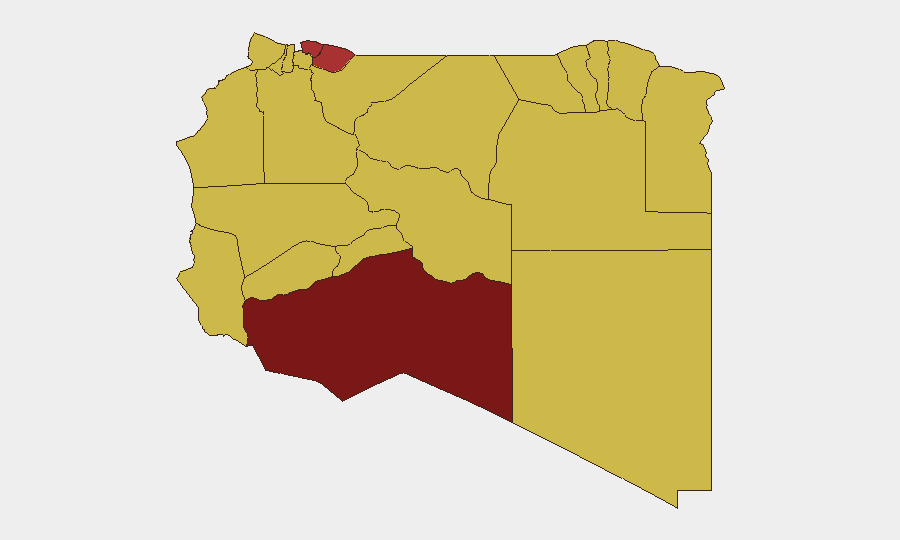
Libya remains a fragmented, high-volatility operating environment with entrenched governance competition, militia activity, and critical infrastructure strain. The composite threat score of 96 and 69 tracked events in the past reporting cycle reflect persistent armed factionalism, state capacity erosion, and localized security incidents across western and southern zones. While Tripoli retains nominal governmental authority, sub-national risk concentration in Murzuq (97.3), Murqub (78.1), and Tripoli itself (76.5) indicates that armed group activity and inter-militia conflict remain the primary drivers of instability. The trajectory is stabilization-resistant; no imminent major escalation is evident, but the risk profile remains elevated and uneven.
Key Developments
- 2026-07-18, Benghazi: Arrest/detention event involving Benghazi-affiliated actors and Libyan authorities; details suggest ongoing law-enforcement or political detention activity.
- 2026-07-18, National: Small arms combat involving militia units; location unspecified in available reporting but consistent with recurring armed-group friction across western Libya.
- 2026-07-18, National: U.S. State Department issued military/diplomatic statements regarding Libya, including disapproval commentary on Libyan ambassador conduct and conventional-force posturing; signals strain in U.S.–Libya relations.
- 2026-07-18, National: Libyan judicial system (Appeals Court) conducted arrest/detention of militant-affiliated individual, indicating ongoing counterterrorism or detention operations.
- 2026-07-17, National: UN Security Council initiated investigation into Libyan governance or security matters; specific subject unspecified but reflects international concern over state stability or armed-group conduct.
- 2026-07-16–17, National: Multiple public statements by Libyan officials and international actors (Greece, President, government); content suggests diplomatic activity or policy positioning but lacks specific operational detail in available sources.
Mid-July Context (not current 24–48h): Central Bank of Libya disclosed a recent cyberattack and stability measures. Government of National Unity activated emergency committee for nationwide electricity outages. Violence and intimidation targeting Sub-Saharan African migrants reported in western cities. Al-Zawiya gunmen attack with fatalities reported but not precisely dated to last 48 hours.
Highest-Risk Areas
Murzuq (97.3) and Murqub (78.1) in southern and western Libya drive the composite threat ranking, with Murzuq's exceptional score reflecting likely armed-group concentration, criminal activity, and weak state presence. Tripoli (76.5), as the seat of nominal government, experiences recurring militia clashes and factional tension despite security force presence. The clustering of secondary-tier risk (67.3) across Az Zawiya, Nalut, Ghat, and Wadi al Shatii indicates that western Libya and the southern desert corridor remain pressure points for trafficking, armed-group recruitment, and inter-militia competition for territorial or resource control. Eastern Libya (Benghazi area) shows discrete detention and security activity but does not rank in the top-12 sub-national zones, suggesting relative containment compared to western instability.
How GeoBit Would Assist
Security teams with personnel or assets in Libya should deploy AOI Monitoring & Early Warning on high-risk zones (Murzuq, Murqub, Az Zawiya) to receive alerting on armed-group movement, checkpoint activity, or violence. Intel Sweep and OSINT fusion across X/Telegram and local sources enable real-time tracking of militia statements, detention announcements, and cross-border trafficking signals. Routing & Network Analysis supports alternative-route planning for staff movement in Tripoli and western cities, reducing exposure to predictable conflict zones and militia checkpoints.
7-Day Outlook
No major escalation is anticipated in the next seven days, but localized armed-group activity and detention operations will likely persist, particularly in western Libya and Murzuq. Critical infrastructure strain (electricity, banking) may drive civil unrest or secondary security incidents. Staff and asset security should remain elevated and location-specific, with contingency protocols for rapid relocation if militia activity intensifies around Tripoli or access routes.
Highest-Risk Areas — Ranked
| # | State / Region | Risk |
|---|---|---|
| 1 | Murzuq | 97.3 |
| 2 | Murqub | 78.1 |
| 3 | Tripoli | 76.5 |
| 4 | Nalut | 67.3 |
| 5 | Ghat | 67.3 |
| 6 | Baladiyah Surman | 67.3 |
| 7 | Az Zawiya District | 67.3 |
| 8 | Wadi al Shatii | 67.3 |
| 9 | Wadi al Hayaa | 67.3 |
| 10 | Kufra | 67.3 |
| 11 | Nuqat al Khams | 67.3 |
| 12 | Jafara | 67.3 |
Sources
Previous Daily Briefs
A new Libya brief is written every day — each with its own risk map and downloadable CSV. Here's the last week; use the calendar to go further back.
📅 Browse every day by calendar →
Highlighted days have a brief. Tap a day for that day's map & analysis, or “csv” for that day's dataset ($5).
Atlas — our AI intelligence desk — emails them this snapshot personally. Nothing else, no list.