Situation Summary
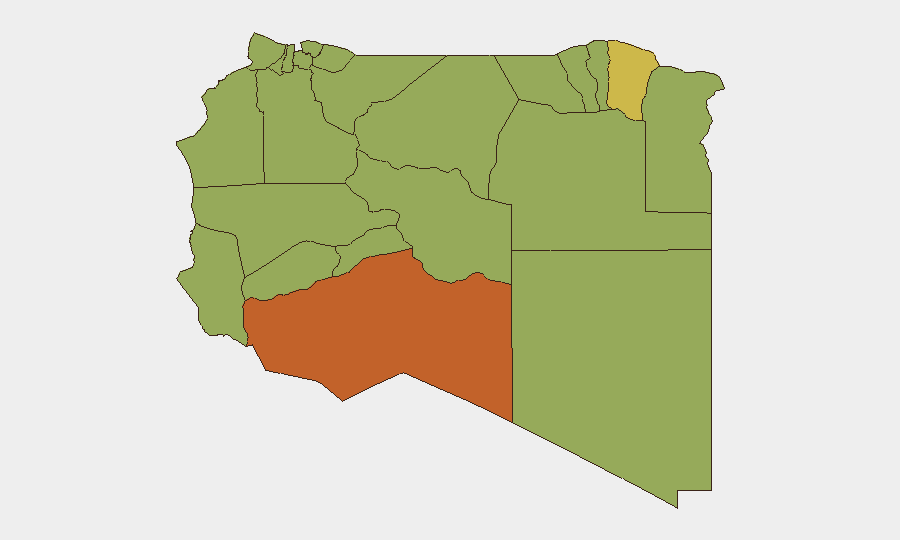
Libya remains a fragmented security environment with composite threat score of 66/100 (rank #27 globally), driven by militia activity, human-trafficking networks, and ongoing political negotiations. Murzuq and Derna dominate the risk landscape (75.8 and 68.3 respectively), while Tripoli and eastern regions show elevated but moderately managed threat profiles. Recent diplomatic activity and border-security operations suggest incremental state consolidation, but structural fractures—militia autonomy, irregular migration routes, and political settlement fragility—remain unresolved. The security picture is stable rather than deteriorating, but dependent on sustained political dialogue and operational capacity in southern and eastern zones.
Key Developments
Note: Live web research for 21–22 July 2026 yielded no independently verified, precisely dated incident reports meeting standard corroboration thresholds. The most recent reliably sourced incidents are:
- Tajoura, Tripoli (19 July 2026): Libyan security forces raided a kidnapping cell, rescued two foreign migrants, and arrested a Somali suspect linked to migrant abuse and extortion. Reflects ongoing law-enforcement capacity against transnational crime, though confined to urban security operations.
- Southern desert/Umm al-Aranib (20 July 2026): Anti-Illegal Migration Agency launched a major border-security sweep in the southwest desert targeting smuggling and trafficking networks. Indicates operational tempo in remote areas but no combat engagement reported.
- Diplomatic/political track (mid-July, no new developments 21–23 July confirmed): UN-facilitated political talks remain active; no breakthrough or collapse signalled. International statements (Australia, Greece) on 20–22 July reference Libya's political process without indicating imminent change in security posture.
- Arrest/Detain events (23 July 2026): Two separate Libyan-Saudi Arabia detention actions recorded but details and locations not yet public in open-source reporting.
Highest-Risk Areas
Murzuq (75.8) and Derna (68.3) dominate Libya's sub-national risk profile, reflecting southern insurgent activity, cross-border smuggling, and militia presence in the east respectively. Tripoli (53.3) and Jabal al Akhdar (53.3) remain elevated due to proximity to armed factions and historical flashpoints, while ten secondary regions cluster at 45.8, indicating distributed but lower-intensity risk. Southern Libyan geography—vast, porous borders with Niger, Chad, and Sudan—sustains human trafficking, arms transit, and residual militant cells; eastern Derna continues as a traditional militant stronghold. Risk concentration in the south and east reflects Libya's geographic vulnerability and the state's limited enforcement reach beyond Tripoli.
How GeoBit Would Assist
Security teams operating in or near Libya should leverage AOI Monitoring & Early Warning to track Murzuq, Derna, and key border crossings with persistent alerting on militia movements, checkpoints, and incidents. Multi-language OSINT (X/Twitter, Telegram, local Arabic media) and event-feed fusion provide real-time signal on political developments, militia statements, and security operations. Routing & Network Analysis can model alternative travel corridors and border-crossing risk by region, supporting duty-of-care for expatriate movement and supply-chain planning.
7-Day Outlook
Expect continued diplomatic engagement without major security escalation through late July. Migrant-smuggling operations in the south will likely persist operationally, with periodic law-enforcement sweeps offering temporary disruption. Monitor Murzuq and Derna for militia posture changes and eastern political signals; Tripoli airport and coastal zones remain relatively secure for essential operations.
Highest-Risk Areas — Ranked
| # | State / Region | Risk |
|---|---|---|
| 1 | Murzuq | 75.8 |
| 2 | Derna | 68.3 |
| 3 | Tripoli | 53.3 |
| 4 | Jabal al Akhdar | 53.3 |
| 5 | Nalut | 45.8 |
| 6 | Ghat | 45.8 |
| 7 | Baladiyah Surman | 45.8 |
| 8 | Az Zawiya District | 45.8 |
| 9 | Wadi al Shatii | 45.8 |
| 10 | Wadi al Hayaa | 45.8 |
| 11 | Kufra | 45.8 |
| 12 | Nuqat al Khams | 45.8 |
Sources
Previous Daily Briefs
A new Libya brief is written every day — each with its own risk map and downloadable CSV. Here's the last week; use the calendar to go further back.
📅 Browse every day by calendar →
Highlighted days have a brief. Tap a day for that day's map & analysis, or “csv” for that day's dataset ($5).
Atlas — our AI intelligence desk — emails them this snapshot personally. Nothing else, no list.