Situation Summary
Turkmenistan remains a low-threat environment with no recorded security incidents in the past week, ranking #184 globally with a composite threat score of 3. However, open-source reporting reveals ongoing state-linked labor coercion in cotton-harvest regions and localized police-involved disputes over commodity-quality disputes, suggesting low-level friction in rural areas rather than organized instability. The country continues to function as a regional diplomatic hub and transit corridor, as demonstrated by its facilitation of South Korean evacuations from Iran, while security services coordinate with regional partners on counterterrorism and cross-border crime.
Key Developments
- Cotton harvest season labor disputes (18 Sep 2026, cotton-growing regions nationwide): Public-sector employees reported to be required to pay monthly fees to avoid forced harvest participation; disputes over moisture-measurement manipulation have resulted in physical altercations between farmers and officials requiring police intervention, indicating localized confrontations and coercive state practices.
- Arkadag Stadium order directive (15 Sep 2026, Arkadag city): Former president Gurbanguly Berdimuhamedov publicly demanded restoration of "order" at the facility, suggesting management concerns over crowd behavior or venue discipline at a major public venue.
- Regional security coordination summit (14–15 Sep 2026, Burabay, Kazakhstan): Turkmenistan's security-service heads participated in a multinational meeting with Kazakhstan, Azerbaijan, Kyrgyzstan, Tajikistan, and Uzbekistan to address counterterrorism, drug and weapons trafficking, and transnational crime.
- Prosecutor General cooperation agreement (mid-September 2026, Ashgabat): Turkmenistan signed a Memorandum of Understanding with South Korea's Supreme Prosecutors' Office as part of a 13-agreement package, widening institutional channels for prosecution coordination and organized-crime enforcement.
- South Korean evacuation facilitation (15 Sep 2026, diplomatic channels): Turkmenistan's President Serdar Berdimuhamedow was publicly thanked by South Korea for enabling the safe evacuation of South Korean nationals from Iran following the outbreak of US–Iran conflict, reinforcing Turkmenistan's role as a regional transit corridor.
- No recorded cross-border incidents (15–21 Sep 2026, national borders): Regional reporting on Afghanistan, Turkey, and Iran-border areas contains no explicit references to security incidents on Turkmenistan's territory or at its borders.
Highest-Risk Areas
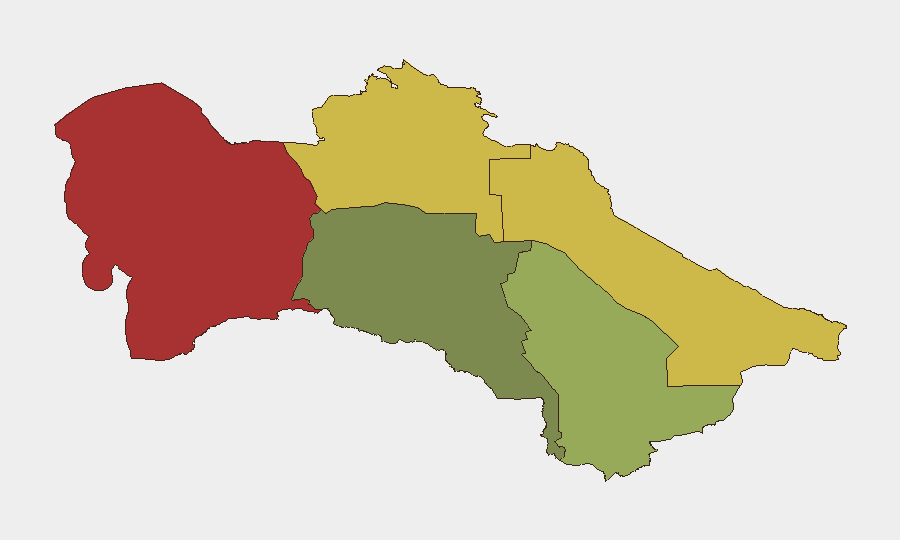
Balkan Region (risk 78) and Lebap Region (risk 68) drive the country's highest composite risk scores, likely reflecting proximity to Afghanistan, cross-border trafficking exposure, and remote governance reach. Dashoguz Region (risk 62) faces similar transnational-crime pressures, while Mary and Ahal regions show moderate risk tied to economic activities and enforcement patterns. Ashgabat City (risk 18) remains substantially lower-risk, consistent with central government control and international-business presence. Risk concentration in the north and east correlates with border proximity and agricultural-labor coercion patterns observed this week.
How GeoBit Would Assist
Security teams would deploy AOI Monitoring & Early Warning on high-risk regions (Balkan, Lebap, Dashoguz) to detect emerging labor disputes, police actions, or cross-border activity; OSINT Fusion (X/Telegram, multi-language search, entity extraction) to corroborate reporting on enforcement actions and identify localized friction; and Regime-Stability Search to track government directives and control patterns. Routing & Network Analysis supports contingency planning for personnel in cotton-growing regions during harvest season.
7-Day Outlook
No escalation of acute threats is expected in the near term; the security environment is likely to remain characterized by low-visibility state control and seasonal labor friction. Harvest-season enforcement dynamics may produce additional localized disputes and police involvement through late September, while regional counterterrorism and trafficking concerns will continue to shape Turkmenistan's security posture absent major geopolitical shifts.
Highest-Risk Areas — Ranked
| # | State / Region | Risk |
|---|---|---|
| 1 | Balkan Region | 78 |
| 2 | Lebap Region | 68 |
| 3 | Dashoguz Region | 62 |
| 4 | Mary Region | 42 |
| 5 | Ahal Region | 35 |
| 6 | Ashgabat City | 18 |
Sources
Previous Weekly Briefs
A new Turkmenistan brief is written every Monday, covering the week — each with its own risk map and downloadable CSV. Use the calendar to go further back.
- September 14, 2026
- September 7, 2026
- September 3, 2026
- September 2, 2026
- September 1, 2026
- August 31, 2026
- August 30, 2026
📅 Browse past briefs by calendar →
Highlighted days have a brief. Tap a day for that day's map & analysis, or “csv” for that day's dataset ($5).
Atlas — our AI intelligence desk — emails them this snapshot personally. Nothing else, no list.