Situation Summary
The United Arab Emirates faces elevated but non-acute regional security pressure stemming from escalating US–Iran tensions and Iran's public attribution of UAE complicity in US military operations. No verified incidents of civil unrest, direct attack, or infrastructure damage have been reported inside UAE territory in the last 24–48 hours. However, rhetorical escalation from Iranian officials and aligned non-state actors—explicitly naming UAE as a target for retaliation—has materialized within the past 48 hours, coupled with expanded US military technology access to the UAE that Tehran has weaponized as evidence of UAE alignment with the US. The trajectory is one of elevated political and cyber-threat risk without immediate kinetic indicators.
Key Developments
- Abu Dhabi – 11 July 2026: UAE Ministry of Foreign Affairs condemned Iran's missile strike on Jordan as a violation of regional security, publicly signaling concern about spillover escalation but reporting no attacks or unrest within UAE boundaries.
- National (Aviation) – 11 July 2026: UAE authorities announced full resumption of air traffic after earlier regional disruptions, indicating aviation infrastructure assessed as operationally safe despite elevated regional tensions.
- National (Export Control Policy) – 10–11 July 2026: US Commerce Department upgraded UAE's export-control status, explicitly expanding access to US military, dual-use, and advanced-computing technology (drones, AI chips). Iran immediately leveraged this decision as public proof of UAE–US military coordination.
- Tehran (Official Rhetoric) – 11 July 2026: Iranian Deputy Foreign Minister Kazem Gharibabadi posted on X that the UAE export-control upgrade constitutes "official proof" of UAE support for US military operations against Iran and declared the UAE "must be held accountable" with "direct international responsibility and legal consequences."
- Tehran (Parliamentary Threat) – 11 July 2026: An Iranian national security committee lawmaker reiterated that the UAE would "pay the price" for alleged US cooperation, explicitly positioning UAE military and US facilities on UAE soil as potential targets.
- Red Sea Region – 11 July 2026: Iran-aligned Houthi spokesmen renewed warnings that Gulf states hosting US military bases—explicitly including the UAE in scope—could become targets if US military action against Iran continues.
- Strait of Hormuz – 10–11 July 2026: Joint Maritime Information Center updated advisories on southern Strait of Hormuz routes, citing "recent unprovoked attacks on merchant vessels." UAE maritime trade corridors remain operationally open but under heightened threat advisory.
Highest-Risk Areas
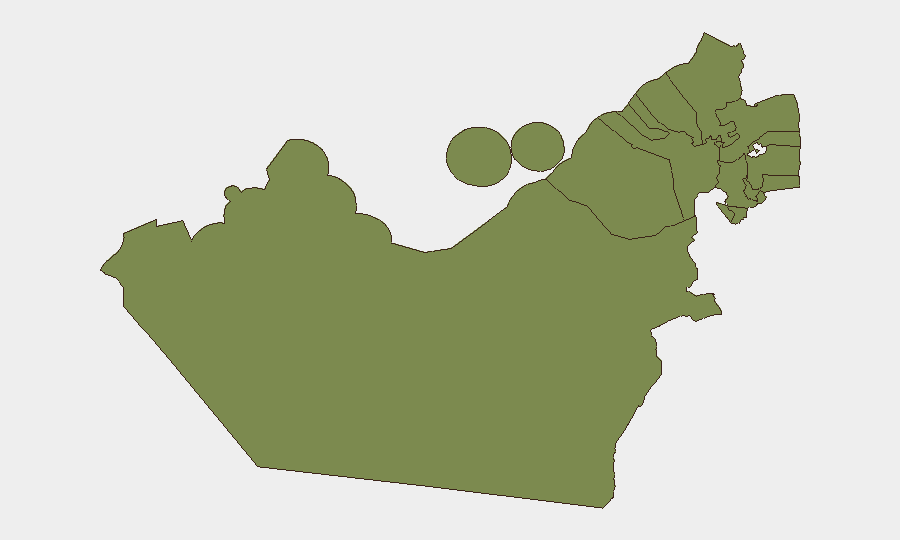
Abu Dhabi Emirate carries the composite risk score of 31.5, more than 14 times higher than Dubai (22.5) and orders of magnitude above other emirates. This reflects Abu Dhabi's role as the political and administrative capital, host to US military facilities (Al Dhafra Air Base and naval coordination points), critical energy infrastructure, and government decision-making centers—all explicitly named in current Iranian and Houthi threat rhetoric. Dubai, while secondary in current threat rhetoric, remains a major financial and maritime hub with significant exposure to Strait of Hormuz disruptions and cyber-attack risk. The remaining five emirates carry minimal current risk signals.
How GeoBit Would Assist
Security teams should deploy Intel Sweep and OSINT fusion to track evolving Iranian threat rhetoric and non-state actor messaging (X, Telegram) in real time, paired with sentiment and temporal analysis to assess escalation trajectories. AOI Monitoring with early-warning alerting on Abu Dhabi's energy, aviation, and military infrastructure, combined with maritime tracking for UAE-flagged and UAE-port-transiting vessels in the Strait of Hormuz, provides persistent visibility of kinetic and cyber-threat emergence. Network and actor analysis can map command-and-control pathways for Iranian proxies and track public declarations of targeting intent.
7-Day Outlook
Expect rhetorical escalation and threat signaling to persist as long as US–Iran military operations continue. No imminent kinetic attack on UAE territory is indicated by current intelligence, but the probability of cyber operations targeting UAE government, financial, and energy sectors remains elevated. Aviation and maritime operations will likely remain nominally stable unless regional hostilities materially widen.
Highest-Risk Areas — Ranked
| # | State / Region | Risk |
|---|---|---|
| 1 | Abu Dhabi Emirate | 31.5 |
| 2 | Dubai | 22.5 |
| 3 | Sharjah Emirate | 1.5 |
| 4 | Ajman Emirate | 1.5 |
| 5 | Ras al-Khaimah | 1.5 |
| 6 | Fujairah Emirate | 1.5 |
| 7 | Umm al-Quwain | 1.5 |
Sources
Previous Daily Briefs
A new United Arab Emirates brief is written every day — each with its own risk map and downloadable CSV. Here's the last week; use the calendar to go further back.
📅 Browse every day by calendar →
Highlighted days have a brief. Tap a day for that day's map & analysis, or “csv” for that day's dataset ($5).
Atlas — our AI intelligence desk — emails them this snapshot personally. Nothing else, no list.