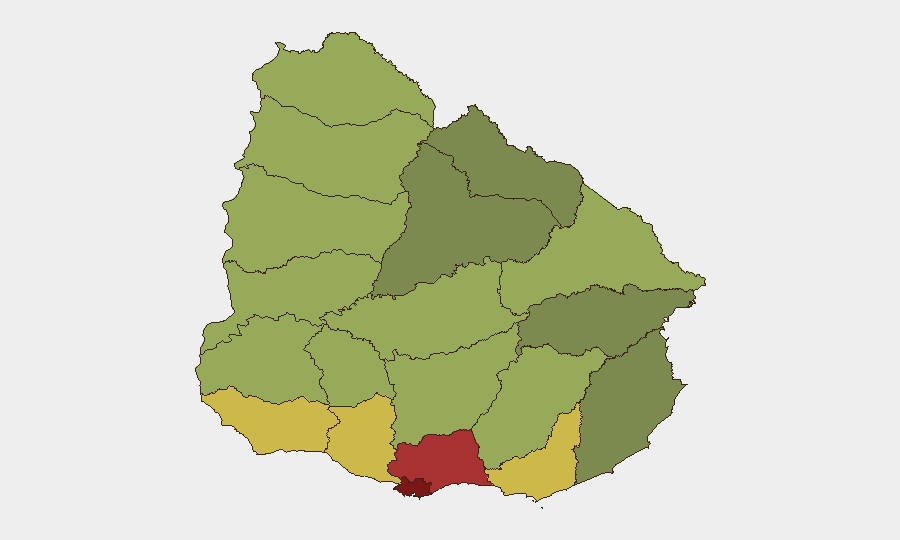
Situation Summary
Uruguay maintains a stable security environment with no confirmed acute incidents, civil unrest, major crime events, or infrastructure disruptions in the past 24–48 hours. The country ranks 154th globally (composite threat score 5) and continues to operate under normal conditions despite structural vulnerabilities in organized-crime activity, labor disputes, and border-region trafficking. The absence of recent verified events reflects Uruguay's relative stability compared to regional peers, though sub-national risk concentration in Montevideo and border departments warrants continued monitoring.
Key Developments
- No confirmed acute security, civil-unrest, crime, or infrastructure incidents documented nationwide in the last 24–48 hours (12–14 July 2026, per OSINT cross-check and open-source security monitoring).
- Two public statements flagged in event signals (14 July 2026): one involving business-sector communication with Uruguay; one involving Uruguay-Brazil diplomatic or commercial messaging. Neither has been corroborated as a security or stability incident; operational context remains unclear pending further intelligence.
- Structural issues persist but remain below acute threshold: organized-crime activity, labor organizing, and trafficking remain endemic to border regions and Montevideo, but no specific incident or flashpoint has crystallized in the last 24–48 hours.
- Travel advisories unchanged: government and international bodies continue to rate Uruguay as low-to-moderate risk with standard safety precautions; no emergency declarations or sudden advisories issued in the reporting window.
Highest-Risk Areas
Montevideo (risk score 92) and Canelones (78) dominate the sub-national threat profile, driven by population density, organized-crime presence, and inter-gang activity in peripheral neighborhoods. Maldonado (68) and the northern border departments—San José (64), Colonia (62), Soriano (58), Río Negro (56), and Salto (54)—register elevated risk owing to drug-trafficking corridors, smuggling networks, and weaker state presence. Southern coastal and central departments (Florida, Flores, Paysandú) remain lower-risk but are not exempt from organized-crime spillover. Risk in these zones is chronic rather than acute; no single recent event has triggered a spike in the last 24 hours.
How GeoBit Would Assist
Corporate security teams with Montevideo or border-region operations would benefit from AOI Monitoring & Early Warning on high-risk neighborhoods and trafficking corridors, combined with OSINT Fusion & Corroboration (Twitter, Telegram, news aggregation) to detect labor strikes, protest activity, or organized-crime incidents before they escalate. GIS & Spatial Analysis and Routing & Network Analysis capabilities enable real-time alternative-route planning for staff and supply chains in event of blockades or road disruptions. Ongoing Intel Sweep and multi-language open-source search ensure duty-of-care teams remain current on structural risks (trafficking, gang activity) without over-reacting to background noise.
7-Day Outlook
No acute flashpoints are forecast for the next seven days; however, structural vulnerabilities (organized-crime activity, labor organizing in transport and public sectors) remain persistent drivers of localized disruption. Montevideo and border regions will continue to warrant elevated monitoring discipline, particularly around labor negotiations and inter-gang territorial disputes. The absence of current incidents should not be mistaken for elimination of underlying risk.
Highest-Risk Areas — Ranked
| # | State / Region | Risk |
|---|---|---|
| 1 | Montevideo | 92 |
| 2 | Canelones | 78 |
| 3 | Maldonado | 68 |
| 4 | San José | 64 |
| 5 | Colonia | 62 |
| 6 | Soriano | 58 |
| 7 | Río Negro | 56 |
| 8 | Salto | 54 |
| 9 | Artigas | 52 |
| 10 | Paysandú | 50 |
| 11 | Florida | 48 |
| 12 | Flores | 46 |
Sources
Previous Daily Briefs
A new Uruguay brief is written every day — each with its own risk map and downloadable CSV. Here's the last week; use the calendar to go further back.
📅 Browse every day by calendar →
Highlighted days have a brief. Tap a day for that day's map & analysis, or “csv” for that day's dataset ($5).
Atlas — our AI intelligence desk — emails them this snapshot personally. Nothing else, no list.