Situation Summary
Afghanistan remains in a state of acute cross-border military escalation and internal insurgent activity, with Pakistani airstrikes on eastern provinces killing at least 38 civilians as of 1 July. The Taliban government faces simultaneous pressure from Pakistani military operations targeting border areas, internal opposition groups claiming attacks on Taliban installations, and continued deterioration of civilian infrastructure in conflict zones. Overall threat trajectory is upward; diplomatic channels (exemplified by Iran's ambassador attending events in Kabul) coexist with intensifying armed conflict and tightening Pakistani border controls that will degrade regional mobility and evacuation options.
Key Developments
- Eastern Afghanistan (Paktia, Paktika, Kunar) – night of 30 June–1 July 2026: Pakistani airstrikes reported by Taliban authorities killed at least 38 civilians and injured 163, including women and children, in cross-border operations. Pakistani officials characterize strikes as targeting terror infrastructure; escalation risk remains high.
- Badakhshan Province – 1 July 2026: Afghanistan Freedom Front (AFF) claimed an attack on a Taliban military base, stating infliction of casualties and facility damage. Social-media posting only; independent verification pending.
- Kabul – 1 July 2026: Iran's ambassador attended opening of the Fifth International Exhibition under heavy security, signaling that large public gatherings and foreign delegations proceed despite broader instability, but at elevated operational risk.
- Pakistan–Afghanistan border – effective 10 July 2026: Pakistani authorities announced nationwide crackdown ordering arrest of undocumented Afghan nationals, significantly complicating cross-border movement and evacuation routing as of this week's announcement.
- Eastern border belt – late June–1 July 2026: UN humanitarian officials (UNOCHA) reported ongoing cross-border strikes destroying civilian homes and livelihoods; damage is recurring, not isolated.
- Nationwide – 2 July 2026: Australia's Smartraveller re-issued "Do not travel" advisory explicitly citing ongoing Pakistan–Afghanistan military conflict, intense border fighting, and recent bombings in Kabul and Kandahar.
Highest-Risk Areas
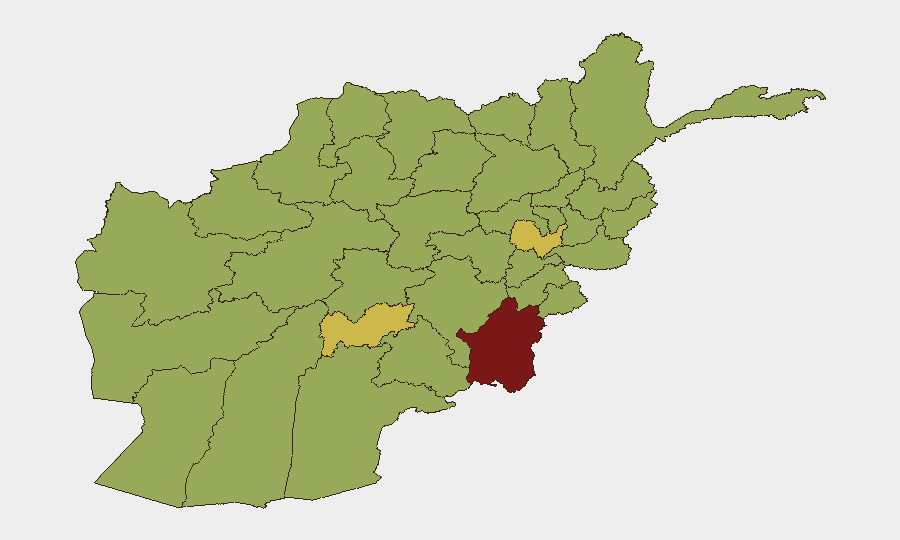
Paktika (81.8), Kabul (68.7), and Uruzgan (61.7) provinces drive the country's composite risk score. Paktika and neighboring Paktia and Kunar rank in the top 10 due to direct exposure to Pakistani cross-border strikes, ongoing Taliban-insurgent clashes, and destruction of civilian infrastructure—creating acute risk for any personnel in or transiting these districts. Kabul's elevated risk (second-highest) reflects its status as the capital, concentrating government, diplomatic, and commercial activity while remaining vulnerable to bombings and unconventional attack, as recent event signals indicate. Uruzgan's high ranking reflects persistent Taliban-insurgent military operations.
How GeoBit Would Assist
Organizations operating in Afghanistan should deploy AOI Monitoring & Early Warning on Paktika, Kabul, and eastern border districts to detect cross-border strikes, airstrikes, and insurgent operations in near real-time; couple this with Intel Sweep and multi-language OSINT to validate Taliban, Pakistani, and opposition claims before acting on unverified reports. Routing & Network Analysis is critical for duty-of-care teams: cross-border movement via Pakistan is now restricted by law as of 10 July; alternative routing (air, northern corridors) must be pre-mapped and verified daily. Conflict & Military tracking and GIS & Spatial Analysis enable precise identification of safe zones within Kabul and other operational centers.
7-Day Outlook
Pakistan's announced enforcement of visa crackdowns (10 July) will materially restrict ground mobility and complicate evacuation planning within the next week. Cross-border airstrikes are likely to persist given the absence of de-escalation signals; organizations should assume eastern provinces remain high-consequence zones. Kabul will likely see continued diplomatic activity and public gatherings, but under heightened security posture and elevated ambient risk from bombing and armed conflict.
Highest-Risk Areas — Ranked
| # | State / Region | Risk |
|---|---|---|
| 1 | Paktika Province | 81.8 |
| 2 | Kabul Province | 68.7 |
| 3 | Uruzgan Province | 61.7 |
| 4 | Parwan Province | 55.4 |
| 5 | Herat Province | 53.6 |
| 6 | Kunar Province | 53 |
| 7 | Helmand Province | 52.1 |
| 8 | Paktia Province | 51.9 |
| 9 | Nangarhar Province | 51.9 |
| 10 | Zabul Province | 51.8 |
| 11 | Kandahar Province | 51.8 |
| 12 | Ghazni Province | 51.8 |
Sources
Previous Daily Briefs
A new Afghanistan brief is written every day — each with its own risk map and downloadable CSV. Here's the last week; use the calendar to go further back.
📅 Browse every day by calendar →
Highlighted days have a brief. Tap a day for that day's map & analysis, or “csv” for that day's dataset ($5).