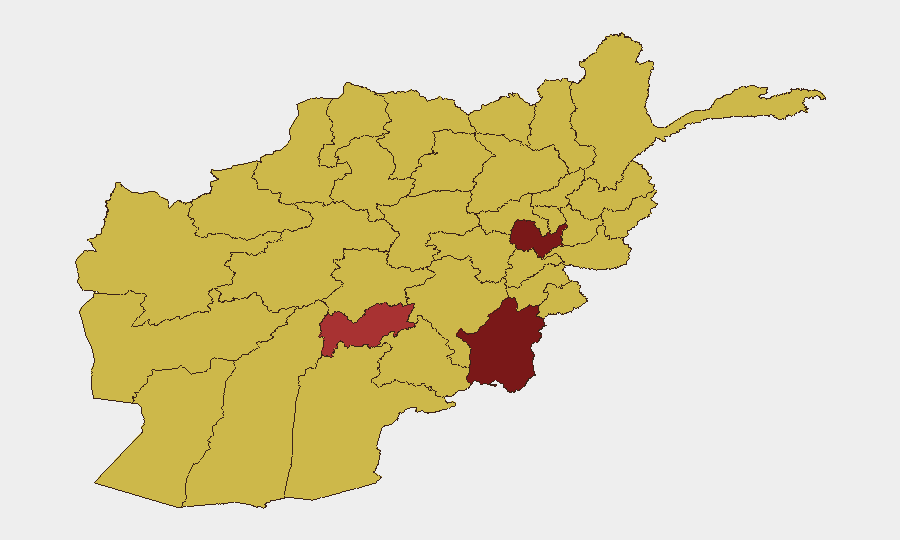
Situation Summary
Afghanistan remains at elevated threat level (#14 globally) driven by persistent insurgency and, as of late June 2026, a sharp escalation in cross-border military confrontation with Pakistan. The June 29 Pakistani airstrikes into Paktika and Kunar provinces—resulting in 36+ confirmed civilian casualties—mark the most direct state-on-state military action in the region in months and have substantially increased volatility across eastern border provinces. Risk trajectories suggest continued pressure on eastern and south-eastern corridors, with broader implications for cross-border movement and regional stability.
Key Developments
- Paktika Province, June 29, 2026: Pakistan conducted overnight airstrikes targeting alleged militant positions near Khost, killing at least 36 civilians and wounding 160+ according to Afghan officials; Pakistan claimed 29 fighters killed. This represents the most direct military confrontation between Afghan and Pakistani state actors to date and has sharply elevated security risk in border regions.
- Kunar Province, late June 2026: Afghan authorities reported Pakistani airstrikes on civilian infrastructure including a university and residential neighborhoods, with at least 7 confirmed dead and 85+ injured; exact date not independently verified but timing aligns with broader cross-border escalation.
- National level, July 1, 2026: Taliban Deputy Prime Minister publicly stated that rising Pakistan tensions "benefit no one" amid continuing reports of cross-border strikes, threats of open war, and mediation efforts by Chinese officials. Statement signals official concern about conflict trajectory but also potential diplomatic off-ramps.
- Border regions, June 30–July 1, 2026: Afghan media reports intensifying deportations of Afghan migrants from Pakistan and Iran, creating civil-unrest and infrastructure-strain risk at major crossing points and compounding border-area instability.
- National trend: 121 tracked events in past reporting period, with "Disapprove" statements, small-arms combat, aerial weapons use, and unconventional violence dominating event-signal mix; indicates multi-actor tension and sustained operational tempo.
Highest-Risk Areas
Paktika Province (96.8 composite risk) dominates the current threat landscape, directly attributable to the June 29 airstrikes and ongoing cross-border militant activity. Kabul Province (85.6) remains elevated due to insurgent targeting of government and civilian infrastructure in the capital. Eastern and south-eastern provinces—Uruzgan, Nangarhar, Kunar, Paktia, and Zabul—form a contiguous high-risk band along the Pakistan border where militant sanctuaries, Pakistani military operations, and Afghan security-force responses create compounded threat. Herat Province (68.1, western border) shows secondary elevation likely tied to Iranian border instability and regional militant networks. Western and southern provinces reflect both Taliban control-consolidation challenges and residual ISIS-K activity.
How GeoBit Would Assist
Security teams should deploy AOI Monitoring & Early Warning on Paktika, Kunar, and Nangarhar provinces to detect cross-border strike patterns and militant movement in near-real time. OSINT Fusion & Corroboration (X/Twitter, Telegram, YouTube, multi-language search) will track Pakistani and Afghan official statements, militant claims, and humanitarian reports to establish incident timelines and casualty counts ahead of mainstream reporting. Battle Mapping and Force Structure analysis would support tracking Pakistani and Afghan military posture shifts and predict secondary escalation risk in adjacent provinces.
7-Day Outlook
Expect continued elevated tension in eastern border provinces with risk of additional cross-border operations, militant retaliation, or unilateral Pakistani strikes if attacks on Pakistani soil resume. Diplomatic engagement (Chinese mediation noted) may provide temporary de-escalation window but structural drivers—sanctuary provision, cross-border militant networks—remain unresolved. Travel risk in Paktika, Kunar, and Nangarhar should be treated as acute through at least July 8; broader country risk stable but contingent on border developments.
Highest-Risk Areas — Ranked
| # | State / Region | Risk |
|---|---|---|
| 1 | Paktika Province | 96.8 |
| 2 | Kabul Province | 85.6 |
| 3 | Uruzgan Province | 79.3 |
| 4 | Parwan Province | 69.3 |
| 5 | Nangarhar Province | 68.3 |
| 6 | Herat Province | 68.1 |
| 7 | Kunar Province | 67.6 |
| 8 | Helmand Province | 67.1 |
| 9 | Paktia Province | 66.9 |
| 10 | Zabul Province | 66.8 |
| 11 | Kandahar Province | 66.8 |
| 12 | Ghazni Province | 66.8 |
Sources
Previous Daily Briefs
A new Afghanistan brief is written every day — each with its own risk map and downloadable CSV. Here's the last week; use the calendar to go further back.
📅 Browse every day by calendar →
Highlighted days have a brief. Tap a day for that day's map & analysis, or “csv” for that day's dataset ($5).