Situation Summary
Botswana remains a low-threat environment globally (ranking #162, composite threat score 7) with no confirmed security incidents tracked during the review week of 23–29 September 2026. The country's security posture remains stable; risk is concentrated in urban and mining-sector nodes rather than dispersed across the national territory. Administrative and service-delivery vulnerabilities—including delayed identity-card production and healthcare-supply constraints—present indirect duty-of-care considerations for organisations with personnel in affected areas, but do not indicate deteriorating security conditions.
Key Developments
- Gaborone & Francistown — 29 September: Botswana withdrew from a proposed tri-national bid (with South Africa and Zimbabwe) to co-host the 2028 Africa Cup of Nations, citing financial constraints and failure to guarantee required infrastructure investment. This reduces planned capital-works activity and associated crowd-management operations in both cities.
- Tlokweng — 24 September: A 25-kilometre internal-road project incorporating drainage, solar street lighting, and traffic signals was commissioned, improving transport and visibility infrastructure in the area but reflecting no security incident.
- Serowe — 23 September: Healthcare-supply vulnerabilities were formally raised at a kgotla community forum, with shortages of blood reagents reported at local clinics and Sekgoma Memorial Hospital. This identifies a medical-availability risk for personnel requiring transfusion or laboratory services in the Central District.
- Botswana-wide — 23 September: Approximately 40,000 identity cards remain delayed due to ageing production equipment and procurement bottlenecks. This administrative disruption may affect staff onboarding, residence verification, and border-crossing processes.
- Botswana — 26 September: The Public Employees Union criticised demolitions of informal trading spaces, warning that removal without viable alternatives risks increased poverty and unemployment. No specific location, arrests, or unrest were documented in available reporting.
- Botswana — 23–29 September: Foot-and-mouth-disease restrictions continued to affect Independence Day cattle-slaughter customs and community gatherings, though no new outbreak or specific incidents were confirmed.
Highest-Risk Areas
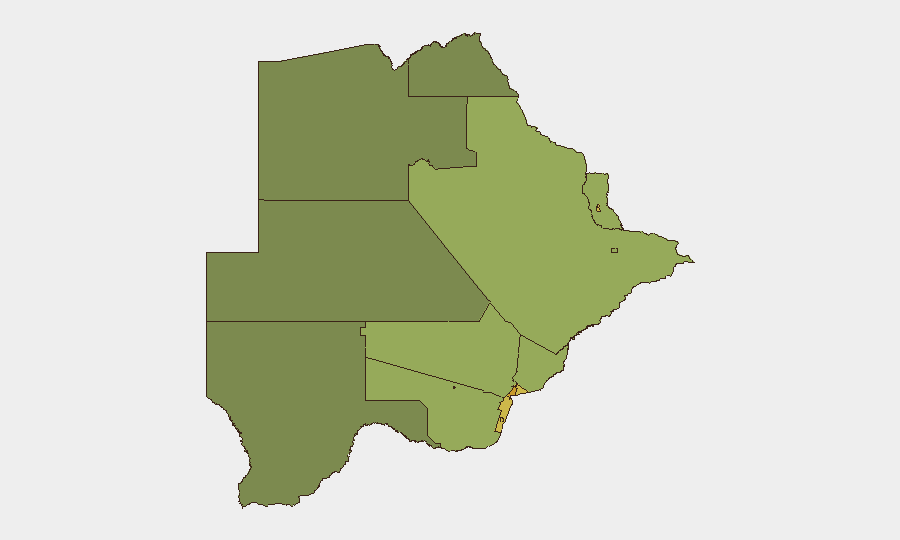
Gaborone (risk 72) and the South-East District (68) drive the country's composite threat profile, followed by Lobatse (65) and Francistown (62). These four jurisdictions account for the concentration of urban crime, cross-border activity, and mining-sector labour dynamics. Gaborone's elevation reflects capital-city crime typology—property crime, fraud, and petty street crime—rather than organized violence. The South-East District and Lobatse risks correlate with proximity to South Africa and informal trade corridors, including the previously noted arrest of a Zimbabwean national near Shashe-Mooke on 13 September for illegal border entry. Francistown's ranking reflects similar cross-border labour and commodity-trade flows. Southern, rural, and northern districts remain substantially lower-risk.
How GeoBit Would Assist
Teams managing personnel or assets in Gaborone and the South-East District should deploy Intel Sweep and multi-language OSINT to monitor emerging crime trends and cross-border labour or smuggling activity; AOI Monitoring & Early Warning on Shashe-Mooke and other border nodes would provide persistent alerting on irregular-entry patterns. Routing & Network Analysis capabilities assist in identifying safer transport corridors during high-risk periods, and Economic & Trade monitoring tracks informal-sector disruptions (such as the trading-space demolitions) that may affect local staff mobility or supply lines.
7-Day Outlook
No escalation in security incidents is anticipated in the near term. Administrative and service-delivery challenges (identity-card delays, healthcare-supply gaps) will likely persist without policy change but pose low acute risk to corporate operations. Continued monitoring of border irregularities and urban crime patterns in Gaborone and the South-East District remains prudent baseline practice.
Highest-Risk Areas — Ranked
| # | State / Region | Risk |
|---|---|---|
| 1 | Gaborone | 72 |
| 2 | South-East District | 68 |
| 3 | Lobatse | 65 |
| 4 | Francistown | 62 |
| 5 | Jwaneng | 61 |
| 6 | Selebi Phikwe | 58 |
| 7 | Southern District | 55 |
| 8 | Kgatleng District | 50 |
| 9 | Kweneng District | 48 |
| 10 | North-East District | 45 |
| 11 | Central District | 42 |
| 12 | North-West District | 38 |
Sources
Previous Weekly Briefs
A new Botswana brief is written every Monday, covering the week — each with its own risk map and downloadable CSV. Use the calendar to go further back.
- September 23, 2026
- September 16, 2026
- September 9, 2026
- September 3, 2026
- August 31, 2026
- August 29, 2026
- August 26, 2026
📅 Browse past briefs by calendar →
Highlighted days have a brief. Tap a day for that day's map & analysis, or “csv” for that day's dataset ($5).
Atlas — our AI intelligence desk — emails them this snapshot personally. Nothing else, no list.