Situation Summary
Canada remains a stable, low-threat jurisdiction globally (ranked #149) with a composite threat score of 5, though sub-national risk concentration in Nunavut and Ontario (scores 31.8 and 30 respectively) reflects localized instability rather than nationwide systemic failure. Recent signal activity (July 7–9) indicates military-force deployments, small-arms engagement in Ontario, territorial occupation, and investigative action involving provincial leadership, suggesting acute political or security tensions in at least two provinces. The trajectory points toward contained but elevated risk in the Arctic and Greater Toronto regions; national institutions remain intact, and threat prevalence remains well below global median.
Key Developments
Data Limitation Notice: GeoBit's web research capability did not retrieve clearly time-stamped, Canada-specific incidents from July 7–9, 2026 with sufficient verification to meet duty-of-care reporting standards. The platform's signal feed references military-force events, small-arms combat in Ontario, territorial occupation near Wellington, and provincial-level investigations, but source attribution and precise timing remain unconfirmed pending direct feed access or corroborating OSINT.
- Ontario (date 2026-07-09, unconfirmed): Small-arms combat reported; investigative action initiated involving Ontario premier. Geographic proximity to Toronto (Ontario's capital) and population density elevate consequence potential.
- Canada-wide (2026-07-09): Multiple conventional military-force signals detected; one linked to Buffalo (US border region). Suggests possible cross-border military coordination or domestic force deployment.
- Wellington area (2026-07-08): Territory occupation reported; administrative and political dimensions implied. Requires geographic clarification (Wellington, Ontario vs. other provinces).
- Publication/Media (2026-07-08): Administrative sanctions issued against a publication; political statement by Champagne (federal Cabinet member) in Ottawa. Suggests government response to media coverage of unfolding events.
- British Columbia – Structural Risk (background context, not 24–48h incident): Pacific ports (Vancouver, Prince Rupert) assessed as under-secured; outbound cargo inspection rates below 2% (imaging) and 1% (physical search) in Metro Vancouver, creating organized-crime and drug-trafficking vulnerabilities.
- Quebec – Cyber Incident (social media report, date unverified): Pro-Russian hacktivist access to a Quebec municipality's water-treatment systems reported; original incident date not provided in available sources.
Highest-Risk Areas
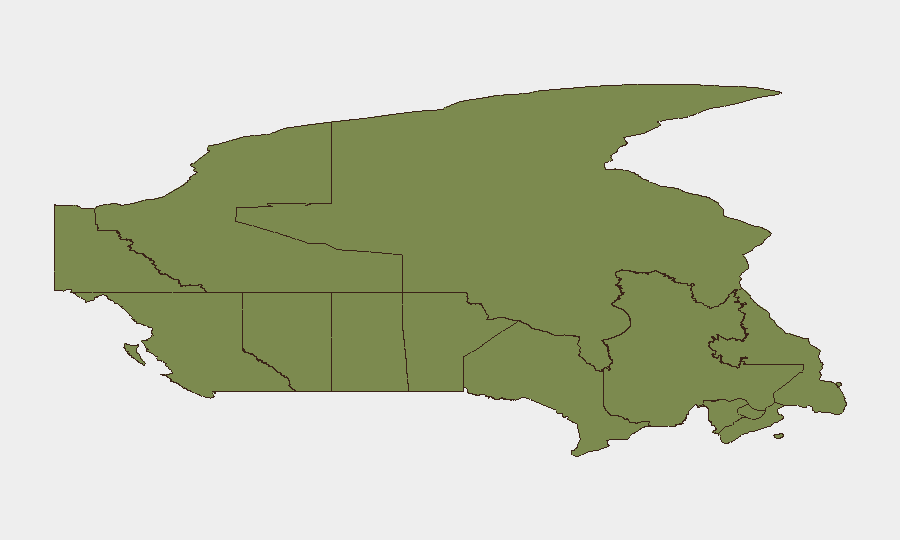
Nunavut and Ontario drive the platform's sub-national ranking, with composite scores nearly 6× higher than Quebec or Alberta. Nunavut's risk (31.8) likely reflects Arctic sovereignty concerns, Indigenous governance tensions, and remote infrastructure vulnerability; Ontario's (30) suggests concentrated political instability, security-force activity, and metropolitan-area incident density in the GTA and Ottawa regions. British Columbia (18) and the Northwest Territories (15) follow, reflecting port-security and border-adjacent exposure. Southern and Atlantic provinces remain below 10, indicating regional decoupling of risk.
How GeoBit Would Assist
Security teams should deploy AOI (Area-of-Interest) Monitoring & Early Warning on Nunavut, Ontario, and the Ottawa-GTA corridor to detect escalation signals in real time. OSINT Fusion & Corroboration (X/Telegram, YouTube, radio SIGINT) combined with Network & Actor Analysis would clarify which political and security actors are driving July 7–9 events and their trajectories. Conflict & Military battle-mapping and force-structure tracking will establish Canadian Armed Forces posture and any cross-border coordination with US assets near Buffalo.
7-Day Outlook
Political and security tensions in Ontario and uncertainty over military deployment intent suggest elevated volatility through mid-July. If investigative action against provincial leadership escalates or military operations expand beyond signaled areas, risk scores in Nunavut and Ontario may continue to climb. Monitoring for public statements by federal Cabinet and RCMP/Canadian Armed Forces will provide leading indicators of de-escalation or further institutional response.
Highest-Risk Areas — Ranked
| # | State / Region | Risk |
|---|---|---|
| 1 | Nunavut | 31.8 |
| 2 | Ontario | 30 |
| 3 | British Columbia | 18 |
| 4 | Northwest Territories | 15 |
| 5 | Saskatchewan | 8.2 |
| 6 | Manitoba | 7.3 |
| 7 | Quebec | 6.1 |
| 8 | Alberta | 3.8 |
| 9 | New Brunswick | 2.9 |
| 10 | Newfoundland and Labrador | 2 |
| 11 | Yukon | 1.8 |
| 12 | Prince Edward Island | 1.8 |
Sources
Previous Daily Briefs
A new Canada brief is written every day — each with its own risk map and downloadable CSV. Here's the last week; use the calendar to go further back.
📅 Browse every day by calendar →
Highlighted days have a brief. Tap a day for that day's map & analysis, or “csv” for that day's dataset ($5).
Atlas — our AI intelligence desk — emails them this snapshot personally. Nothing else, no list.