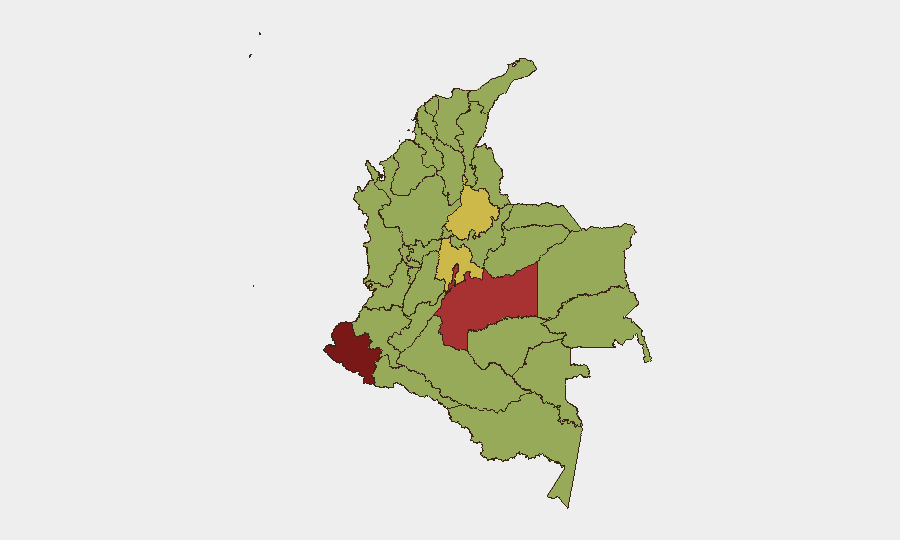
Situation Summary
Colombia remains at composite threat level #34 globally (score 75), with insurgency as the primary driver across 250 tracked events. The security environment is characterized by overlapping threats: active ELN operations in Chocó, drug-trafficking organization (DTO) consolidation and retaliation following recent narcotics interdictions, and significant political tension surrounding the presidential transition. The combination of militant activity, organized crime reactivation, and institutional strain creates a complex, volatile operating environment for corporate and personnel safety.
Key Developments
- Chocó Department – ELN offensive (July 4–10, 2026): The National Liberation Army (ELN) executed more than 50 coordinated terrorist actions across Chocó over a six-day period, representing one of the most serious regional security crises of 2026 and prompting national emergency response. This marks a significant escalation in militant intensity in the Pacific coastal zone.
- Nariño Department – cocaine-processing complex dismantled (reported July 10, 2026): Colombian Military Forces, Counter-Narcotics Command, Air Force, and police intelligence units, supported by FBI assets, located and dismantled a large cocaine-processing facility operated by *Comuneros del Sur*. The complex used underground pools for drug concealment; this operation signals intensified counter-narcotics pressure in the country's southwestern border region.
- Political transition crisis (ongoing, as of July 11, 2026): President-elect Abelardo de la Espriella has suspended the formal handover from incumbent Gustavo Petro, alleging irregular institutional conduct. This political friction compounds security uncertainty and may affect inter-agency coordination on security operations.
- Extradition reactivation – Clan del Golfo leadership (July 11, 2026): Colombian authorities have reactivated extradition orders for Clan del Golfo leaders, including "Chiquito Malo," signaling the collapse of previous dialogue frameworks and likely triggering internal criminal-organization restructuring and territorial competition.
- Urban Security Defence Units proposal (under review, July 11, 2026): Government has proposed new paramilitary-style units to combat extortion, homicide, and organized crime in major cities. The initiative remains controversial and operationally undefined; implementation will affect Bogotá, Medellín, Cali, and other urban centers.
Highest-Risk Areas
Nariño (82.6) and Meta Department (78.3) anchor the highest-risk tier, driven by ELN and dissent-group activity in Nariño's border zone and drug-trafficking infrastructure in Meta's interior. The Capital District (77.1) reflects urban crime, extortion, and political volatility. Santander (66.5) and Cundinamarca (64.1) remain elevated due to militant presence and organized-crime operations. Northern departments (Norte de Santander, Antioquia) continue as trafficking corridors and ELN strongholds. Risk is geographically dispersed rather than concentrated, requiring differentiated area-of-interest strategies by corporate security teams.
How GeoBit Would Assist
Security and risk teams should deploy AOI (Area-of-Interest) Monitoring & Early Warning on Nariño, Meta, Chocó, and Bogotá to detect militant activity, criminal retaliation, and political escalation in real time. Intel Sweep and multi-language OSINT (X, Telegram, local media) will track DTO announcements and ELN communications signaling new operations or territorial disputes. Battle mapping and network & actor analysis will identify criminal and insurgent reorganization following recent interdictions and extradition orders.
7-Day Outlook
Expect continued ELN activity in Chocó and border regions and potential DTO retaliation against government interdictions, particularly in Nariño and southern transit zones. Political transition friction may slow inter-agency security coordination. Urban security proposals may provoke organized-crime countermeasures in major cities. Risk trajectory remains elevated and volatile through mid-July.
Highest-Risk Areas — Ranked
| # | State / Region | Risk |
|---|---|---|
| 1 | Nariño | 82.6 |
| 2 | Meta Department | 78.3 |
| 3 | Capital District | 77.1 |
| 4 | Santander Department | 66.5 |
| 5 | Cundinamarca Department | 64.1 |
| 6 | Bolívar Department | 59 |
| 7 | Atlántico Department | 57.7 |
| 8 | Valle del Cauca Department | 54.7 |
| 9 | La Guajira | 54 |
| 10 | Norte de Santander Department | 53.7 |
| 11 | Antioquia Department | 53.3 |
| 12 | Quindío Department | 53.3 |
Sources
Previous Daily Briefs
A new Colombia brief is written every day — each with its own risk map and downloadable CSV. Here's the last week; use the calendar to go further back.
📅 Browse every day by calendar →
Highlighted days have a brief. Tap a day for that day's map & analysis, or “csv” for that day's dataset ($5).
Atlas — our AI intelligence desk — emails them this snapshot personally. Nothing else, no list.