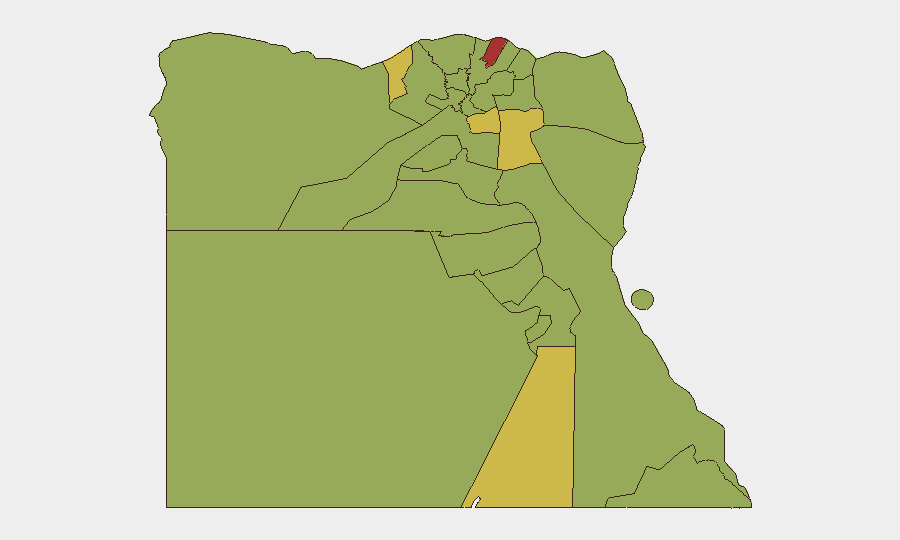
Situation Summary
Egypt remains at composite threat rank #18 globally (score 68/100) with 147 tracked events. The security environment is shaped primarily by the 29–30 July Damietta port drone strike and its aftermath—an incident that has elevated maritime and critical-infrastructure risk along the Suez Canal corridor and highlighted potential vulnerability to drone-delivered precision attacks. No major new security incidents are documented within the past 24–48 hours; current reporting focuses on follow-on analysis, diplomatic reactions, and updated risk assessments tied to the earlier Damietta event. Regional tensions, particularly involving Iran-linked actors and escalation dynamics, remain elevated.
Key Developments
- Damietta Port security posture & maritime risk (Damietta Governorate, ongoing as of 30–31 July)
Egyptian authorities continued damage assessment and security reviews at Damietta LNG following the 29 July drone strike that ignited two gas vessels. Prime Minister Madbouly issued statements affirming port operations continue and warning of regional escalation risk. This represents follow-on risk management rather than a fresh incident, but underscores immediate focus on port hardening and drone-defense posture.
- Suez Canal / Red Sea shipping corridor elevated-threat status (maritime zone, late July into early August)
Maritime-security firms and international shipping intelligence have flagged sustained elevated risk to gas and container traffic in the Suez–Red Sea corridor, tying heightened threat to the Damietta incident and potential for similar drone or missile attacks on critical chokepoints. This reflects updated threat modeling rather than a new attack.
- U.S. Embassy travel advisory maintenance (national, standing as of late July)
The U.S. State Department maintained Level 2 travel advisory with "Do Not Travel" zones covering Northern and Middle Sinai, parts of the Western Desert, and isolated areas. Advisories cite terrorism, military operations, and potential for flight disruption, but do not document new specific attacks in the past 24–48 hours.
- Diplomatic and investigative activity (national, 31 July–2 August)
Event signals indicate ongoing diplomatic disapproval between Abu Dhabi and Egypt, and between Qatar and Egypt, related to broader regional developments. Authorities are investigating unspecified matters involving Iran. These signals suggest tension within regional partnerships and potential state-level coordination concerns, but do not constitute fresh operational incidents.
- No documented fresh major incidents in past 24–48 hours
Open-source monitoring found no confirmed, multi-source reports of new terrorist attacks, civil unrest, crime incidents, or infrastructure damage occurring in Egypt during 1–2 August 2026. Risk reporting is dominated by secondary analysis of the 29–30 July Damietta event.
Highest-Risk Areas
Damietta (77.4), Cairo (66.8), and Suez (63.3) drive the highest composite risk and reflect concentration of critical infrastructure, maritime chokepoints, dense populations, and recent incident activity. Damietta's rank surge is tied directly to the 29 July drone strike on port facilities; Cairo's persistent high rank reflects general terrorism and protest dynamics; Suez's elevated score reflects both shipping-corridor vulnerability and proximity to Sinai-based militant activity. North and South Sinai remain persistently elevated (47.4 each) due to long-standing ISKP and affiliated militant presence, though they do not rank in the absolute top five by recent composite scoring.
How GeoBit Would Assist
Security teams with personnel or assets in Damietta, Cairo, or the Suez corridor should employ AOI Monitoring & Early Warning to track port activity, maritime traffic, and military/security deployments in near-real time. Maritime & Aviation Tracking combined with Satellite & Imagery Analysis enable confirmation of vessel status, port infrastructure condition, and emerging staging activity. Intel Sweep (OSINT fusion, Telegram/X monitoring, multi-language feeds) provides early warning of escalation rhetoric, militant operational chatter, or regional actor positioning 24–48 hours ahead of physical events.
7-Day Outlook
Near-term risk trajectory remains elevated but not acutely escalating. Damietta port security will remain under close official and international scrutiny; maritime insurers and shipping firms will maintain heightened premiums and routing caution. Diplomatic engagement and potential regional de-escalation talks may dampen immediate risk, but the demonstrated capability and intent to strike critical infrastructure suggests sustained drone/missile threat to ports, energy facilities, and Suez-corridor traffic over the coming week.
Highest-Risk Areas — Ranked
| # | State / Region | Risk |
|---|---|---|
| 1 | Damietta | 77.4 |
| 2 | Cairo | 66.8 |
| 3 | Suez | 63.3 |
| 4 | Aswan | 61.5 |
| 5 | Alexandria | 60.9 |
| 6 | Suhaj | 54.4 |
| 7 | South Sinai | 48.6 |
| 8 | North Sinai | 47.4 |
| 9 | Qena | 47.4 |
| 10 | Red Sea | 47.4 |
| 11 | Halaib Triangle | 47.4 |
| 12 | Matruh | 47.4 |
Sources
Previous Daily Briefs
A new Egypt brief is written every day — each with its own risk map and downloadable CSV. Here's the last week; use the calendar to go further back.
📅 Browse every day by calendar →
Highlighted days have a brief. Tap a day for that day's map & analysis, or “csv” for that day's dataset ($5).
Atlas — our AI intelligence desk — emails them this snapshot personally. Nothing else, no list.