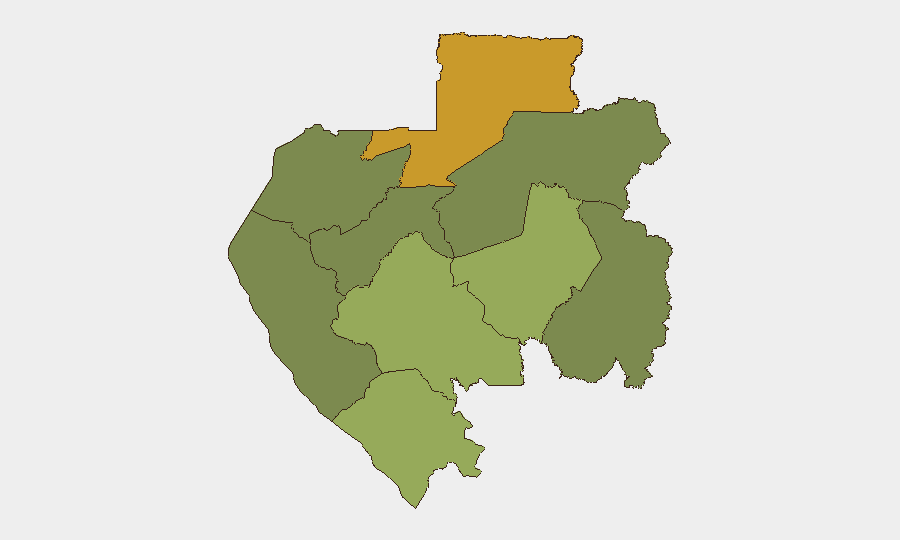
Situation Summary
Gabon remains a low-threat environment (ranked #63 globally) with no recorded security incidents in the tracked week, but faces underlying vulnerabilities in administrative stability, political contestation, and localized infrastructure fragility. Recent government actions—including a large civil-service dismissal (1,299 agents on 18 September) and the suspension of a contested leadership body—signal efforts to manage internal tensions rather than response to imminent crises. The northern frontier province of Woleu-Ntem carries significantly elevated risk (score 72), while the capital Libreville and coastal zones remain relatively secure; however, opportunistic crime, informal-sector enforcement operations, and fire-safety gaps remain persistent secondary concerns.
Key Developments
- Libreville (6ᵉ arrondissement & airport zone) – 16–17 September: Joint police operation spanning nine neighborhoods resulted in 28 arrests, closure of 7 bars, and a minor confrontation at the "Bandzi" bar; no serious injuries or major disorder reported. Reflects routine public-order maintenance rather than emergency response.
- Libreville – 14 September, 08:00: Commercial fire destroyed "La Maison des Ordinateurs," a computer retail establishment in central Libreville; no casualties reported. Highlights ongoing urban fire-safety and property-risk exposure.
- Lambaréné (2ᵉ arrondissement) – 14–15 September: Accidental overnight fire destroyed a wooden bridge providing access to the GSEZ industrial zone at Ikolo, disrupting regional supply-chain connectivity. Infrastructure vulnerability underscores maintenance and resilience gaps in secondary cities.
- Libreville – 18 September: Council of Ministers suspended a contested *Directoire* leadership body as a precautionary measure against anticipated "internal tensions and risks of public-order disturbance"; no demonstrations materialized but decision reflects elite-level coordination around political risk mitigation.
- Port-Gentil (announced) / Libreville (decision) – 18 September: Government confirmed dismissal of 1,299 public-sector workers following biometric civil-service audit. Large-scale layoff carries potential for union grievance and social discontent, though no organized unrest documented in the current window.
- Mabanda (Département de la Doutsila, southern Gabon) – ~16 September: Security forces arrested five artisanal gold miners during enforcement operations. Reflects ongoing crackdown on informal resource extraction with environmental and localized displacement risks.
- Geneva (UN Committee on Enforced Disappearances) – 16 September: Gabonese officials were questioned regarding allegations of arbitrary arrests involving former president's family and concerns about indigenous-community victimization; Gabon reported zero enforced-disappearance cases. Underscores international scrutiny of security-sector conduct and accountability gaps.
- Libreville (political sphere) – 19 September: Former President Ali Bongo Ondimba issued a statement characterized as a "major political event," reflecting continued contestation in the post-coup environment. Elite-level signaling without immediate street-level impact, but relevant to regime-stability monitoring.
Highest-Risk Areas
Woleu-Ntem Province (northeastern frontier; risk score 72) and Ogooué-Lolo (east-central; score 58) drive the national risk profile and warrant priority monitoring; both regions have limited state presence, informal cross-border activity, and historical exposure to organized crime and resource-extraction disputes. Ngounié, Nyanga, and Haut-Ogooué provinces (scores 48, 42, 35 respectively) present moderate risk, primarily linked to informal mining, transport-corridor vulnerabilities, and sparse law-enforcement capacity. Libreville and Estuaire Province (score 15) remain the safest zones but are not immune to opportunistic crime and infrastructure deficiencies.
How GeoBit Would Assist
Security teams would employ AOI Monitoring & Early Warning to track political gatherings and civil-service union activity for early detection of protest mobilization; OSINT fusion and multi-language social-media intelligence to correlate sentiment shifts around the civil-service layoffs and elite statements; and GIS & Spatial Analysis to map informal mining operations and fire-incident clusters against asset locations, informing routing decisions and contingency planning.
7-Day Outlook
No major escalation is expected in the near term, but the combination of political contestation, large-scale job losses, and international scrutiny creates conditions for delayed grievance expression. Continued routine police operations and administrative enforcement should be anticipated; infrastructure incidents (fire, transport disruption) will likely remain sporadic and localized.
Highest-Risk Areas — Ranked
| # | State / Region | Risk |
|---|---|---|
| 1 | Woleu-Ntem | 72 |
| 2 | Ogooué-Lolo Province | 58 |
| 3 | Ngounié Province | 48 |
| 4 | Nyanga Province | 42 |
| 5 | Haut-Ogooué Province | 35 |
| 6 | Moyen-Ogooué Province | 28 |
| 7 | Ogooué-Maritime Province | 25 |
| 8 | Estuaire Province | 15 |
| 9 | Ogooué-Ivindo | 0 |
Sources
Previous Weekly Briefs
A new Gabon brief is written every Monday, covering the week — each with its own risk map and downloadable CSV. Use the calendar to go further back.
- September 14, 2026
- September 7, 2026
- September 1, 2026
- August 30, 2026
- August 28, 2026
- August 25, 2026
- August 23, 2026
📅 Browse past briefs by calendar →
Highlighted days have a brief. Tap a day for that day's map & analysis, or “csv” for that day's dataset ($5).
Atlas — our AI intelligence desk — emails them this snapshot personally. Nothing else, no list.