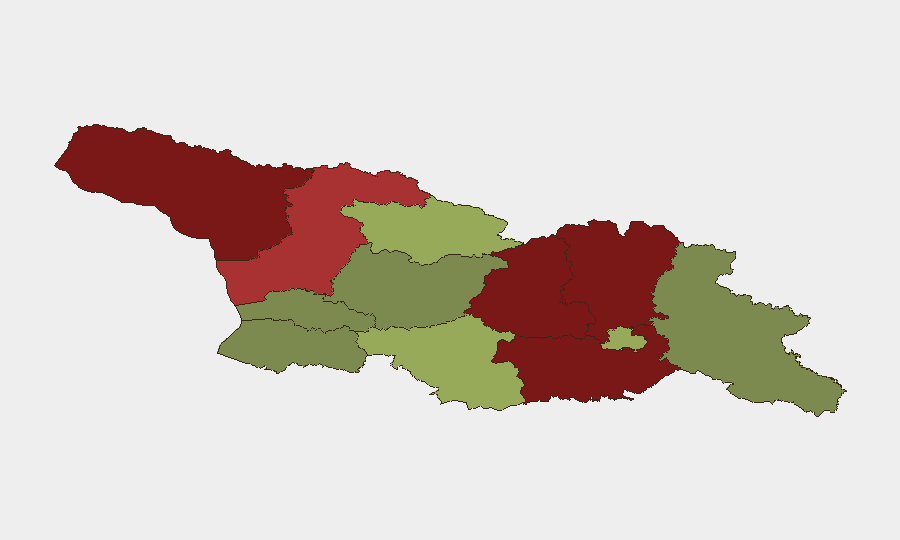
Situation Summary
Georgia remains a lower-tier global security concern (composite score 18, rank #88 globally), but sub-national risk is highly fragmented, with separatist-controlled Abkhazia and Russian-adjacent border regions (Shida Kartli, Lower Kartli) presenting materially elevated threat profiles. Recent events—including a nationwide power outage tied to the shared Enguri hydropower facility, arrests of Iranian nationals on document fraud, and an ongoing 619-day protest cycle demanding release of detainees—indicate simultaneous infrastructure vulnerability, transnational illicit activity, and sustained political instability. Civil unrest remains the primary composite threat driver; no armed conflict escalation is currently tracked.
Key Developments
- 2026-08-06 · Nationwide Power Outage, Tbilisi & Regional Grid: A major power disruption affected Tbilisi metro and rail services and regional transmission infrastructure, tied to maintenance testing at the Enguri hydroelectric plant (jointly operated with Abkhazia). Cause under investigation by Georgian State Electrosystem; duration and cascading impact on water supply and communications networks not yet fully characterized.
- 2026-08-07 · Iranian Nationals Arrested at Tbilisi International Airport: Georgian police arrested three Iranian nationals attempting to exit Georgia using forged travel documents. Context of Iranian presence and operational intent remains under assessment; arrest suggests heightened document-fraud risk at border points.
- 2026-08-07 · Major Anti-Narcotics Operation, Nationwide: Interior Ministry dismantled an alleged ₾53.8 million narcotics-trafficking scheme and arrested 17 individuals in a coordinated operation, indicating sustained drug-distribution networks with significant financial throughput.
- 2026-08-07 · Unidentified Drone Fragment Recovered, Black Sea Coast (Shekvetili): A drone fragment washed ashore near Shekvetili. Origin, operational context, and surveillance/military intent remain unconfirmed; recovery location near coastal infrastructure warrants monitoring.
- 2026-08-10 · Continued Large-Scale Protest Activity, Tbilisi (Rustaveli Avenue): Anti-government and pro-European demonstrations persisted on the 619th consecutive day despite the nationwide power outage, indicating sustained organized dissent and potential for escalation if political detainee-release demands remain unmet.
- 2026-08-06 · Civilian Fatality, Flash Flood (Khobistskali River): A child died and a mother remains missing after both were swept away during apparent flooding in Samegrelo-Upper Svaneti region, highlighting acute vulnerability to seasonal weather events in mountainous areas.
Highest-Risk Areas
Abkhazia (risk 95) and the Russian-adjacent Shida Kartli and Lower Kartli regions (risk 88 and 85) drive the sub-national risk profile, primarily due to unresolved separatist territorial control, proximity to Russian military positioning, and limited Georgian state authority. Mtskheta-Mtianeti (risk 82) adds mountainous terrain vulnerability and ethnic complexity. Together, these four regions account for the majority of compounded civil-conflict and cross-border illicit-transit risk; Tbilisi itself (risk 45), while home to 1+ million residents and critical infrastructure, ranks below several outlying regions, though power-grid fragility and sustained protest activity present localized duty-of-care concerns for corporate operations.
How GeoBit Would Assist
Security teams monitoring Georgia should employ Intel Sweep and X/Telegram OSINT to track real-time protest escalation, Iranian and transnational illicit-actor presence, and drone/surveillance activity. AOI Monitoring & Early Warning on Abkhazia, Shida Kartli, and border crossing points would provide persistent alerting on conflict, infrastructure disruption, and document-fraud patterns. Satellite & Imagery analysis of the Enguri hydropower facility and coastal drone-recovery sites can clarify operational intent and infrastructure risk without reliance on official statements.
7-Day Outlook
Protest activity is expected to persist absent significant political concessions. Power-grid stability remains uncertain pending Enguri facility investigation; secondary outages cannot be ruled out. Transnational illicit transit (narcotics, Iranian nationals, forged documents) and border-region instability will likely remain at current elevated levels; no imminent armed escalation is tracked, but Russian military posture monitoring in the north remains essential.
Highest-Risk Areas — Ranked
| # | State / Region | Risk |
|---|---|---|
| 1 | Autonomous Republic of Abkhazia | 95 |
| 2 | Shida Kartli | 88 |
| 3 | Lower Kartli | 85 |
| 4 | Mtskheta-Mtianeti | 82 |
| 5 | Samegrelo-Upper Svaneti | 78 |
| 6 | Samtskhe-Javakheti | 48 |
| 7 | Tbilisi | 45 |
| 8 | Racha-Lechkhumi and Kvemo Svaneti | 42 |
| 9 | Kakheti | 38 |
| 10 | Autonomous Republic of Adjara | 35 |
| 11 | Imereti | 32 |
| 12 | Guria | 28 |
Sources
Previous Daily Briefs
A new Georgia brief is written every day — each with its own risk map and downloadable CSV. Here's the last week; use the calendar to go further back.
- August 11, 2026
- August 10, 2026
- August 9, 2026
- August 8, 2026
- August 7, 2026
- August 6, 2026
- August 5, 2026
📅 Browse every day by calendar →
Highlighted days have a brief. Tap a day for that day's map & analysis, or “csv” for that day's dataset ($5).
Atlas — our AI intelligence desk — emails them this snapshot personally. Nothing else, no list.