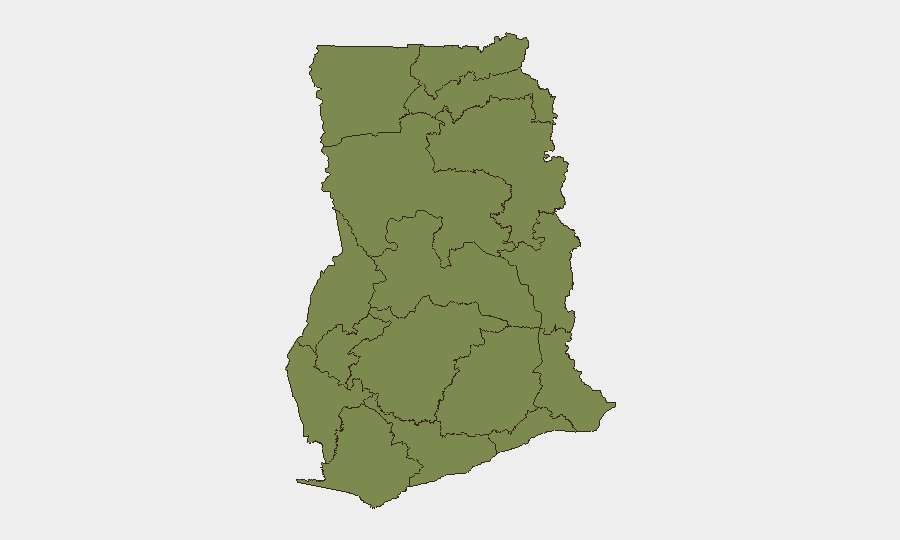
Situation Summary
Ghana remains a stable West African democracy rated #107 globally on composite threat, with a risk score of 8 and 67 tracked events. However, concentrated political and institutional activity over the past 24–48 hours—including public statements by President John Dramani Mahama, the Chief Justice, Parliament, and the Central Bank—signals potential friction around governance, currency stability, or labour relations. Sub-national risk is heavily concentrated in Greater Accra Region (34.5), which accounts for approximately one-third of all tracked national risk, while a secondary cluster in Bono East Region (20.8) suggests localized instability requiring separate monitoring.
Key Developments
- Greater Accra Region, 20 July 2026: President John Dramani Mahama issued two public statements, one directed at Ghana and a second addressing African audiences, with content and timing currently under analysis for policy or diplomatic significance.
- Greater Accra Region, 19 July 2026: The Chief Justice and Parliament both issued public statements; context and substance require corroboration against parliamentary and judicial records to determine whether these reflect routine business or institutional tension.
- Greater Accra Region, 19 July 2026: The Central Bank issued a public statement; no independent confirmation of subject matter or market impact is yet available.
- Greater Accra Region, 19 July 2026: Ghana rejected a position or demand from a trades union; labour disputes have the potential to affect port operations, transport, or essential services if escalation occurs.
- Eastern Region, 18 July 2026: A heavily loaded articulated truck crashed and blocked the Accra–Kumasi Highway; police established temporary diversions via Kibi and Apedwa, impacting supply-chain and personnel routing.
- Ashanti Region, 17 July 2026: The National Anti-Illegal Mining Operations Secretariat dismantled an illegal mining site at Ahwiren, Bekwai Municipality, disabling six excavators and recovering two shotguns with 19 rounds of ammunition; this reflects ongoing enforcement activity in mining-rich areas.
Note: Multiple event signals (Zimbabwe vs Accra, Envoy statement, threats) appear in the platform feed but lack independent corroboration in open sources from the last 24–48 hours. Confirmation is pending.
Highest-Risk Areas
Greater Accra Region dominates the risk profile at 34.5—more than 60 % higher than the second-ranked region—driven by concentration of government, financial, port, and diplomatic infrastructure and activity. Bono East Region (20.8) shows secondary but material risk; the cause requires further investigation but may reflect mining disputes, inter-communal tension, or criminal activity. The remaining ten regions each score below 10, indicating that national security planning should treat Accra as the primary point of concentration and Bono East as a secondary focus for asset and personnel protection.
How GeoBit Would Assist
Teams managing operations in Ghana should employ Intel Sweep and X/Twitter & Telegram OSINT to validate the political and institutional signals emerging from Accra in real time, and multi-language search and entity extraction to identify specific policy outcomes (currency, labour, sanctions) before market or operational impact. AOI Monitoring & Early Warning on Greater Accra Region and Bono East Region, combined with alternative routing & journey planning, will enable proactive protection of supply chains, personnel movements, and asset access around the highway disruption and mining activity. Sentiment and temporal analysis on parliamentary, judicial, and labour feeds will flag escalation before formal announcement.
7-Day Outlook
The concentration of official statements within 24–48 hours suggests a coordinated announcement cycle or response to an emerging policy or economic issue; outcomes should clarify by end-week. Highway disruption is likely to clear within 48 hours; mining enforcement will continue as a routine baseline activity. No indicators of violence, civil unrest, or border instability are present; current risk remains administrative and economic rather than kinetic.
Highest-Risk Areas — Ranked
| # | State / Region | Risk |
|---|---|---|
| 1 | Greater Accra Region | 34.5 |
| 2 | Bono East Region | 20.8 |
| 3 | Volta Region | 9.3 |
| 4 | Ashanti Region | 7.5 |
| 5 | Upper East Region | 6.3 |
| 6 | Bono Region | 5.8 |
| 7 | Northern Region | 5.1 |
| 8 | Upper West Region | 4.5 |
| 9 | Savannah Region | 4.5 |
| 10 | North East Region | 4.5 |
| 11 | Eastern Region | 4.5 |
| 12 | Oti Region | 4.5 |
Sources
Previous Daily Briefs
A new Ghana brief is written every day — each with its own risk map and downloadable CSV. Here's the last week; use the calendar to go further back.
📅 Browse every day by calendar →
Highlighted days have a brief. Tap a day for that day's map & analysis, or “csv” for that day's dataset ($5).
Atlas — our AI intelligence desk — emails them this snapshot personally. Nothing else, no list.