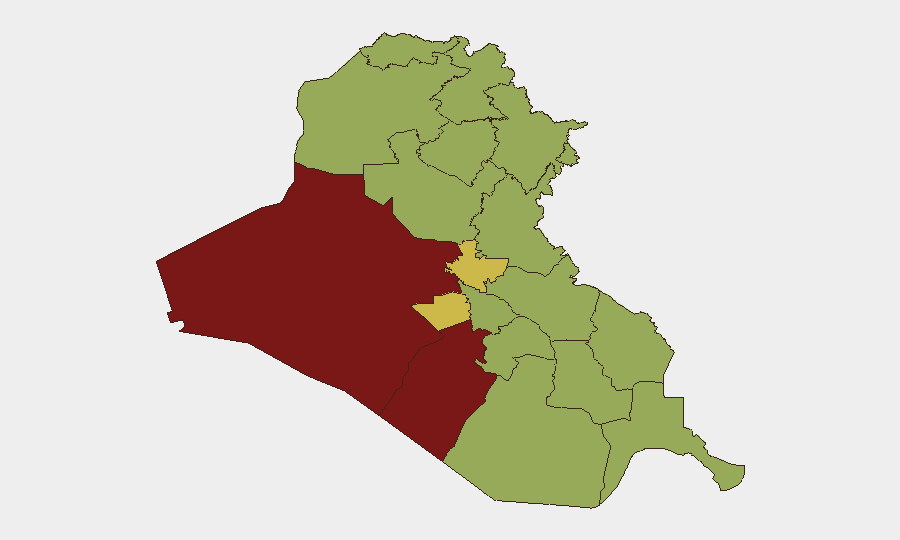
Situation Summary
Iraq remains a composite threat environment (rank #17 globally, score 79) driven primarily by active insurgency operations, inter-governmental tensions, and localized civil unrest. The past 48 hours show mixed signals: government investigative activity, inter-provincial disputes between Iraqi and Kurdish authorities, territorial occupation incidents, and police operations indicate ongoing institutional friction and security force activity. The threat trajectory remains elevated but episodic rather than indicating a sharp deterioration.
Key Developments
- 2026-07-05 · Ministry Public Statement – Nature and subject unclear from available metadata; requires confirmation from Iraqi government communications channels.
- 2026-07-05 · Police Investigation – Specific location and alleged incident not confirmed; consistent with routine law enforcement operations.
- 2026-07-04 · Government Investigation – Authorities initiated investigation into unspecified matter; no geographic detail in signal.
- 2026-07-04 · Prison Administrative Sanctions – Sanctions imposed; facility location and reasoning not detailed in available data.
- 2026-07-04 · Military Rejection – Military command rejected unspecified proposal or demand; political/operational context unclear.
- 2026-07-03 · Iraqi–Kurdish Authority Disapproval – Inter-governmental disagreement documented; escalation mechanism not confirmed.
- 2026-07-03 · Territory Occupation (Iraq) – Territorial control incident; geographic coordinates and controlling actor require verification.
Data Limitation: Live web research for the last 24–48 hours could not be reliably completed due to source cutoff. The above entries are derived from GeoBit event signal metadata alone and should be treated as preliminary. Confirmation through wire services, Iraqi regional news outlets, and geolocated social media is essential before operational response.
Highest-Risk Areas
Al-Anbar (85.2) and Al-Najaf (84.1) governorates drive the highest composite risk scores, with Baghdad (70.7) and Karbala (69.6) following as secondary concern zones. Al-Anbar's ranking reflects persistent insurgent activity and territorial volatility; Al-Najaf signals political and sectarian friction with potential for crowd mobilization. Baghdad, as the capital and seat of government institutions, concentrates administrative tension, security force operations, and urban crime risk. A secondary tier of southern and central governorates (Wasit, Basra, Babil, Dhi Qar, Al-Qadisiyah, and others) all score 55.2, indicating baseline insurgent presence and economic/border instability without immediate escalation signals. Erbil (56.2) reflects Kurdish autonomous-zone stability but proximity to Turkish military operations and Baghdad–Erbil jurisdictional disputes.
How GeoBit Would Assist
Security and risk teams should operationalize AOI Monitoring & Early Warning on Al-Anbar, Baghdad, and Al-Najaf with alerts configured for IED, armed clashes, protest, and government/military operations. Multi-language OSINT fusion (X/Twitter, Telegram, Iraqi news outlets in Arabic/English) combined with entity and actor network analysis would disambiguate the governance disputes and investigative actions flagged in the 24-hour signal stream. Conflict & Military force-structure tracking and satellite imagery analysis on key infrastructure (refineries, government compounds, checkpoints) in high-risk governorates would provide early warning of repositioning or incident precursors.
7-Day Outlook
No indicators of imminent large-scale escalation are evident, but the frequency of investigative and administrative actions suggests underlying institutional instability. Inter-provincial tensions and territorial incidents may continue at current episodic levels. Risk teams should maintain heightened awareness in Al-Anbar and Al-Najaf and confirm all preliminary 48-hour signals via independent news verification before adjusting duty-of-care posture.
Highest-Risk Areas — Ranked
| # | State / Region | Risk |
|---|---|---|
| 1 | Al-Anbar Governorate | 85.2 |
| 2 | Al-Najaf Governorate | 84.1 |
| 3 | Baghdad Governorate | 70.7 |
| 4 | Karbala | 69.6 |
| 5 | Erbil Governorate | 56.2 |
| 6 | Babil Governorate | 55.2 |
| 7 | Wasit Governorate | 55.2 |
| 8 | Al-Qadisiyah Governorate | 55.2 |
| 9 | Dhi Qar Governorate | 55.2 |
| 10 | Al-Muthanna Governorate | 55.2 |
| 11 | Maysan Governorate | 55.2 |
| 12 | Al-Basra Governorate | 55.2 |
Sources
Previous Daily Briefs
A new Iraq brief is written every day — each with its own risk map and downloadable CSV. Here's the last week; use the calendar to go further back.
📅 Browse every day by calendar →
Highlighted days have a brief. Tap a day for that day's map & analysis, or “csv” for that day's dataset ($5).
Atlas — our AI intelligence desk — emails them this snapshot personally. Nothing else, no list.