Situation Summary
Israel faces a composite threat score of 100 (global rank #2) with 369 tracked events, driven by active conventional military operations, cyber campaigns, and internal security tensions. A 2026 Iran conflict remains unresolved, with confirmed Iranian cyberattacks against Israeli critical infrastructure continuing as recently as 48 hours ago. Public confidence in security improvements is low (38% per Israel Democracy Institute survey, July 8), and cross-border incidents along the Lebanon frontier are recurring. The threat trajectory is elevated and sustained rather than de-escalating.
Key Developments
- Gaza Strip (July 7–8): Israeli air and artillery strikes killed seven Palestinians and led to recovery of nine bodies from rubble; Gaza Health Ministry reports continuing ceasefire violations, signaling active kinetic operations in the highest-risk sub-national zone.
- Iran-linked Cyber Campaign (July 7–8, nationwide): Confirmed surge in malware, DDoS, and data-breach operations targeting Israeli businesses and critical infrastructure, verified by Israel National Cyber Directorate; operations erased data and disrupted services within the last 48 hours.
- Israel–Lebanon Border (July 7–8, Beaufort area): IDF Chief of Staff Eyal Zamir visited forward-deployed troops in southern Lebanon amid ongoing cross-border attacks; recent military operations footage released on Israeli media indicates repeated rocket and/or drone fire from Lebanon on Israeli positions since July 4.
- Southern Lebanon Security Operations (July 8): Israeli public broadcasters confirmed recent attacks originating from Lebanese territory, with IDF reinforcing deployments along the northern border in response to escalating incident frequency.
- Internal Security Climate (July 8 survey data): Israel Democracy Institute released findings showing 38% of respondents believe security has improved since the 2026 Iran war; nearly 50% perceive police as lenient on ultra-Orthodox disturbances tied to the Conscription Law, indicating internal friction alongside external threats.
- Cyber Defense Posture (July 8, nationwide): Israeli and regional outlets report ongoing penetration attempts against Israeli networks and state hardening of critical infrastructure; heightened cyber-defense posture is in direct response to parallel U.S.–Iran kinetic exchanges.
Highest-Risk Areas
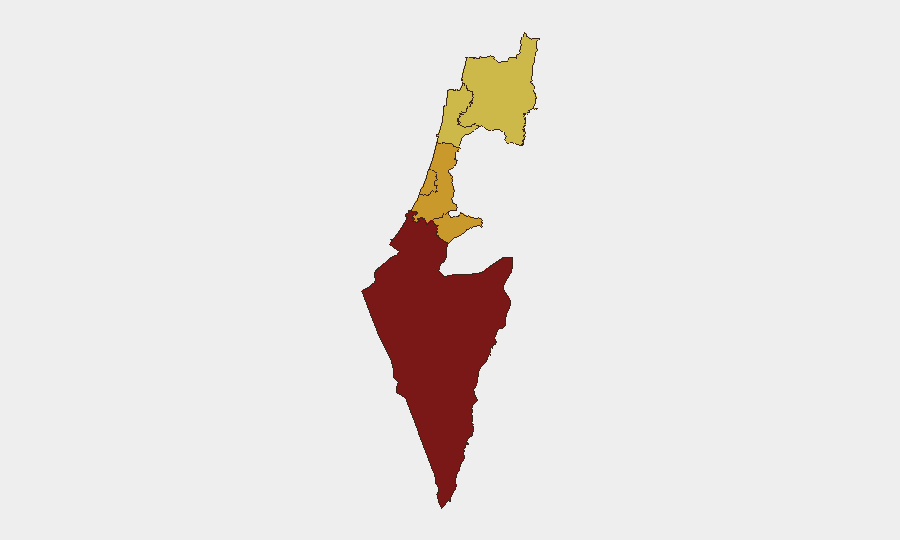
South District (risk score 100) remains the critical focal point, driven by active Israeli–Palestinian military operations and ceasefire violations in Gaza. Tel-Aviv, Center, Jerusalem, Haifa, and North Districts (scores 70–72.4) face secondary but substantial risk from spillover military activity, cyber operations affecting civilian and commercial targets nationwide, and cross-border incidents from Lebanon. The clustering of high risk across multiple regions reflects both kinetic conflict (south and north borders) and distributed cyber threats targeting critical infrastructure and commercial entities across populated centers.
How GeoBit Would Assist
Security teams should employ AOI Monitoring & Early Warning for persistent watch on South District, Gaza border, and Israel–Lebanon frontier, with real-time alerting on military activity and ceasefire violations. Intel Sweep and OSINT fusion (X/Twitter, Telegram, YouTube, multi-language feeds, entity extraction) enable continuous tracking of Iranian cyber-threat actors, attack patterns, and operational tempo. GIS & Spatial Analysis combined with Conflict & Military mapping provide situational awareness of IDF deployments, cross-border incident locations, and risk distribution across districts to inform duty-of-care routing and asset protection.
7-Day Outlook
Cross-border military activity (Gaza and Lebanon) is likely to persist at current levels absent a major diplomatic shift. Iranian cyber operations will continue targeting Israeli critical infrastructure and commercial entities, requiring sustained defensive posture. Internal security tensions over conscription and police response may create secondary unrest, particularly in urban centers, complicating movement and access for personnel and assets.
Highest-Risk Areas — Ranked
| # | State / Region | Risk |
|---|---|---|
| 1 | South District | 100 |
| 2 | Tel-Aviv District | 72.4 |
| 3 | Center District | 71.3 |
| 4 | Jerusalem District | 71.3 |
| 5 | Haifa District | 70.1 |
| 6 | North District | 70 |
Sources
Previous Daily Briefs
A new Israel brief is written every day — each with its own risk map and downloadable CSV. Here's the last week; use the calendar to go further back.
📅 Browse every day by calendar →
Highlighted days have a brief. Tap a day for that day's map & analysis, or “csv” for that day's dataset ($5).
Atlas — our AI intelligence desk — emails them this snapshot personally. Nothing else, no list.