Situation Summary
Pakistan remains a complex, fragmented security environment (composite threat rank #31 globally, score 66) with acute risk concentrated in Punjab—driven by active militant and law-enforcement incidents—and chronic cross-border terrorism threats in Balochistan and Khyber Pakhtunkhwa. The past 48 hours have featured a significant anti-police attack in Balochistan, military-level concern over Afghan-enabled militant staging, and diplomatic friction with Western partners, signaling both operational volatility and political-security strain. The trajectory suggests sustained pressure from TTP and affiliated groups, compounded by infrastructure-security vulnerabilities and inter-agency response challenges.
Key Developments
- Ziarat, Balochistan (2026-07-07, overnight into 07-08 local): Gunmen attacked police guarding Mangi Dam construction site, killing at least 9 officers including 2 senior ranks; subsequent security operation reported 15 suspected TTP militants killed in response. This represents a direct assault on critical water-infrastructure security and signals militant capability to target strategic civilian-military assets.
- National Highway, Ziarat vicinity (2026-07-07): Local road blockades and public protests erupted following the Mangi Dam attack, with communities denouncing security failures; ongoing mourning activities and protest pressure reported on broadcast media.
- Rawalpindi, GHQ (2026-07-07): Pakistan Army 276th Corps Commanders Conference noted "serious concern" over Afghan territory being used by Indian-sponsored militant groups to stage Pakistan-bound attacks; Operation Ghazab lil‑Haq directives reaffirmed heightened vigilance and operational readiness across commands.
- Nationwide (2026-07-07): Ministry-level statement on prison conditions and detainee management flagged as indicative of potential corrections-system tensions and security concerns.
- Lahore and diplomatic channels (2026-07-06–07): U.S. public statement on Lahore security concerns and envoy-related tensions with Pakistan contributed to signals of political-diplomatic instability and elevated protest risk in major urban centers.
- Nationwide security posture (2026-07-07): Official narrative acknowledges counter-terrorism operations while international community (including U.S.) calls for intensified action against militant hideouts in Afghanistan; reflects ongoing cross-border tension.
Highest-Risk Areas
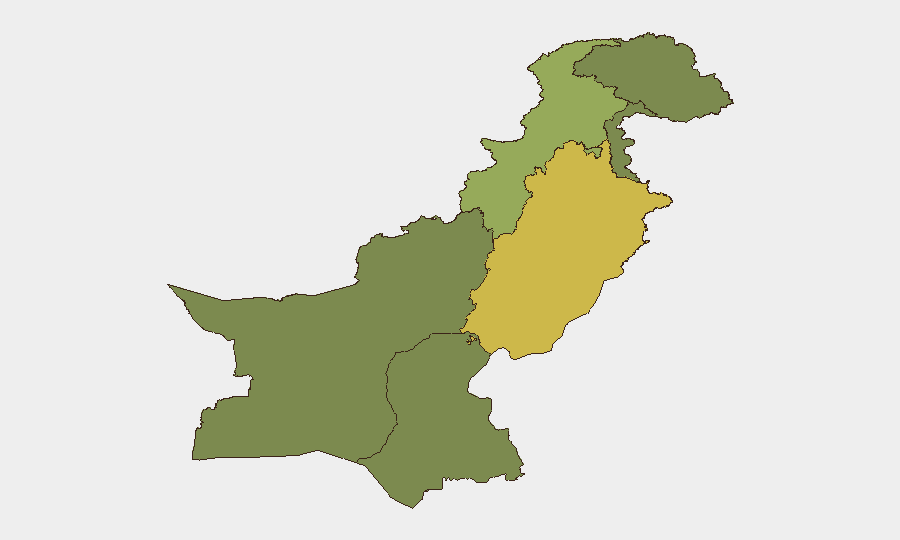
Punjab dominates the composite risk ranking (66.2) and drives Pakistan's overall threat score, with active law-enforcement incidents and militant activity concentrated around Lahore and Rawalpindi corridors. Balochistan (37.6) and Khyber Pakhtunkhwa (42.4) remain high-risk due to established TTP/militant networks, Afghan-border exposure, and infrastructure-targeting capability—as evidenced by the Mangi Dam attack. Islamabad Capital Territory (41.6) carries elevated diplomatic and political risk, with recent envoy tensions and government-level security statements amplifying protest and instability signals in the capital region.
How GeoBit Would Assist
Security teams operating in Pakistan should deploy AOI Monitoring & Early Warning on Balochistan and KP border zones to track militant staging patterns and cross-border movement; leverage Network & Actor Analysis to map TTP command structure and affiliate relationships; and use OSINT fusion (X/Telegram, broadcast monitoring, radio SIGINT) to detect emerging protest signals and diplomatic fractures in real-time. Intel Sweep and multi-language search enable continuous tracking of prison-related tensions and military-security posture shifts that often precede operational escalations.
7-Day Outlook
Militant pressure is expected to persist, particularly in Balochistan and KP, with TTP and affiliated groups likely continuing infrastructure and law-enforcement targeting in response to military operations. Diplomatic friction with Western partners may amplify security restrictions and protest risk in urban centers, especially Lahore and Islamabad. Heightened inter-agency operational readiness should temper attack frequency but will not eliminate cross-border threat flow from Afghan sanctuaries.
Highest-Risk Areas — Ranked
| # | State / Region | Risk |
|---|---|---|
| 1 | Punjab | 66.2 |
| 2 | Khyber Pakhtunkhwa | 42.4 |
| 3 | Islamabad Capital Territory | 41.6 |
| 4 | Azad Kashmir | 37.8 |
| 5 | Balochistan | 37.6 |
| 6 | Sindh | 37.4 |
| 7 | Gilgit-Baltistan | 36.2 |
Sources
Previous Daily Briefs
A new Pakistan brief is written every day — each with its own risk map and downloadable CSV. Here's the last week; use the calendar to go further back.
📅 Browse every day by calendar →
Highlighted days have a brief. Tap a day for that day's map & analysis, or “csv” for that day's dataset ($5).
Atlas — our AI intelligence desk — emails them this snapshot personally. Nothing else, no list.