Situation Summary
Tajikistan remains at global risk rank #128 with a composite threat score of 14 and zero tracked major events during the reporting period. The country's security environment is characterized by persistent frontier violence along the Kyrgyz–Tajik border and localized instability in mountainous autonomous regions, but no systemic escalation was observed in the past week. The security posture reflects endemic tensions in high-altitude disputed territories rather than acute nationwide deterioration.
Key Developments
- October 6 — Dushanbe: U.S. Embassy delivered an unmanned aircraft system to Tajikistan's National Guard as part of bilateral security cooperation, signaling continued external engagement on border and counter-terrorism capacity.
- October 6 — Kulob: Authorities commissioned a 110/35/10 kV electrical substation, part of ongoing infrastructure hardening in a mid-risk region (Khatlon Region, rank #2 sub-nationally).
- October 6 — Kulob: Local authorities completed 62.5 km of road improvements in the city and surrounding area, indicating active development in Khatlon despite elevated regional risk.
- October 8 — Awaza, Turkmenistan (regional statement): President Emomali Rahmon called for strengthened Central Asian cooperation against terrorism, extremism, organized crime, cybercrime, and drug trafficking at a regional leaders' meeting; a policy statement reflecting transnational threat awareness rather than a localized incident.
- October 9 — Warsaw, Poland (diaspora advocacy): Tajik opposition representatives and Pamiri activists raised concerns at an OSCE conference regarding alleged deaths in custody, torture at detention facilities in Gorno-Badakhshan (highest-risk sub-national region, rank #1), and alleged abductions of critics abroad—issues that underpin international scrutiny of security-force conduct.
- September 29 — Kyrgyz–Tajik frontier (Somoniyon village): A civilian was killed in a shooting near the disputed border at approximately 0500 hours; Tajik authorities reported the incident. This reflects the ongoing low-level frontier violence that characterizes the highest-risk region.
Highest-Risk Areas
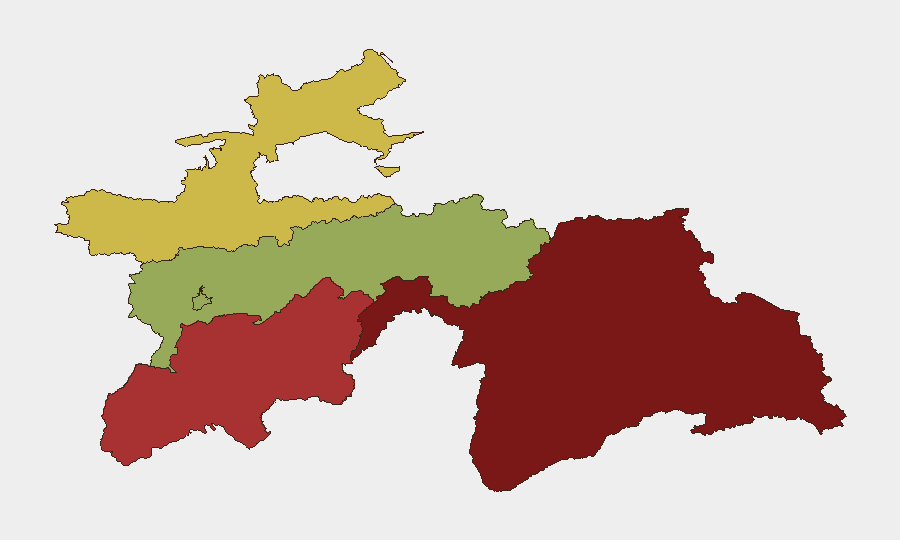
Gorno-Badakhshan Autonomous Region (GBAO, risk 92) dominates the threat landscape due to its mountainous geography, sparse state presence, and proximity to the contested Kyrgyz border—the site of recurring civilian casualties and armed clashes. Khatlon Region (risk 78) ranks second, reflecting drug-trafficking corridors, organized-crime activity, and cross-border smuggling networks. Sughd Region (risk 65) presents moderate risk tied to similar transnational criminal flows and border-area volatility. By contrast, Dushanbe (risk 42) and Districts of Republican Subordination (risk 58) experience lower but non-negligible risk, primarily from urban crime and regime-stability concerns rather than active conflict.
How GeoBit Would Assist
Security teams operating in Tajikistan should deploy GeoBit's AOI Monitoring & Early Warning capabilities on high-risk zones (particularly GBAO and Khatlon) to track frontier incidents and armed activity in near-real time. Intel Sweep, multi-language OSINT, and X/Twitter/Telegram intelligence enable continuous monitoring of opposition claims, regime statements, and emerging tensions that signal deterioration. GIS & Spatial Analysis and Routing & Network Analysis support route planning and safe-area assessment for personnel movements, especially across regions ranked 65 or above.
7-Day Outlook
No acute escalation is forecast for the immediate week. Frontier violence in GBAO and transnational crime flows in Khatlon will likely persist at endemic levels. Monitoring should remain elevated on any statements from regional leaders, international organizations, or opposition voices that may signal policy shifts or deteriorating detention practices.
Highest-Risk Areas — Ranked
| # | State / Region | Risk |
|---|---|---|
| 1 | Gorno-Badakhshan Autonomous Region | 92 |
| 2 | Khatlon Region | 78 |
| 3 | Sughd Region | 65 |
| 4 | Districts of Republican Subordination | 58 |
| 5 | Dushanbe | 42 |
Sources
Previous Weekly Briefs
A new Tajikistan brief is written every Monday, covering the week — each with its own risk map and downloadable CSV. Use the calendar to go further back.
- October 5, 2026
- September 28, 2026
- September 21, 2026
- September 14, 2026
- September 7, 2026
- September 3, 2026
- September 2, 2026
📅 Browse past briefs by calendar →
Highlighted days have a brief. Tap a day for that day's map & analysis, or “csv” for that day's dataset ($5).
Atlas — our AI intelligence desk — emails them this snapshot personally. Nothing else, no list.