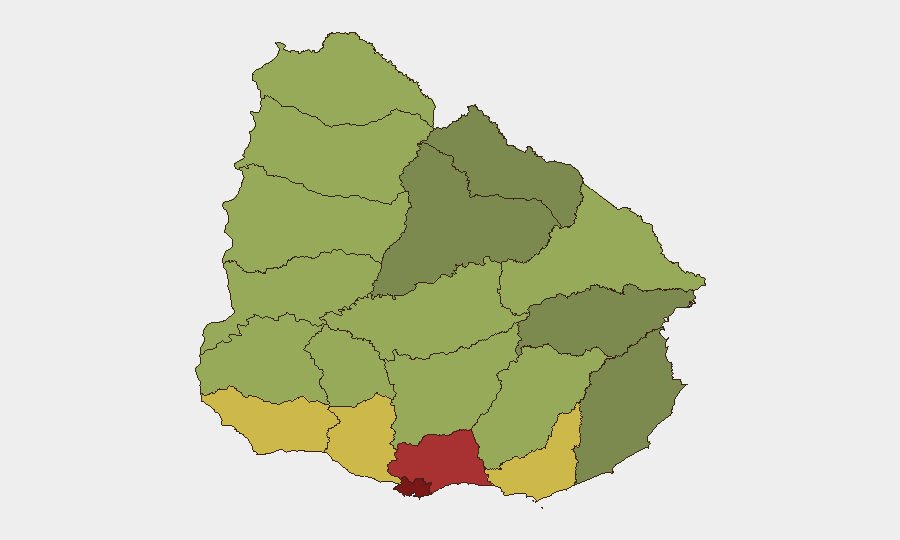
Situation Summary
Uruguay remains a stable, low-threat environment by regional standards, ranked #152 globally with a composite threat score of 5. Open-source security monitoring and cross-checked OSINT feeds confirm no acute security incidents, civil unrest, major crime events, or infrastructure disruptions in the past 24–48 hours. The operating environment is assessed as stable nationwide, though underlying urban crime and organized-crime vulnerabilities persist in high-density urban zones.
Key Developments
No discrete, corroborated security, civil-unrest, or infrastructure incidents meeting actionable thresholds have been recorded for Uruguay in the last 24–48 hours (12–15 July 2026). Open-source event-signal monitoring detected two non-incident public statements on 14 July (business-sector communication with Uruguay and Uruguay–Brazil diplomatic messaging), but these have not been linked to security, stability, or conflict developments and remain below operational alert level. Nationwide OSINT and social-media scanning report no verified acute threats or disturbances in this window.
Highest-Risk Areas
Montevideo dominates the sub-national risk landscape with a composite score of 92, driven by population density, commercial activity, and urban-crime exposure. The metropolitan corridor extending into Canelones (78) and secondary urban centers in Maldonado (68) and San José (64) account for the majority of documented crime-risk concentration. Interior and border departments (Soriano, Río Negro, Salto, Artigas, Paysandú) register lower absolute scores but retain baseline organized-crime and smuggling vulnerabilities typical of frontier zones; corporate and expatriate presence is lighter in these regions, reducing day-to-day exposure for most international staff.
How GeoBit Would Assist
Security teams operating in or transiting Uruguay should leverage GeoBit's Intel Sweep and global event feeds for real-time confirmation of any acute incidents in Montevideo and Canelones, and X/Twitter and multi-language OSINT to track urban-crime signals and civil-society messaging in high-risk neighborhoods. AOI Monitoring & Early Warning can establish persistent watch on Montevideo's CBD and logistics hubs to detect sudden crime or unrest spikes; alternative route and journey planning (Routing & Network Analysis) helps corporate teams avoid documented high-crime corridors during staff movement. Risk & Threat Assessment capabilities enable duty-of-care teams to model evolving threat profiles as economic or political conditions shift.
7-Day Outlook
No imminent acute threats are signaled in the 7-day outlook. Uruguay's institutional stability and low regional conflict profile suggest the environment will remain broadly stable; however, underlying urban crime and organized-crime activity warrant continuous low-level monitoring, particularly in Montevideo and its suburban industrial zones. Any sudden diplomatic, economic, or border-region developments should be tracked via OSINT feeds to detect cascading effects on business continuity or staff safety.
GEOBIT THREAT RANKING: #152 globally | SUB-NATIONAL HOTSPOT: Montevideo (92) | TREND: Stable | CONFIDENCE: Medium | NEXT BRIEF: 2026-07-16
Highest-Risk Areas — Ranked
| # | State / Region | Risk |
|---|---|---|
| 1 | Montevideo | 92 |
| 2 | Canelones | 78 |
| 3 | Maldonado | 68 |
| 4 | San José | 64 |
| 5 | Colonia | 62 |
| 6 | Soriano | 58 |
| 7 | Río Negro | 56 |
| 8 | Salto | 54 |
| 9 | Artigas | 52 |
| 10 | Paysandú | 50 |
| 11 | Florida | 48 |
| 12 | Flores | 46 |
Sources
Previous Daily Briefs
A new Uruguay brief is written every day — each with its own risk map and downloadable CSV. Here's the last week; use the calendar to go further back.
📅 Browse every day by calendar →
Highlighted days have a brief. Tap a day for that day's map & analysis, or “csv” for that day's dataset ($5).
Atlas — our AI intelligence desk — emails them this snapshot personally. Nothing else, no list.