Situation Summary
Uzbekistan maintains overall stability with no credible reports of acute security incidents, civil unrest, armed conflict, or major infrastructure failures within the last 24–48 hours. Routine law-enforcement activity and minor infrastructure maintenance issues (electricity supply monitoring, construction-site safety) remain the primary reported developments. The country's composite threat score of 3 reflects low near-term volatility, though regional variance—particularly in the Fergana Valley—warrants sector-specific attention for organizations operating in high-risk oblasts.
Key Developments
- No time-verified acute security incidents reported in last 24–48 hours. Web and social media monitoring across Uzbekistan yields no credible, cross-confirmed reports of conflict, unrest, crime waves, or infrastructure emergencies meeting incident-reporting thresholds.
- Tashkent electricity supply under government review (late July, precise date unconfirmed). Ministry of Energy stated oil reserves sufficient for 2–3 months while a special commission investigates recent supply interruptions; no new outage declared in past 48 hours, but underlying infrastructure stress warrants monitoring by organizations dependent on grid reliability.
- Law enforcement cybercrime enforcement (recent, date not specified). Uzbek authorities dismantled two illegal call centers in Tashkent's Yashnabad and Yakkasaray districts tied to transnational fraud targeting Western markets; over 130 individuals detained. Confirms active organized cybercrime ecosystems but reflects reactive enforcement, not new threat emergence.
- Routine crime caseload (Jizzakh, Tashkent, Kashkadarya; cases undated in reporting). Reports include a bribery prosecution (Jizzakh), extortion arrests (Tashkent), and sexual assault investigation (Kashkadarya). Standard law-enforcement activity without indicators of organized escalation.
- Tashkent infrastructure incident (date unspecified). Construction-site ground collapse caused rupture of main sewer pipeline; localized public-health and safety risk, resolved through emergency repair protocols.
Highest-Risk Areas
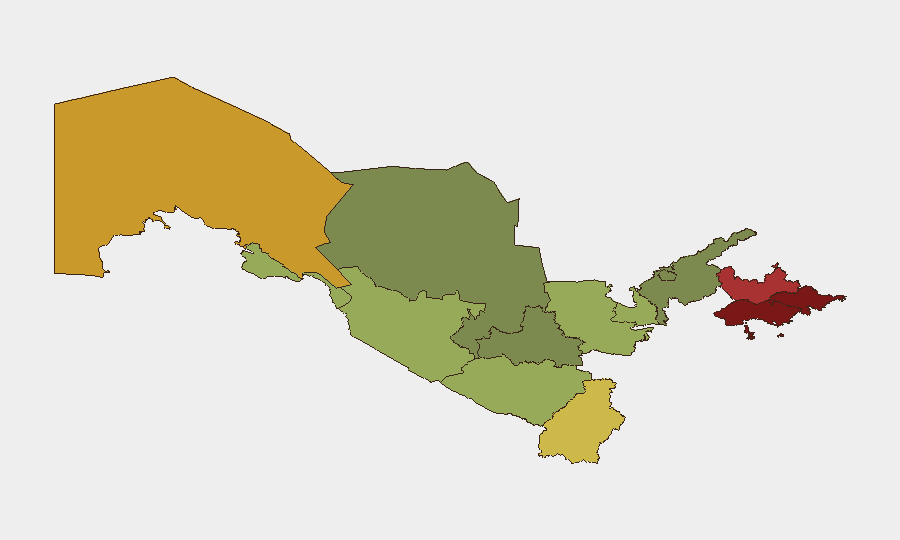
The Fergana Valley—comprising Andijan (88), Fergana (82), and Namangan (78) regions—accounts for the three highest sub-national risk scores and reflects historical patterns of transnational smuggling, irregular armed activity, and cross-border criminal networks tied to Central Asian supply routes and porous Kyrgyz borders. Andijan's elevated score reflects both legacy instability (2005 civil unrest) and persistent informal networks. Karakalpakstan (72) ranks fourth, driven by environmental degradation, economic marginalization, and weak state capacity in its interior. Organizations with assets, personnel, or supply chains in these zones face materially higher exposure to border-related crime, contraband transit, and localized governance volatility than those operating in Tashkent or southern oblasts.
How GeoBit Would Assist
Teams managing Uzbekistan exposure would deploy AOI Monitoring & Early Warning on Andijan, Fergana, and Namangan to detect cross-border trafficking, security-force deployments, or unrest signals before mainstream reporting. OSINT fusion (X/Telegram/YouTube monitoring, multi-language search) combined with entity extraction and network analysis would track informal actors, sanctions evasion, and smuggling routes affecting supply-chain security. GIS & spatial analysis with conflict and border-monitoring capabilities would support alternative routing and journey planning for personnel transiting the Fergana Valley or approaching the Kyrgyz frontier.
7-Day Outlook
No acute escalation triggers are visible in current reporting. Electricity supply remains a modest operational risk through summer 2026; organizations should confirm backup power for critical functions. Geopolitical tensions (reflected in the 2026-07-24 China–Uzbekistan statement) warrant watching for trade or investment policy shifts but pose no imminent ground-level security impact.
Highest-Risk Areas — Ranked
| # | State / Region | Risk |
|---|---|---|
| 1 | Andijan Region | 88 |
| 2 | Fergana Region | 82 |
| 3 | Namangan Region | 78 |
| 4 | Republic of Karakalpakstan | 72 |
| 5 | Surxondaryo Region | 65 |
| 6 | Qashqadaryo Region | 58 |
| 7 | Sirdaryo Region | 55 |
| 8 | Jizzakh Region | 48 |
| 9 | Xorazm Region | 45 |
| 10 | Bukhara Region | 42 |
| 11 | Navoiy Region | 38 |
| 12 | Samarqand Region | 35 |
Sources
Previous Daily Briefs
A new Uzbekistan brief is written every day — each with its own risk map and downloadable CSV. Here's the last week; use the calendar to go further back.
📅 Browse every day by calendar →
Highlighted days have a brief. Tap a day for that day's map & analysis, or “csv” for that day's dataset ($5).
Atlas — our AI intelligence desk — emails them this snapshot personally. Nothing else, no list.