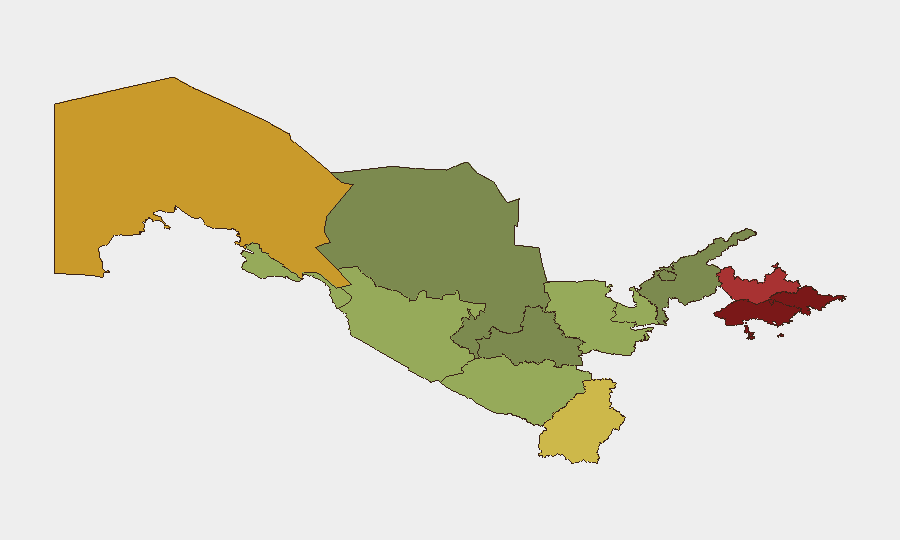
Situation Summary
Uzbekistan remains a low-threat jurisdiction globally (ranked #149) with minimal reported security incidents in the reporting week. However, significant regional variance exists: the Fergana Valley (Andijan, Fergana, and Namangan regions) exhibits substantially elevated risk profiles, reflecting historical ethnic tensions, border complexity, and trafficking vulnerabilities. Drug interdiction, anti-corruption enforcement, and border-control measures have proceeded routinely. The security environment remains stable overall, though concentrated geographic risk requires differentiated operational awareness.
Key Developments
- Tashkent International Airport, 22 September: Customs and State Security Service personnel intercepted 13.08 kg of hashish oil transiting from Thailand; trafficking network dismantling continued in Tashkent and Samarkand.
- Surkhandarya Region, 22 September: Head of a district sanitary and epidemiological department detained on suspicion of bribery; part of ongoing anti-corruption enforcement.
- Tashkent, 22 September: France deployed a new Central Asia internal-security representative to Uzbekistan with portfolio covering organized crime, cybercrime, drug trafficking, terrorism, illegal immigration, and border threats.
- National Power System, 25 September: Emergency shutdown of 1,516 MW of generating capacity disrupted Kazakhstan's grid; Uzbekistan's system stability was restored, though 962 MW in consumer restrictions were imposed during the incident.
- Uzbekistan Senate, 24 September: Approved criminal-liability amendments targeting construction, use, organization, or financing of illegal cross-border tunnels, following identification of 12 such tunnels during 2016–2025.
- Samarkand, announced 24 September: U.S. Secretary of State Marco Rubio to lead 100+ U.S. company delegation to Samarkand in mid-October; advance diplomatic and investment engagement (event scheduled outside reporting window).
Highest-Risk Areas
The Fergana Valley—Andijan (88), Fergana (82), and Namangan (78) regions—drives the country's internal risk profile due to dense population, ethnic diversity, historical border disputes, and established trafficking corridors. Karakalpakstan (72) and Surxondarya (65) follow, reflecting environmental stress, socioeconomic factors, and cross-border vulnerabilities. Southern regions generally outrank the safer northwest and central zones. The Tashkent capital zone, not separately ranked, remains the primary hub for international business and diplomatic presence; risk there is lower than the regional averages. Organizations with operations or personnel in Fergana Valley or southern regions should maintain heightened situational awareness.
How GeoBit Would Assist
Security teams should deploy AOI Monitoring & Early Warning across the Fergana Valley and southern border zones to detect trafficking, protest activity, or security-force movements in near-real time. Multi-language OSINT (X/Telegram, local media, YouTube) combined with sentiment & temporal analysis enables detection of emerging civil unrest or organized-crime signals before mainstream reporting. Network & Actor Analysis linked to customs and law-enforcement data supports tracking of narcotics and smuggling routes. Border & Disputed-Territory Search capabilities provide baseline intelligence on boundary flashpoints and cross-border tunnel networks identified by authorities.
7-Day Outlook
No acute security triggers are evident for the coming week. Routine enforcement and border operations will likely continue. The scheduled mid-October U.S. business delegation arrival should proceed without disruption, though pre-visit security protocols should account for elevated activity in Samarkand. Regional risk in the Fergana Valley remains chronic rather than acute, warranting persistent monitoring rather than crisis posture.
Highest-Risk Areas — Ranked
| # | State / Region | Risk |
|---|---|---|
| 1 | Andijan Region | 88 |
| 2 | Fergana Region | 82 |
| 3 | Namangan Region | 78 |
| 4 | Republic of Karakalpakstan | 72 |
| 5 | Surxondaryo Region | 65 |
| 6 | Qashqadaryo Region | 58 |
| 7 | Sirdaryo Region | 55 |
| 8 | Jizzakh Region | 48 |
| 9 | Xorazm Region | 45 |
| 10 | Bukhara Region | 42 |
| 11 | Navoiy Region | 38 |
| 12 | Samarqand Region | 35 |
Sources
Previous Weekly Briefs
A new Uzbekistan brief is written every Monday, covering the week — each with its own risk map and downloadable CSV. Use the calendar to go further back.
- September 21, 2026
- September 14, 2026
- September 7, 2026
- September 3, 2026
- September 2, 2026
- September 1, 2026
- August 31, 2026
📅 Browse past briefs by calendar →
Highlighted days have a brief. Tap a day for that day's map & analysis, or “csv” for that day's dataset ($5).
Atlas — our AI intelligence desk — emails them this snapshot personally. Nothing else, no list.