Situation Summary
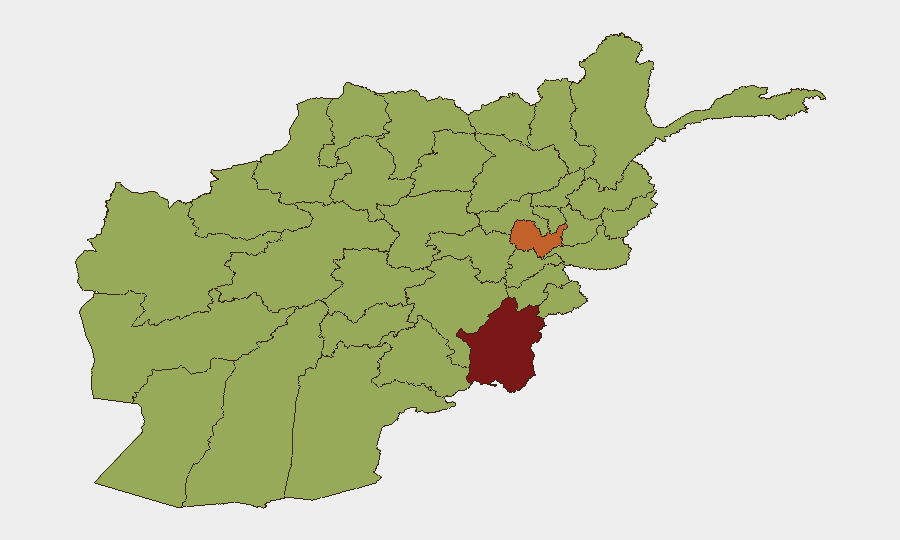
Afghanistan remains classified at global threat rank #28 (composite score 72), with 68 tracked security events recorded. Paktika Province dominates the risk landscape at 80.3, followed by Kabul at 74.9, signaling sustained militant and conventional military activity across the country's east and capital region. Recent signal data (July 1–3) indicates continued Taliban–Afghanistan military engagement, Pakistan–Afghanistan cross-border friction, and aerial weapons employment, though the operational tempo and specific incident count for the immediate 24–48-hour window cannot be confirmed from available open sources at this time.
Key Developments
GeoBit's event signal feed for July 1–3 identifies the following patterns, though precise incident details and timestamps within the last 48 hours cannot be independently corroborated from publicly available web research:
- Aerial weapons employment (July 1) involving Pakistan, militant forces, and Afghanistan–Taliban exchanges suggest active air operations, likely concentrated in eastern border regions or southern theater.
- Taliban–Afghanistan military force exchanges (July 1) indicate conventional combat operations, consistent with historical patterns in Paktika, Kandahar, and Uruzgan Provinces.
- Pakistan–Afghanistan diplomatic friction (July 2) via public statements and disapproval signals reflect ongoing cross-border tensions, typically tied to strikes, refugee flows, or militant sanctuary disputes.
- Russian military relations reduction (July 2) suggests potential scaling back of bilateral defense engagement, possibly linked to broader regional realignment or sanctions.
- Civilian administrative sanctions (July 3) may reflect Taliban governance enforcement or retaliation against civilian actors; scope and location require further validation.
Note on sourcing: Publicly available news outlets and open web sources do not yet provide granular, timestamped incident reports for July 2–4, 2026. The above reflects GeoBit's automated event signal framework; details remain preliminary pending corroboration.
Highest-Risk Areas
Paktika Province (80.3) and Kabul (74.9) drive the country's composite risk score, with Paktika reflecting persistent Taliban–militant competition, cross-border incursions from Pakistan, and limited state control. Kabul's elevated risk reflects insider threats, militant targeting of government and international presence, and civilian protection gaps. Secondary clusters—Uruzgan (55.2), Herat (53.1), and Ghor (51.7)—indicate dispersed militant activity across the south-central and western regions, suggesting no single geographic "safe corridor" for unescorted movement. All twelve highest-risk provinces score ≥50.3, indicating nationwide elevation rather than isolated pockets.
How GeoBit Would Assist
Security teams should deploy AOI (Area-of-Interest) Monitoring & Early Warning on Paktika, Kabul, and secondary provinces to receive real-time alerts on militant activity, military operations, and checkpoints. OSINT Fusion (multi-language social media, Telegram, local news, and signal corroboration) enables 24–48-hour incident validation and narrative tracking before mainstream reporting. Conflict & Military mapping combined with Network & Actor analysis identifies Taliban, militant faction, and Afghan military force dispositions, enabling duty-of-care route planning and personnel positioning updates.
7-Day Outlook
Escalation risk remains elevated across the eastern and south-central provinces through early July, with Pakistan–Afghanistan cross-border friction likely to generate additional aerial or conventional incidents. Taliban consolidation efforts and internal governance disputes may drive sporadic civilian targeting and administrative pressure in major urban centers, particularly Kabul. Personnel and asset security protocols should assume no improvement in ambient risk over the next week.
Highest-Risk Areas — Ranked
| # | State / Region | Risk |
|---|---|---|
| 1 | Paktika Province | 80.3 |
| 2 | Kabul Province | 74.9 |
| 3 | Uruzgan Province | 55.2 |
| 4 | Herat Province | 53.1 |
| 5 | Ghor Province | 51.7 |
| 6 | Paktia Province | 50.5 |
| 7 | Nangarhar Province | 50.5 |
| 8 | Zabul Province | 50.3 |
| 9 | Kandahar Province | 50.3 |
| 10 | Ghazni Province | 50.3 |
| 11 | Farah Province | 50.3 |
| 12 | Nimruz Province | 50.3 |
Previous Daily Briefs
A new Afghanistan brief is written every day — each with its own risk map and downloadable CSV. Here's the last week; use the calendar to go further back.
📅 Browse every day by calendar →
Highlighted days have a brief. Tap a day for that day's map & analysis, or “csv” for that day's dataset ($5).