Situation Summary
Argentina remains at moderate global risk (rank #45) with a composite threat score of 34 and 231 tracked events, reflecting underlying volatility in crime, provincial governance, and political tensions rather than acute instability. A nationwide elevated security alert ("alto") has remained in force since 28 February 2026, maintaining heightened police presence and controls at critical infrastructure, diplomatic missions, and transport hubs in response to global geopolitical pressures. The immediate incident picture over the past 24–48 hours shows relative calm at the tactical level, though a recent bomb threat at the US Embassy in Buenos Aires (now ruled out) underscores persistent vulnerabilities in the capital. Risk remains concentrated in the northwestern and northeastern provinces, where resource competition, indigenous disputes, and cross-border activity drive elevated threat scores.
Key Developments
- Buenos Aires (US Embassy, Palermo) – 30 July 2026 (approx.)
The US Embassy received a phone call reporting "a bomb outside the embassy," triggering evacuation, large police deployment, street closures, and explosives-unit response. Federal Police completed a thorough investigation and ruled out the threat; all staff were confirmed safe. The incident highlighted vulnerability of diplomatic assets despite elevated national security posture.
- Argentina–Turkey Border/Diplomatic – 30 July 2026
Argentine authorities executed an expulsion/deportation action against a Turkish national, indicating ongoing immigration enforcement and possible diplomatic friction in the bilateral relationship.
- Argentina (Federal/Military-Company Interaction) – 30 July 2026
A conventional military force operation was directed at a company, suggesting government enforcement action or regulatory compliance operation; full details remain unclear from available open-source reporting.
- Argentina (Nationwide Police Activity) – 31 July 2026
Police conducted an investigation (subject and location not yet specified in available data), consistent with ongoing law-enforcement operations under the elevated alert level.
- Argentina (Government & Legislative Statements) – 31 July 2026
Government, legislative, and ambassador-level public statements were issued, likely tied to broader policy or security posture announcements; sentiment and content not yet detailed in available summaries.
- Argentina (Disapproval & Community Tensions) – 29–31 July 2026
Public disapproval actions and a community-versus-school statement signal localized social friction; indigenous-versus-indigenous tensions were also noted, reflecting ongoing resource and governance disputes in provincial areas.
Note: Open-source reporting explicitly documents an absence of major confirmed incidents in the strict 24–48-hour window. Events listed above represent the most recent timestamped or high-confidence signals; many routine crime and police incidents in local media lack precise dates and have been excluded to avoid misrepresenting older events as current.
Highest-Risk Areas
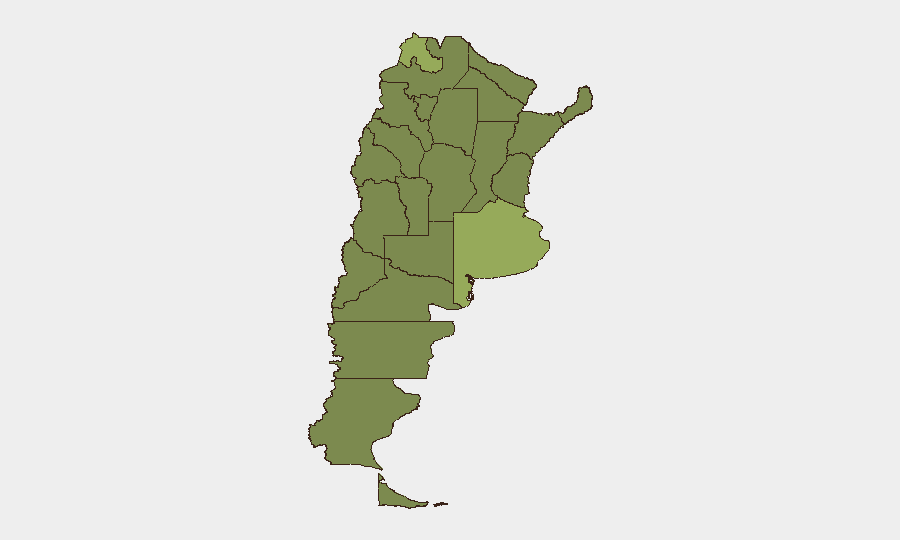
Buenos Aires Province (53.9) dominates the risk ranking and accounts for the largest share of tracked threat events, driven by crime, gang activity, and the concentration of diplomatic, financial, and transport infrastructure. The northwestern provinces—Jujuy (40.1), Santiago del Estero (38.9), and Chaco (38.9)—show elevated risk due to indigenous land disputes, cross-border smuggling routes, and resource competition; Neuquén Province (38.9) similarly reflects extractive-industry tensions and indigenous activism. Río Negro (37.8) and Córdoba (32) round out the higher-risk tier, while southern and central provinces (Salta, Santa Fe, San Juan, Misiones, Catamarca) register lower but still measurable scores. Corporate and duty-of-care teams should prioritize enhanced monitoring and contingency planning for Buenos Aires and the northwestern corridor.
How GeoBit Would Assist
Security teams should employ AOI (Area-of-Interest) Monitoring & Early Warning to track Buenos Aires diplomatic zones, provincial capitals, and border crossings in real time, with alerting triggered by police, military, or protest activity. Intel Sweep, multi-language OSINT, and X/Telegram analysis enable continuous monitoring of indigenous disputes, cross-border trafficking, and political rhetoric in the northwestern provinces. Routing & Network Analysis supports alternative journey planning for personnel and asset movement, accounting for ongoing police controls and infrastructure vulnerabilities.
7-Day Outlook
The elevated national security alert is expected to remain in force, maintaining heightened controls and delays at airports and border crossings. No major escalation is anticipated in the near term, though localized incidents (indigenous clashes, crime, police enforcement) will likely continue in high-risk provinces. Personnel and assets in Buenos Aires should maintain situational awareness of diplomatic zones and transport hubs, while northwestern operations should assume ongoing restrictions on movement and heightened scrutiny.
Highest-Risk Areas — Ranked
| # | State / Region | Risk |
|---|---|---|
| 1 | Buenos Aires Province | 53.9 |
| 2 | Jujuy Province | 40.1 |
| 3 | Neuquén Province | 38.9 |
| 4 | Santiago del Estero Province | 38.9 |
| 5 | Chaco Province | 38.9 |
| 6 | Río Negro Province | 37.8 |
| 7 | Córdoba | 32 |
| 8 | Salta Province | 27.4 |
| 9 | Santa Fe Province | 26.2 |
| 10 | Catamarca Province | 25.1 |
| 11 | Misiones | 25.1 |
| 12 | San Juan Province | 23.9 |
Sources
Previous Daily Briefs
A new Argentina brief is written every day — each with its own risk map and downloadable CSV. Here's the last week; use the calendar to go further back.
📅 Browse every day by calendar →
Highlighted days have a brief. Tap a day for that day's map & analysis, or “csv” for that day's dataset ($5).
Atlas — our AI intelligence desk — emails them this snapshot personally. Nothing else, no list.