Situation Summary
Bolivia is experiencing a nationwide general strike as of early July 2026, paralyzing major urban centers and disrupting normal economic and operational activity in response to President Rodrigo Paz's austerity program. The strike reflects acute economic stress—inflation exceeded 24% in 2025, dollar reserves have depleted, and informal workers and the urban poor face heightened financial pressure. Security event signals show a pattern of arrests, demonstrations, and government disapproval spanning 2–4 July, with La Paz (risk score 62.1) and Cochabamba (48.8) at the epicenter of unrest and highest vulnerability to escalation.
Key Developments
- Nationwide general strike (early July 2026, ongoing as of 4 Jul): Coordinated labor and social movements launched a strike against austerity measures, creating widespread work stoppages and disrupting transport, commerce, and service delivery across Bolivia.
- Urban demonstrations in La Paz and major cities (early July 2026, present tense as of 4 Jul): Labor and social protests tied to the strike are intensifying in primary urban centers, with marches and rallies increasing risk of civil unrest, traffic obstruction, and potential confrontation with security forces.
- Arrest/detention activity (2–3 Jul): Security event signals indicate arrests and detentions in La Paz and nationwide on 2–3 July, suggesting government response to strike organizers or protest participants.
- Executive and judicial tension (2–4 Jul): A judge issued disapproval of Bolivia's government on 3 July, a legislator was under investigation on 2 July, and authorities issued disapproval on 4 July, indicating institutional friction and political instability concurrent with labor action.
- Presidential response (3 Jul): The president issued a public statement on 3 July, likely addressing the strike and austerity position, as demand signals from Bolivian actors and specific demands against the presidency were recorded on 2–3 July.
Highest-Risk Areas
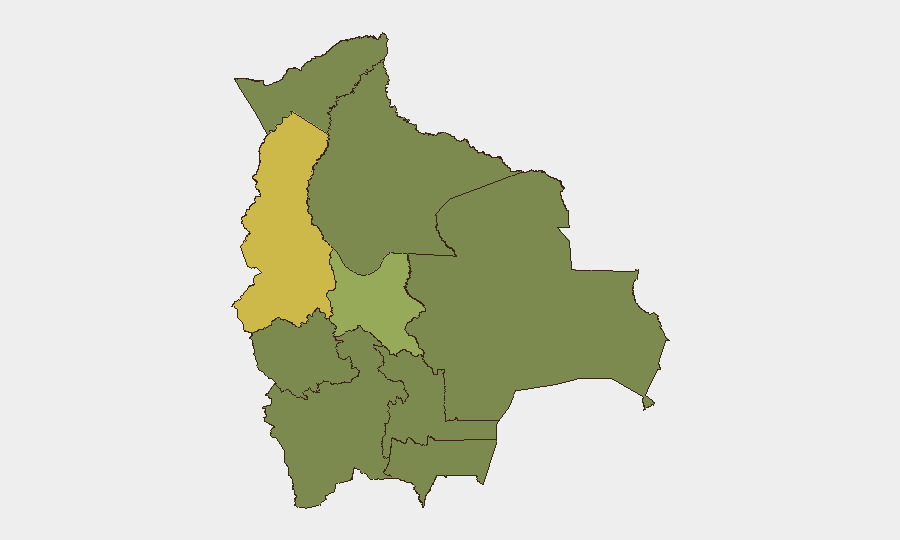
La Paz and Cochabamba account for the preponderance of tracked risk (62.1 and 48.8 respectively), driven by high concentrations of urban workers, informal employment, and organized labor capacity. La Paz's additional role as the seat of government and primary locus of protest activity makes it the primary flashpoint for strike coordination, police response, and potential escalation. The remaining departments—Potosí, Tarija, Pando, Beni, Oruro, Chuquisaca, and Santa Cruz—register a secondary, uniform risk tier (32.1), reflecting lower strike intensity but ongoing economic stress and potential for localized mobilization.
How GeoBit Would Assist
AOI Monitoring & Early Warning would establish persistent watch over La Paz and Cochabamba with real-time alerting on protest activity, roadblocks, and security force deployments. Intel Sweep, multi-language OSINT, and X/Twitter/Telegram analysis would track labor union communications, government statements, and grassroots mobilization to forecast strike escalation or de-escalation. Routing & Network Analysis would enable duty-of-care teams to plan alternative routes and safe passages around blockades and demonstrations, and Sentiment & Temporal Analysis would flag shifts in narrative and actor positioning that precede violence or policy concessions.
7-Day Outlook
The strike is likely to persist through the immediate week, with potential for localized clashes between protesters and security forces in La Paz and Cochabamba if the government does not signal policy concessions. Economic disruption will deepen, and international travel/cargo movements will remain compromised. A resolution pathway depends on presidential negotiation or labor-government dialogue; absent either, unrest may broaden to secondary cities or shift toward more disruptive tactics (roadblocks, resource-sector strikes).
Highest-Risk Areas — Ranked
| # | State / Region | Risk |
|---|---|---|
| 1 | La Paz | 62.1 |
| 2 | Cochabamba | 48.8 |
| 3 | Potosí | 33.1 |
| 4 | Tarija | 32.1 |
| 5 | Pando | 32.1 |
| 6 | Beni | 32.1 |
| 7 | Oruro | 32.1 |
| 8 | Chuquisaca | 32.1 |
| 9 | Santa Cruz | 32.1 |
Sources
Previous Daily Briefs
A new Bolivia brief is written every day — each with its own risk map and downloadable CSV. Here's the last week; use the calendar to go further back.
📅 Browse every day by calendar →
Highlighted days have a brief. Tap a day for that day's map & analysis, or “csv” for that day's dataset ($5).
Atlas — our AI intelligence desk — emails them this snapshot personally. Nothing else, no list.