Situation Summary
Colombia remains in the mid-range of global threat indices (rank #34, composite score 77) with insurgency as the primary driver. The security environment is characterized by persistent subnational conflict in border regions and coca-producing zones, compounded by emerging institutional instability tied to transitional justice mechanisms. Recent event signals indicate friction between judicial, administrative, and security institutions, alongside cross-border diplomatic tensions. The threat trajectory reflects chronic rather than acute deterioration, but institutional uncertainty may create operational gaps in conflict-affected zones.
Key Developments
- National – Transitional Justice Institutional Uncertainty (Bogotá, 11 July 2026)
President-elect Abelardo de la Espriella has publicly committed to dismantling or fundamentally reforming the Special Jurisdiction for Peace (SJP), the war-crimes tribunal handling FARC-era accountability cases. His designated justice minister has signaled mixed messaging—ruling out elimination but demanding operational results and budget review—creating institutional ambiguity that may affect victim protections, witness security, and conflict-related prosecutions in regions where SJP has investigative presence.
- Diplomatic Tension – Bolivia–Colombia Statement (Regional, 11 July 2026)
Bolivia issued a public statement regarding Colombia, indicating interstate friction on an unspecified issue. Context and nature of dispute require monitoring for potential trade, migration, or border implications affecting cross-border operations.
- Judicial–Community Disapproval Signal (National, 11 July 2026)
High court issued a disapproval statement regarding community actors, signaling potential civil-society conflict or judicial pressure on grassroots organizations. Scope and geographic concentration remain unclear pending further reporting.
- Administrative Rejection (National, 11 July 2026)
Government administration rejected an unspecified proposal or action. Without detail, risk relevance is indeterminate; escalation watch warranted.
- Security Force–Civilian Confrontation (Specific location TBD, 10 July 2026)
Conventional military force engagement between civilian and police actors was recorded. Nature, location, and casualty count not yet confirmed in available open sources.
- Arrest/Detain Action (Judicial system, 10 July 2026)
Arrest or detention event involving judge and prison authorities suggests either a judicial integrity incident or high-profile detainee processing. Reputational or procedural implications possible.
- Government Deportation Action (National, 10 July 2026)
Government executed expulsion or deportation. Without identification of subject nationality or location, operational relevance for corporate presence remains unclear.
- Violent Protest/Uprising Signal (Location TBD, 10 July 2026)
An uprising or violent protest event was recorded. Geographic concentration and trigger remain unconfirmed; community-level instability or labor/political mobilization cannot yet be ruled out.
Highest-Risk Areas
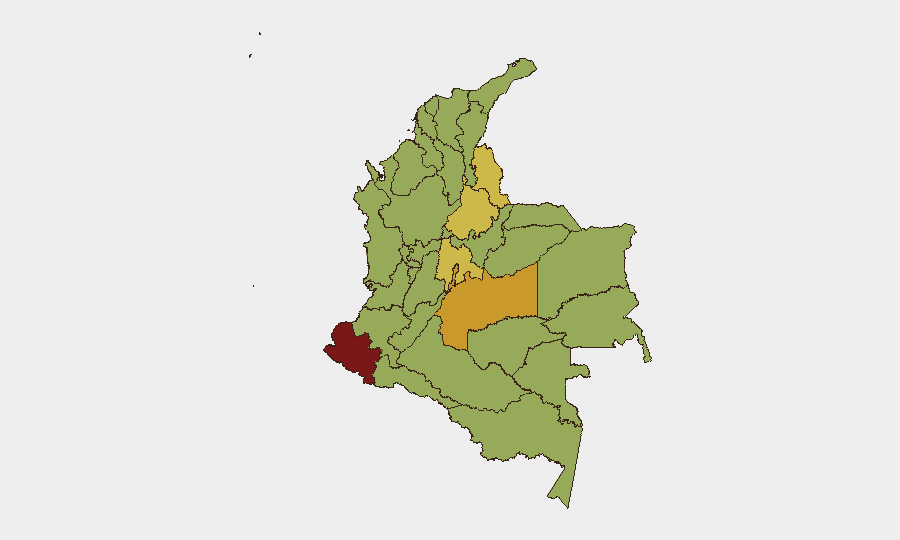
Nariño Department (83.8) and Meta Department (72.4) dominate the subnational ranking, reflecting ongoing coca production, armed group presence, and limited state authority in southern and eastern border zones. The Capital District (71.9) and Cundinamarca (67.5) rank higher than historical norms, suggesting recent uptick in institutional, protest, or crime-related events in the Bogotá metropolitan area. Northern departments (Santander, Norte de Santander, La Guajira) remain chronically elevated due to Venezuelan migration, cross-border trafficking, and ELN/dissidentFARC activity. Corporate teams with personnel in Bogotá should note the elevated metropolitan ranking; field operations in Nariño and Meta require heightened vigilance and contingency planning.
How GeoBit Would Assist
AOI Monitoring & Early Warning with persistent watch on Nariño, Meta, and Cundinamarca would alert teams to event clustering before escalation. Network & Actor Analysis would map institutional friction within the judiciary and administration, identifying pressure points affecting operations. OSINT fusion combining X/Twitter, radio SIGINT, and multi-language web search would fill the 24-48h reporting gap and corroborate or clarify the event signals listed above.
7-Day Outlook
Institutional volatility around SJP reform is likely to generate further public statements and potential civil-society mobilization over the coming week. Subnational conflict in border zones will persist at baseline; no major escalation is currently signaled, but reduced judicial oversight in conflict zones may embolden armed actors. Teams should prepare contingency communication and routing plans for Bogotá-based staff pending clarification of the administrative and judicial friction noted above.
Highest-Risk Areas — Ranked
| # | State / Region | Risk |
|---|---|---|
| 1 | Nariño | 83.8 |
| 2 | Meta Department | 72.4 |
| 3 | Capital District | 71.9 |
| 4 | Cundinamarca Department | 67.5 |
| 5 | Santander Department | 66.9 |
| 6 | Norte de Santander Department | 63.9 |
| 7 | Bolívar Department | 59.7 |
| 8 | Atlántico Department | 58.1 |
| 9 | La Guajira | 55.5 |
| 10 | Valle del Cauca Department | 55.1 |
| 11 | Quindío Department | 54.5 |
| 12 | Boyacá Department | 54.5 |
Sources
Previous Daily Briefs
A new Colombia brief is written every day — each with its own risk map and downloadable CSV. Here's the last week; use the calendar to go further back.
📅 Browse every day by calendar →
Highlighted days have a brief. Tap a day for that day's map & analysis, or “csv” for that day's dataset ($5).
Atlas — our AI intelligence desk — emails them this snapshot personally. Nothing else, no list.