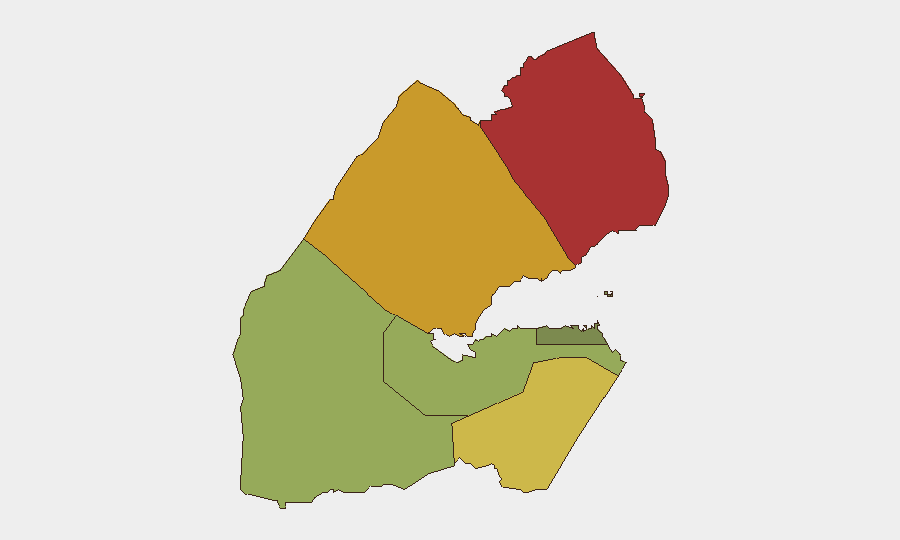
Situation Summary
Djibouti remains a low-risk jurisdiction globally (rank #96), but faces mounting indirect security pressures from Yemen's intensified conflict and the resulting humanitarian crisis. A sharp surge in refugee arrivals—over 3,400 Yemenis in less than a week—has concentrated risk in the northern Obock region, straining resources and border-management capacity. Concurrent law-enforcement operations targeting urban crime and gang activity reflect authorities' effort to contain domestic security threats, while Houthi advances along Yemen's Red Sea coast have elevated strategic concerns for critical assets including Camp Lemonnier and regional maritime corridors.
Key Developments
- Obock region, 14–17 September 2026: Over 3,400 Yemeni refugees arrived by sea in northern Djibouti within days, following intensified fighting in Yemen; authorities and UN agencies are managing registration, food, shelter, and security at arrival points, with further crossings anticipated.
- Obock and northern coast, 14–15 September 2026: Single-wave arrivals exceeded 1,200–1,300 persons; Djibouti's prime minister instructed agencies to prioritize safety and security of new arrivals, signaling government acknowledgment of humanitarian and protection risks.
- Nationwide urban hotspots, 17 September 2026: National Gendarmerie conducted a large-scale anti-crime sweep, arresting 180 individuals suspected of gang involvement, extortion, and weapons possession; foreign nationals without legal status face repatriation.
- Djibouti City, 18–19 September 2026: Detainees from the 17 September operation were referred to judicial authorities, indicating ongoing criminal investigations and potential detention-facility capacity strain.
- Government statement, 17–19 September 2026: Djibouti condemned an attempted drone attack targeting Mecca, expressed solidarity with Saudi Arabia, and reinforced its strategic alignment against Houthi activities—underlining heightened regional threat perception.
- Red Sea / Perim Island, mid-September 2026: Houthi seizure of Perim Island and enhanced control of Yemen's Red Sea coast and Bab al-Mandeb strait have reduced geographic buffer between hostile forces and Camp Lemonnier; this raises operational and maritime-security implications for US military operations and regional shipping.
- Northern border / maritime zone, 10–16 September 2026: Djibouti government placed on heightened alert and requested urgent international aid as refugee numbers accelerated; border-management and maritime-security capabilities are visibly strained.
Highest-Risk Areas
Obock (risk 78) and Tadjourah (risk 72) are the primary drivers of elevated national risk, both concentrated along the northern coast and directly exposed to maritime refugee arrivals and potential maritime security incidents from the Yemen conflict zone. Ali Sabieh (risk 65) borders Ethiopia and Yemen, presenting secondary border-management and spillover vulnerabilities. By contrast, Djibouti city (risk 35) and southern regions remain significantly lower-risk; urban crime hotspots targeted in the 17 September sweep are localized and responsive to law-enforcement intervention. The northern maritime corridor—particularly Obock's arrival points—is the single highest-consequence vulnerability for humanitarian, resource, and security operations.
How GeoBit Would Assist
Security teams should employ AOI Monitoring & Early Warning on Obock's coastal zone and maritime approaches to detect arrival surges, vessel movements, and resource bottlenecks in real time. Maritime & Aviation tracking combined with GIS & Spatial Analysis enables mapping of refugee flows, bottleneck identification, and route-risk assessment. OSINT fusion (X/Twitter, local media, radio SIGINT, and YouTube eyewitness accounts) provides early indicators of escalations in Yemen, cross-strait violence, or camp-security incidents before formal reporting.
7-Day Outlook
Refugee arrivals are likely to continue or accelerate if fighting in Yemen persists; Djibouti's humanitarian and security capacity will remain under stress through the coming week. Law-enforcement sweeps may recur in urban areas to manage crime spillover, and maritime-security vigilance along the northern coast should be assumed as baseline. No imminent direct military threat to Djibouti City or major installations is indicated, but resource scarcity and humanitarian strain in northern zones pose indirect risks to supply chains, labor mobility, and social stability.
Highest-Risk Areas — Ranked
| # | State / Region | Risk |
|---|---|---|
| 1 | Obock | 78 |
| 2 | Tadjourah | 72 |
| 3 | Ali Sabieh | 65 |
| 4 | Arta | 48 |
| 5 | Dikhil | 42 |
| 6 | Djibouti | 35 |
Sources
Previous Weekly Briefs
A new Djibouti brief is written every Monday, covering the week — each with its own risk map and downloadable CSV. Use the calendar to go further back.
- September 14, 2026
- September 7, 2026
- September 1, 2026
- August 30, 2026
- August 27, 2026
- August 25, 2026
- August 23, 2026
📅 Browse past briefs by calendar →
Highlighted days have a brief. Tap a day for that day's map & analysis, or “csv” for that day's dataset ($5).
Atlas — our AI intelligence desk — emails them this snapshot personally. Nothing else, no list.