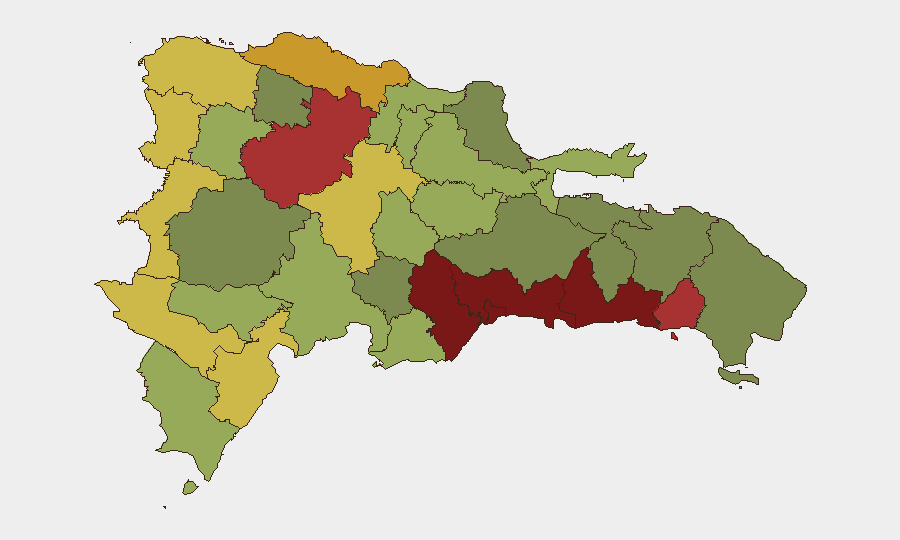
Situation Summary
The Dominican Republic maintains a composite threat score of 9 with no tracked security events in the current reporting window, indicating a relatively stable security environment on a national level. However, sub-national risk remains concentrated in urban centers, particularly Santo Domingo and the Nacional District, where gang activity, organized crime, and law-enforcement operations continue to drive elevated threat profiles. Recent developments—including a death during police operations in Barahona and migration enforcement activity in Santiago—reflect ongoing operational security pressures rather than systemic instability. The trajectory remains one of localized rather than widespread or escalating threats.
Key Developments
- Barahona Province (La Ciénaga, Paraíso, Enriquillo municipalities), late July 2026 – A foreign national died following a medical emergency during a National Police and Public Prosecutor raid; circumstances involved an altercation with officers and subsequent collapse. The death remains under investigation and represents a law-enforcement operation fatality with potential consular and diplomatic dimensions for foreign nationals in-country.
- Tamboril, Santiago Province, 30 July 2026 – Migration authorities (DGM) detained 74 Haitian nationals in irregular status (31 men, 24 women, 19 minors) during an enforcement operation; one detainee fled on foot, abandoning a motorcycle. This reflects intensified immigration enforcement and potential for migrant-related tensions in northern provinces.
- Santo Domingo (national), early August 2026 – The government and fuel-station association Anadegas partially suspended a planned halt on card-payment acceptance at service stations, averting a potential disruption to fuel-purchasing infrastructure. This indicates supply-chain and payment-system vulnerability that could affect corporate mobility and logistics operations if re-escalated.
- No substantiated incidents of large-scale civil unrest, armed conflict, major infrastructure failure, or terrorism in the last 48 hours – Most recent news cycles continue to surface incidents from June and July (hospital protests, road accidents, localized crime reports) rather than new incidents.
Highest-Risk Areas
Santo Domingo (risk 92) and the Nacional District (risk 88) drive national risk concentration, reflecting high gang prevalence, organized-crime activity, and law-enforcement operations in the capital and surrounding metropolitan zone. San Cristóbal, San Pedro de Macorís, and La Romana (risks 85, 83, 78 respectively) represent secondary risk corridors along the southern coast, where narcotics trafficking and associated criminal networks remain active. Provincial capitals in the north and border regions (Santiago, Puerto Plata, Elías Piña, Dajabón) show elevated risk scores due to migrant flows, trafficking routes, and weaker institutional presence. Risk is fundamentally sub-national and localized to specific provinces and municipalities rather than representing a national emergency.
How GeoBit Would Assist
Security teams should deploy AOI Monitoring & Early Warning on high-risk provinces (Santo Domingo, Nacional District, San Cristóbal) to capture real-time incident signals and law-enforcement operations affecting corporate or personnel movements. OSINT fusion and multi-language search capabilities enable continuous tracking of migration enforcement, fuel-supply disruptions, and localized crime trends across Dominican news sources and social platforms. Routing & Network Analysis and alternative journey planning tools allow duty-of-care teams to avoid high-risk corridors and adjust travel itineraries in real time based on emerging threats in specific municipalities.
7-Day Outlook
Dominican Republic security environment is expected to remain stable with continued localized enforcement operations and migration-related activity in northern and coastal provinces. No indicators of significant escalation or systemic instability are present; however, law-enforcement fatalities and migrant detention operations may generate political or social friction. Corporate security postures should remain calibrated to sub-national risk variation rather than elevated national alert.
Highest-Risk Areas — Ranked
| # | State / Region | Risk |
|---|---|---|
| 1 | Santo Domingo | 92 |
| 2 | Nacional District | 88 |
| 3 | San Cristóbal | 85 |
| 4 | San Pedro de Macorís | 83 |
| 5 | La Romana | 78 |
| 6 | Santiago | 76 |
| 7 | Puerto Plata | 72 |
| 8 | Elías Piña | 70 |
| 9 | Dajabón | 68 |
| 10 | Barahona | 65 |
| 11 | Independencia Province | 64 |
| 12 | La Vega | 62 |
Sources
Previous Daily Briefs
A new Dominican Republic brief is written every day — each with its own risk map and downloadable CSV. Here's the last week; use the calendar to go further back.
📅 Browse every day by calendar →
Highlighted days have a brief. Tap a day for that day's map & analysis, or “csv” for that day's dataset ($5).
Atlas — our AI intelligence desk — emails them this snapshot personally. Nothing else, no list.