Situation Summary
Georgia remains at moderate overall risk (global rank #89, composite threat score 18) with civil unrest as the primary driver. The country faces a bifurcated threat landscape: sustained political tension in Tbilisi linked to pro-European sentiment and the ruling Georgian Dream party, alongside enduring separatist and border instability in the northern and southern breakaway regions. Recent infrastructure disruptions and localized security incidents (school threats, robbery, minor violence) reflect friction rather than systemic breakdown, but the 619-day protest cycle and ongoing detention of opposition figures signal persistent state-society strain.
Key Developments
- Tbilisi, 2026-08-15: Heavy rainfall caused street flooding and water ingress at Rustaveli and Vaja-Pshavela metro stations; a damaged gas line on Chikovani Street, Saburtalo prompted local evacuations and emergency-services activation.
- Darial Gorge / Kazbegi–Upper Lars crossing, 2026-08-13 to 2026-08-14: Russia–Georgia border crossing temporarily closed after warning-system activation triggered by rising water in Devdoraki gorge; restrictions were lifted within 24 hours and normal operation resumed.
- Tbilisi, 2026-08-13: Security forces dispersed a march demanding release of political prisoners using tear gas and water cannons; multiple detentions followed, continuing the pattern of police response to anti-government demonstrations.
- Imereti region, 2026-08-11: Georgian Interior Ministry announced detention of four individuals in a criminal-underworld crackdown; two additional suspects charged in absentia, reflecting ongoing organized-crime enforcement operations outside the capital.
- Jackson and Hall Counties, 2026-08-15: Automated AI-generated bomb threats delivered via phone call prompted school evacuations and district-wide closures; no explosives reported. (Note: these are U.S. jurisdictions; included for completeness but outside Georgia country scope.)
Highest-Risk Areas
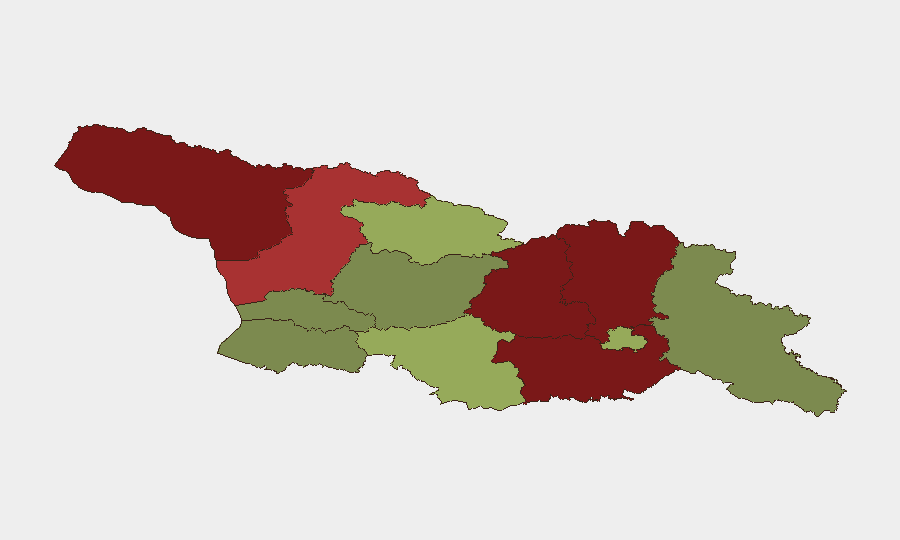
Abkhazia and Shida Kartli (Russian-backed separatist territory and the immediately adjacent core-conflict zone) remain the acutest risk nodes, followed by Lower Kartli and Mtskheta-Mtianeti, all in the North Caucasus border region. These areas carry persistent risks from unresolved territorial dispute, military posture, and limited state authority. Samtskhe-Javakheti and Samegrelo-Upper Svaneti, while secondary, retain elevated risk from border tension and historical conflict legacies. Tbilisi (rank 45) concentrates political protest and civil-unrest risk but remains operationally stable; southern and western lowland regions (Adjara, Imereti, Guria) present significantly lower threat profiles.
How GeoBit Would Assist
Teams with personnel or assets in Georgia should employ AOI Monitoring & Early Warning on separatist zones (Abkhazia, South Ossetia) and the Tbilisi political sphere to detect escalation in demonstrations, border friction, or security operations. GIS & Spatial Analysis and Routing & Network Analysis capabilities support real-time assessment of infrastructure disruptions (flooding, gas leaks, border closures) and alternative travel planning—particularly critical on I-75-equivalent corridors and the Darial crossing during weather events. Conflict & Military and Regime-Stability monitoring track Georgian Dream governance strain and military posture near breakaway territories, informing longer-term duty-of-care planning.
7-Day Outlook
Protest activity in Tbilisi is likely to persist at current operational levels absent major political concessions or escalation by security forces. Weather-related infrastructure incidents (flooding, utilities) should be anticipated given seasonal rainfall; infrastructure teams should verify contingency routes. Border stability appears restored, but the Russia–Georgia frontier remains subject to closure without notice.
Highest-Risk Areas — Ranked
| # | State / Region | Risk |
|---|---|---|
| 1 | Autonomous Republic of Abkhazia | 95 |
| 2 | Shida Kartli | 88 |
| 3 | Lower Kartli | 85 |
| 4 | Mtskheta-Mtianeti | 82 |
| 5 | Samegrelo-Upper Svaneti | 78 |
| 6 | Samtskhe-Javakheti | 48 |
| 7 | Tbilisi | 45 |
| 8 | Racha-Lechkhumi and Kvemo Svaneti | 42 |
| 9 | Kakheti | 38 |
| 10 | Autonomous Republic of Adjara | 35 |
| 11 | Imereti | 32 |
| 12 | Guria | 28 |
Sources
Previous Daily Briefs
A new Georgia brief is written every day — each with its own risk map and downloadable CSV. Here's the last week; use the calendar to go further back.
- August 15, 2026
- August 14, 2026
- August 12, 2026
- August 11, 2026
- August 10, 2026
- August 9, 2026
- August 8, 2026
📅 Browse every day by calendar →
Highlighted days have a brief. Tap a day for that day's map & analysis, or “csv” for that day's dataset ($5).
Atlas — our AI intelligence desk — emails them this snapshot personally. Nothing else, no list.