Situation Summary
Turkmenistan maintains a stable internal security posture with no reported violent incidents, civil unrest, or infrastructure failures during the week of 12–19 October 2026. The country's composite threat ranking remains low globally (#186, score 3), though regional variance is pronounced: the Balkan and Lebap regions carry substantially elevated risk profiles, while the capital and southern areas remain comparatively secure. Senior leadership engagement in regional diplomatic forums signals continued focus on trade and transport connectivity rather than acute crisis response.
Key Developments
- Baku, Azerbaijan — 15 October: Turkmen foreign ministry participated in trilateral talks with Azerbaijan and Uzbekistan on expanding transport corridors and international transit connectivity during the CICA summit. The discussion reflects priority on regional supply-chain integration and logistics infrastructure resilience.
- Baku, Azerbaijan — 13 October: OCCRP published allegations via social media that Turkmen authorities maintain arrest warrants targeting dissidents and opposition figures abroad, signaling continued transnational political monitoring. Independent corroboration of specific warrant details remains unavailable in open sources.
- Yerevan, Armenia — 16 October: President Serdar Berdimuhamedov traveled to Armenia to attend the COP17 climate leaders' summit (opening 19 October). No security incidents accompanied the senior-level movement or international engagement.
- Ashgabat, Turkmenistan — 18 October: Turkmenistan's participation in regional connectivity initiatives underscored state emphasis on simplified cross-border trade procedures and multimodal transport corridors. No operational disruptions or security complications were documented.
Highest-Risk Areas
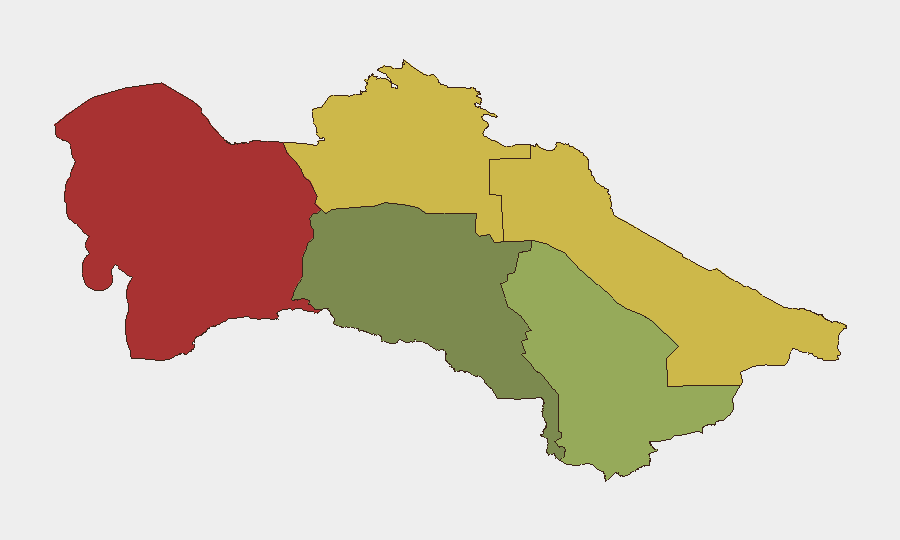
The Balkan Region (risk 78) and Lebap Region (risk 68) together drive Turkmenistan's subnational threat profile, accounting for a substantial share of tracked risk exposure. Both regions border Afghanistan and Uzbekistan respectively, creating exposure to cross-border trafficking, informal militant transit, and smuggling networks that persist despite low-frequency reporting. The Dashoguz Region (risk 62, northern Uzbekistan border) follows as the third-highest-risk zone. By contrast, Ashgabat City (risk 18) and Ahal Region (risk 35) reflect the security and administrative concentration typical of capital-centric governance and lower incident density in southern Turkmenistan. Corporate assets and personnel in border zones—particularly western and northern regions—face elevated duty-of-care thresholds relative to the capital.
How GeoBit Would Assist
Security teams monitoring Turkmenistan would employ GeoBit's AOI Monitoring & Early Warning capability to maintain persistent watch over the Balkan and Lebap regions for trafficking patterns, informal movements, or emerging instability signals. OSINT fusion and multi-language social-media intelligence (Intel Sweep, X/Telegram monitoring) would continue tracking allegations of transnational repression and opposition activity, enabling organizations to assess reputational and operational risk tied to local partner vetting. Routing & Network Analysis combined with economic & trade monitoring would support supply-chain risk assessment as Turkmenistan deepens regional corridor participation.
7-Day Outlook
No acute security escalation is forecast for the coming week; the country's trajectory remains stable with low incident density. Diplomatic engagement and regional infrastructure cooperation are likely to sustain as priorities. Corporate and NGO teams should maintain standard border-region vigilance protocols and continue OSINT-driven monitoring of transnational legal and political targeting, particularly if operations involve staffing or partnerships in sensitive sectors or opposition-adjacent domains.
Highest-Risk Areas — Ranked
| # | State / Region | Risk |
|---|---|---|
| 1 | Balkan Region | 78 |
| 2 | Lebap Region | 68 |
| 3 | Dashoguz Region | 62 |
| 4 | Mary Region | 42 |
| 5 | Ahal Region | 35 |
| 6 | Ashgabat City | 18 |
Sources
Previous Weekly Briefs
A new Turkmenistan brief is written every Monday, covering the week — each with its own risk map and downloadable CSV. Use the calendar to go further back.
- October 12, 2026
- October 5, 2026
- September 28, 2026
- September 21, 2026
- September 14, 2026
- September 7, 2026
- September 3, 2026
📅 Browse past briefs by calendar →
Highlighted days have a brief. Tap a day for that day's map & analysis, or “csv” for that day's dataset ($5).
Atlas — our AI intelligence desk — emails them this snapshot personally. Nothing else, no list.