Situation Summary
Ukraine remains under sustained Russian conventional attack across multiple oblasts, with a marked intensification of strikes against civilian infrastructure and logistics nodes in the past 48 hours. Kyiv faces the highest composite threat level globally (rank 1, score 100), driven by repeated large-scale ballistic-missile and drone barrages; eastern and southern regions (Kharkiv, Zaporizhzhia, Odesa, Sumy, Kherson) are experiencing coordinated strikes on supply-chain facilities and residential areas. The pattern indicates Russian strategy aimed at degrading military logistics capacity and civilian morale. Risk trajectory remains elevated with no near-term de-escalation indicators.
Key Developments
- Kyiv city & oblast, overnight 19–20 July 2026: Russia conducted one of its largest combined ballistic-missile and drone barrages against the capital, killing at least 1 person and injuring 16–17, with fires and structural damage to residential buildings, a supermarket, and other civilian infrastructure across multiple districts.
- Kharkiv suburbs, early 19 July 2026: Russian missile strike destroyed a Nova Poshta logistics terminal, killing at least 4 people and injuring at least 19; the facility is a key node in Ukraine's supply chain and its destruction represents a direct targeting of military logistics infrastructure.
- Zaporizhzhia city, evening 19 July 2026: Russian guided aerial bomb strikes on residential areas killed 2 civilians and injured 42 (including 8 children), causing extensive damage to housing and civilian infrastructure in the southeastern oblast.
- Black Sea / Odesa oblast, 20 July 2026: Russian strike hit a Guinea-Bissau–flagged merchant vessel near Odesa port, killing 10 people including the pilot; eight crew members were rescued after emergency response operations. Incident underscores maritime supply-line vulnerability in the region.
- Sumy city, overnight 19–20 July 2026: Russian guided aerial bomb strikes killed 1 person and injured several; northeastern city remains under pressure despite its distance from active ground combat zones.
- Kherson city, 19–20 July 2026: Russian shelling killed 1 person and injured several others, targeting civilian areas of the southern regional center.
- Multi-oblast pattern, past 48 hours: Sustained conventional attacks (ballistic missiles, guided bombs, drones) across Kyiv, Kharkiv, Zaporizhzhia, Odesa, and Dnipropetrovsk indicate coordinated Russian campaign against both military logistics and civilian morale.
Highest-Risk Areas
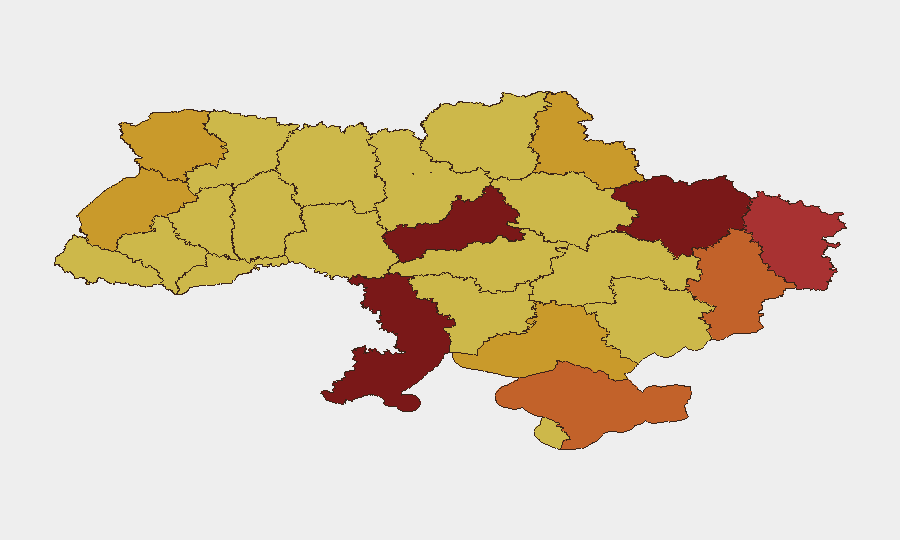
Kyiv and Cherkasy Oblast dominate the risk ranking (100 and 87.7 respectively), reflecting the capital's status as a political, administrative, and logistics hub and Cherkasy's proximity to active operations and critical infrastructure. Odesa, Kharkiv, and Luhansk oblasts (83.6–79.4) face acute risk from sustained conventional strikes on ports, supply terminals, and residential zones; Odesa's maritime exposure adds supply-chain vulnerability. Frontline and near-frontline regions (Donetsk, Kherson, Sumy, Volyn) and Crimea remain elevated; western oblasts (Lviv, Zakarpattia) show lower but non-negligible risk from occasional strikes and cyber activity. Risk concentration in the east and south reflects the active ground-war geography and Russian targeting priorities.
How GeoBit Would Assist
Security teams would deploy AOI Monitoring & Early Warning on critical facilities (logistics terminals, ports, power infrastructure) in Kyiv, Kharkiv, and Odesa to detect strike patterns and provide alerting on incoming threats. Battle Mapping, force-structure tracking, and weapons-capability analysis enable real-time understanding of Russian targeting doctrine and ground-force positioning. Routing & Network Analysis supports safe alternative movement and supply routing for personnel and assets; Maritime & Aviation tracking monitors vessel and air-threat movement near Odesa and other ports.
7-Day Outlook
Russian air and missile operations are expected to maintain or intensify frequency and geographic spread. Kyiv, Kharkiv, and Odesa will remain primary targets; logistics infrastructure across central and eastern Ukraine faces sustained pressure. No diplomatic or military developments suggest imminent de-escalation; personnel and asset protection measures should remain at elevated readiness.
Highest-Risk Areas — Ranked
| # | State / Region | Risk |
|---|---|---|
| 1 | Kyiv | 100 |
| 2 | Cherkasy Oblast | 87.7 |
| 3 | Odesa Oblast | 83.6 |
| 4 | Kharkiv Oblast | 82.6 |
| 5 | Luhansk Oblast | 79.4 |
| 6 | Autonomous Republic of Crimea | 73.4 |
| 7 | Donetsk Oblast | 73.2 |
| 8 | Sumy Oblast | 72.7 |
| 9 | Kherson Oblast | 71.5 |
| 10 | Lviv Oblast | 71.4 |
| 11 | Volyn Oblast | 71.3 |
| 12 | Zakarpattia Oblast | 70.7 |
Sources
Previous Daily Briefs
A new Ukraine brief is written every day — each with its own risk map and downloadable CSV. Here's the last week; use the calendar to go further back.
📅 Browse every day by calendar →
Highlighted days have a brief. Tap a day for that day's map & analysis, or “csv” for that day's dataset ($5).
Atlas — our AI intelligence desk — emails them this snapshot personally. Nothing else, no list.