Situation Summary
Uruguay remains one of the Western Hemisphere's most stable countries and ranks globally at #148 on composite threat measures. No acute security, civil-unrest, or infrastructure incidents were confirmed in the last 24–48 hours across national open-source and regional intelligence channels. Structural organized-crime and trafficking risks persist in Montevideo and border departments, but do not currently translate to active operational threats to corporate personnel or assets.
Key Developments
No specific security incidents meeting the 24–48 hour criterion were identified in current monitoring. Uruguay's diplomatic calendar shows routine statements on regional relations (Venezuela, Brazil, Holy See) and one business-sector statement on 14 July, but these represent policy positions rather than security events affecting ground conditions.
Note: The most recent organized-crime incident on GeoBit watch—a gang-related quintuple homicide in El Monarca, Montevideo on 10 July 2026—falls outside the 48-hour window and is flagged here for situational awareness only, not as an acute development.
Highest-Risk Areas
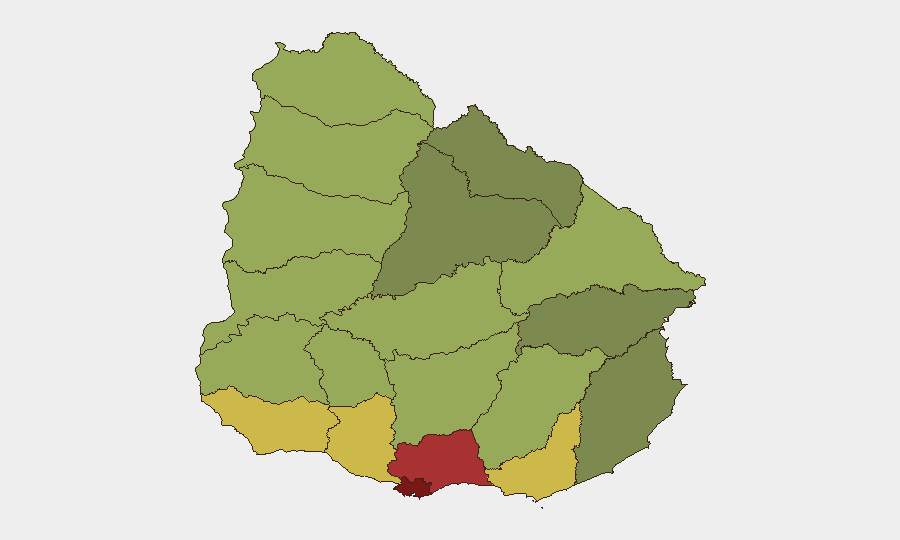
Montevideo (risk 92) and Canelones (risk 78) drive national risk scores, reflecting persistent gang-based drug-trafficking, organized extortion, and localized violence concentrated in northeastern and suburban outskirts (El Monarca, Cerro, Casavalle zones). Maldonado (risk 68), a border and tourism hub, and the departments along the Brazil frontier (San José, Colonia, Soriano, Río Negro) carry elevated structural risk linked to narcotics transit and organized-crime networks. Montevideo's commercial and diplomatic core remains secure; risk concentrates in peripheral residential and industrial areas not typically frequented by international corporate personnel.
How GeoBit Would Assist
A security team with staff or assets in Montevideo should deploy AOI Monitoring & Early Warning on high-risk peripheral departments (El Monarca, Cerro, Casavalle) to flag organized-crime incidents, roadblocks, or gang activity before they affect transport or supply chains. Intel Sweep and multi-language OSINT fusion—particularly monitoring Spanish-language gang communications, local news, and Telegram/X networks—provide 24–48 hour lead time on localized violence or trafficking operations. Routing & Network Analysis supports contingency planning and real-time journey optimization away from active incident zones in Montevideo and border regions.
7-Day Outlook
No escalation in organized-crime activity or civil unrest is anticipated in the near term. Diplomatic statements are expected to remain routine. The structural crime environment in Montevideo's periphery and border zones will persist at current levels, with sporadic gang-related incidents likely but not systemic. Corporate operations in central Montevideo and other major cities should remain operationally unaffected.
GEOBIT THREAT RANKING: #148 globally | Composite Score: 5 | Tracked Events: 8
Highest Sub-National Risk: Montevideo (92) | Briefing Date: 2026-07-16
Highest-Risk Areas — Ranked
| # | State / Region | Risk |
|---|---|---|
| 1 | Montevideo | 92 |
| 2 | Canelones | 78 |
| 3 | Maldonado | 68 |
| 4 | San José | 64 |
| 5 | Colonia | 62 |
| 6 | Soriano | 58 |
| 7 | Río Negro | 56 |
| 8 | Salto | 54 |
| 9 | Artigas | 52 |
| 10 | Paysandú | 50 |
| 11 | Florida | 48 |
| 12 | Flores | 46 |
Sources
Previous Daily Briefs
A new Uruguay brief is written every day — each with its own risk map and downloadable CSV. Here's the last week; use the calendar to go further back.
📅 Browse every day by calendar →
Highlighted days have a brief. Tap a day for that day's map & analysis, or “csv” for that day's dataset ($5).
Atlas — our AI intelligence desk — emails them this snapshot personally. Nothing else, no list.