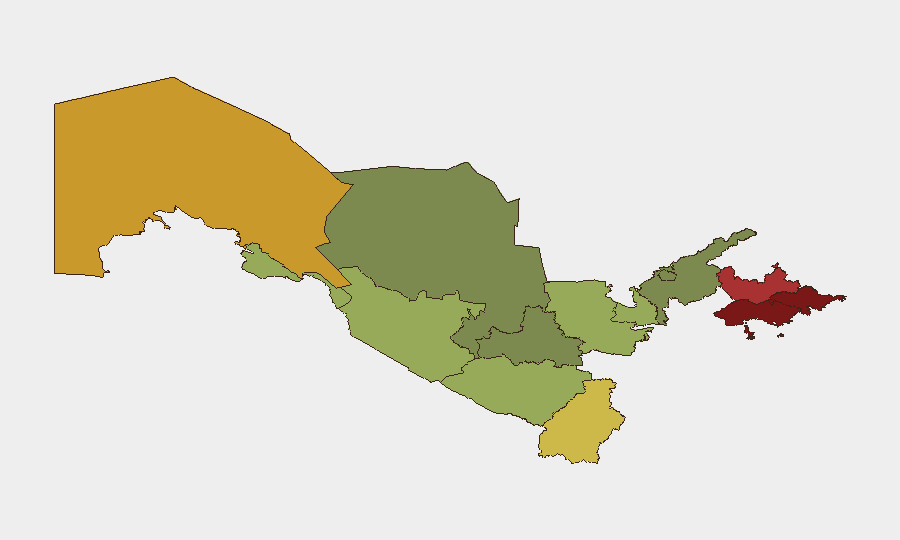
Situation Summary
Uzbekistan remains a low-threat operating environment globally (composite rank #150) with minimal tracked security incidents over the reporting week. However, significant regional variance exists: the Fergana Valley states (Andijan, Fergana, Namangan) carry considerably elevated risk profiles, driven by historical militant activity, cross-border smuggling networks, and proximity to conflict zones in Afghanistan and Tajikistan. Recent government action has focused on cryptocurrency regulation, customs modernization, and organized-crime enforcement rather than response to acute security crises.
Key Developments
- Uzbekistan (Sep 28–Oct 1): Anti-money-laundering and counter-terrorist-financing rules for cryptocurrency service providers took effect, with mandatory customer verification and suspicious-transaction reporting procedures. This reflects intensified financial-sector compliance and potential concern over illicit fund flows through digital channels.
- Tashkent (Oct 1): Online customs declaration system launched, streamlining traveler and cargo clearance at border posts and airports.
- Bukhara historic center (Oct 1): Restrictions on electric scooters, motorcycles, rickshaws, and similar vehicles entered force—a public-safety and urban-order measure with no security-incident trigger reported.
- Uzbekistan (Oct 3): Senate passed tougher penalties for organized crime, organized hooliganism, illegal combat-sports operations, and large-scale property destruction. Supporting data cited 2,515 crimes involving 789 individuals across 292 organized groups during the first eight months of 2026, indicating ongoing legislative focus on gang-related and inter-group violence rather than a new crisis event.
- Uzbekistan (Oct 1): Multi-nation special-forces exercise ("Eternal Brotherhood-5") involving Pakistani and other foreign troops conducted domestically—part of routine regional military cooperation.
- Azerbaijan/Uzbekistan region (Oct 3): Over 3,500 personnel from Azerbaijan, Türkiye, and Uzbekistan participated in the "Power of Unity-2026" military exercise in Azerbaijan's Karabakh region, reflecting regional defense integration.
- Austria Foreign Ministry advisory (Oct 3): Maintained Level 2 warning for Uzbekistan, citing petty crime, nighttime travel hazards, possible demonstrations, poor road conditions, and heightened risks near Afghanistan, Tajikistan, and Kyrgyzstan borders.
- Border security (Sep 22 & 24): Customs and security services interdicted 13.08 kg of hashish oil at Tashkent International Airport (Sep 22) and approximately 600 kg of narcotics at Termez border crossing (Sep 24), indicating sustained drug-trafficking pressure from the south.
Highest-Risk Areas
Andijan (88), Fergana (82), and Namangan (78) regions dominate the threat landscape and are substantially riskier than the national average. These three Fergana Valley enclaves share histories of militant recruitment, ISIS-K sympathizer networks, and entrenched drug-trafficking corridors. Cross-border tensions with Tajikistan and proximity to Afghanistan compound exposure. Risk scores decline sharply moving westward and southward; Samarqand (35) and Navoiy (38) pose minimal concern for most corporate operations. Organizations with personnel or assets in the Fergana Valley should maintain heightened situational awareness and restrict travel to high-risk districts.
How GeoBit Would Assist
Security teams should deploy AOI Monitoring & Early Warning capabilities on Andijan, Fergana, and Namangan regions to detect shifts in militant activity, smuggling patterns, or cross-border incidents in near-real time. Intel Sweep and multi-language OSINT (including Telegram monitoring) can track organized-crime and drug-trafficking developments, complemented by Network & Actor Analysis to map trafficking syndicates and their supply chains. Routing & Network Analysis helps identify secure travel corridors and border-crossing alternatives for personnel and cargo movements.
7-Day Outlook
No acute security deterioration is anticipated over the next week. Organized-crime legislative measures and cryptocurrency compliance tightening suggest authorities are managing chronic challenges (trafficking, corruption) rather than responding to escalating crises. Border drug interceptions remain routine. Continued monitoring of the Fergana Valley for any uptick in militant signaling or cross-border skirmishes with Tajikistan is warranted.
Highest-Risk Areas — Ranked
| # | State / Region | Risk |
|---|---|---|
| 1 | Andijan Region | 88 |
| 2 | Fergana Region | 82 |
| 3 | Namangan Region | 78 |
| 4 | Republic of Karakalpakstan | 72 |
| 5 | Surxondaryo Region | 65 |
| 6 | Qashqadaryo Region | 58 |
| 7 | Sirdaryo Region | 55 |
| 8 | Jizzakh Region | 48 |
| 9 | Xorazm Region | 45 |
| 10 | Bukhara Region | 42 |
| 11 | Navoiy Region | 38 |
| 12 | Samarqand Region | 35 |
Sources
Previous Weekly Briefs
A new Uzbekistan brief is written every Monday, covering the week — each with its own risk map and downloadable CSV. Use the calendar to go further back.
- September 28, 2026
- September 21, 2026
- September 14, 2026
- September 7, 2026
- September 3, 2026
- September 2, 2026
- September 1, 2026
📅 Browse past briefs by calendar →
Highlighted days have a brief. Tap a day for that day's map & analysis, or “csv” for that day's dataset ($5).
Atlas — our AI intelligence desk — emails them this snapshot personally. Nothing else, no list.