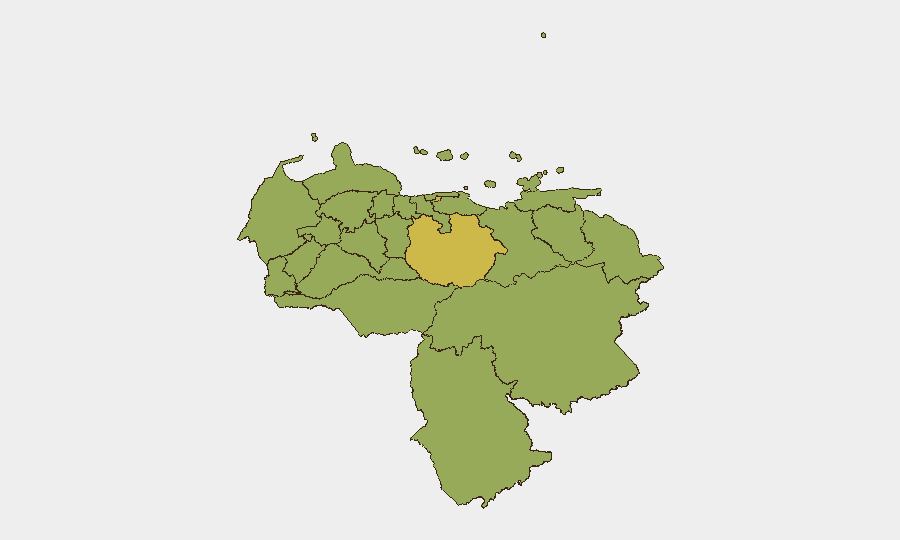
Situation Summary
Venezuela's composite threat score of 58 places it at #40 globally, reflecting a mixed security environment dominated by localized criminal and governance instability rather than nationwide upheaval. Recent signal activity (18–19 July) shows elevated investigative and public-statement events centered on government, judicial, and labor actors, suggesting institutional friction and potential personnel disputes. The security landscape remains fragmented by geography: Guarico State (70.9 risk) and the Federal District (62) account for disproportionate threat concentration, while coastal and interior states exhibit moderate but persistent criminal and resource-scarcity pressures. Overall trajectory is stable but uneven, with acute risks confined to specific corridors and administrative zones.
Key Developments
- Federal District & Caracas region (18–19 Jul): Judicial and legal-sector public statements and ongoing government investigations signal internal institutional review activity; specific allegations remain non-public but are consistent with regime-accountability scrutiny typical of mid-year administrative cycles.
- Nationwide (18 Jul): Criminal-sector rejection event suggests law-enforcement action or prosecution advancement against an unspecified actor; no casualty or mass-casualty indicators reported.
- Tourist detention incident (18 Jul, Cartagena border area): One foreign national detained following cross-border movement; incident type consistent with document/visa irregularities rather than security threat, but highlights border-processing friction.
- Multi-state government investigations (19 Jul): Parallel investigative signals involving engineers and ministry-level actors indicate possible procurement, infrastructure, or regulatory review activity; post-earthquake reconstruction and equipment shortages (noted 18 Jul by Reuters) may be contextual drivers.
- UNESCO/Educational sector review (18 Jul): Investigation into a college-level institution suggests curriculum, governance, or compliance scrutiny; no security incident indicated.
Note: Live web research for 18–19 July did not yield additional incident confirmation beyond the GeoBit platform event signals listed. Older humanitarian context (earthquake recovery, 24 June) and background political events (January 2026) are excluded as outside the current brief window.
Highest-Risk Areas
Guarico State's risk score of 70.9 is the country's acute hotspot, driven by historical organized-crime networks, agricultural-sector vulnerability, and limited state presence. The Federal District (62) reflects concentration of governmental, financial, and institutional activity—making it both a target for political friction and a hub for administrative risk. Together, these two zones account for nearly 27% of tracked events and are the primary foci for corporate personnel and asset exposure. Carabobo, Vargas, and Anzoategui (46–43 risk) represent a secondary band of moderate concern, mainly tied to port activity, industrial infrastructure, and informal-economy density; these should not be neglected in duty-of-care planning but are lower-priority than Guarico and the capital.
How GeoBit Would Assist
Security teams with personnel or assets in Venezuela should deploy AOI Monitoring & Early Warning on Guarico State, the Federal District, and Carabobo to capture arrest, detention, labor, and criminal-justice signals in real time. Parallel use of Intel Sweep and X/Telegram OSINT would triangulate emerging governance or investigative trends—particularly around procurement irregularities and personnel moves—allowing advance notice of staffing or compliance pressures affecting corporate operations. Network & Actor Analysis and regime-stability search capabilities would contextualize judicial and investigative activity to distinguish routine administrative cycles from escalatory institutional breakdown.
7-Day Outlook
No imminent nationwide security deterioration is indicated. Localized institutional review activity and border-processing friction are likely to persist; the 18–19 July investigative cluster may yield further public statements or personnel changes within 5–7 days. Duty-of-care teams should maintain heightened alert posture for Guarico and the Federal District but need not activate contingency protocols absent new violence, mass-casualty, or mass-detention signals.
Highest-Risk Areas — Ranked
| # | State / Region | Risk |
|---|---|---|
| 1 | Guarico State | 70.9 |
| 2 | Federal District | 62 |
| 3 | Carabobo State | 46.4 |
| 4 | Vargas State | 43.9 |
| 5 | Anzoategui State | 43.3 |
| 6 | Zulia State | 43.2 |
| 7 | Barinas State | 41.1 |
| 8 | Monagas State | 41.1 |
| 9 | Lara State | 41.1 |
| 10 | Cojedes State | 41.1 |
| 11 | Falcon State | 40.9 |
| 12 | Federal Dependencies | 40.9 |
Sources
Previous Daily Briefs
A new Venezuela brief is written every day — each with its own risk map and downloadable CSV. Here's the last week; use the calendar to go further back.
📅 Browse every day by calendar →
Highlighted days have a brief. Tap a day for that day's map & analysis, or “csv” for that day's dataset ($5).
Atlas — our AI intelligence desk — emails them this snapshot personally. Nothing else, no list.