Situation Summary
Burkina Faso remains ranked #18 globally for composite threat risk (score 71), driven primarily by sustained insurgency activity and extremist operations by JNIM and ISGS across multiple regions. The security environment is characterized by a *persistently high but relatively quiet* 48-hour window on kinetic incidents—no independently verified attacks or major clashes have been confirmed in the last 24–48 hours—yet the underlying threat level remains acute due to active terrorist cells, checkpoint restrictions, and curfews affecting civilian mobility. Parallel to the insurgency, the military junta has intensified internal control measures, including passport confiscation of government members and a crackdown on civil society, elevating political-instability and governance risk. Overall trajectory: high structural threat with near-term incident risk balanced against no imminent escalation signal in the immediate reporting window.
Key Developments
- Burkina Faso (nationwide) – 2026-07-29 · Public statement incident flagged between police and INTERPOL; specific details remain limited in open reporting but signal ongoing coordination friction or policy divergence on law-enforcement cooperation.
- Burkina Faso (nationwide) – 2026-07-29 · Arrest/detain event recorded (state vs. state); no additional detail yet available; consistent with ongoing internal security operations.
- Burkina Faso (nationwide) – 2026-07-27 · Business-sector disapproval noted; likely related to either regulatory tightening, operational restrictions, or junta-imposed controls on commerce or mobility.
- Burkina Faso (nationwide) – 22–23 July 2026 · No new verified kinetic attacks or major incidents during the preceding 48-hour window; however, curfews, checkpoints, and movement restrictions persist across multiple regions, continuing to disrupt civilian and commercial activity.
- Ghana–Burkina Faso border areas – 19–20 July 2026 · Heightened military and diplomatic tension at frontier crossings reported; increased checkpoint controls and delays for cross-border mobility and logistics, operationally relevant for supply chains and personnel transit.
- Burkina Faso (national) – late July 2026 · Junta intensifying internal control measures, including passport confiscation of government members, framed as consolidation effort amid persistent insecurity; contributes to governance instability and political-risk profile.
- Burkina Faso (national) – late July 2026 · Country added to international human-rights watchlist due to crackdown on civil society and political rivals; increased constraints on civil liberties and potential for unrest dynamics unrelated to active insurgency.
Highest-Risk Areas
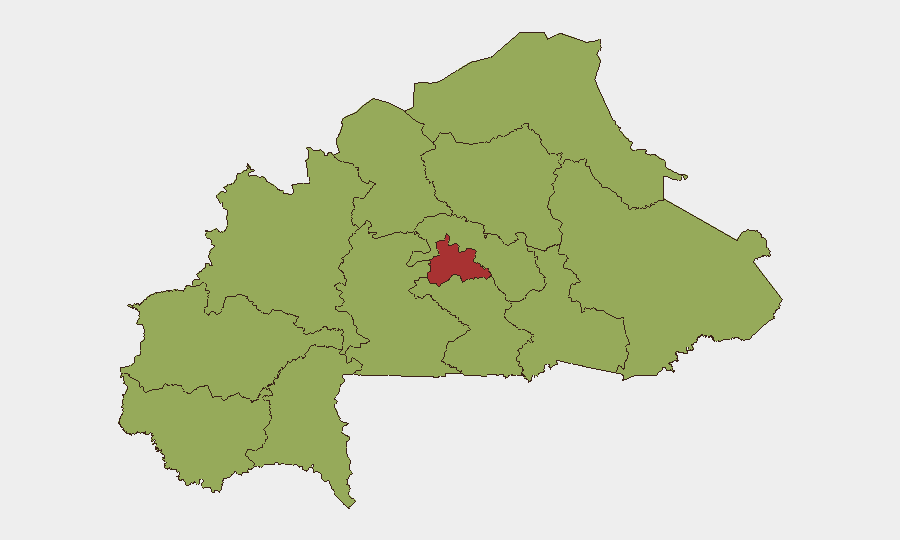
Centre region (risk 79.6) dominates the sub-national ranking and is the primary driver of Burkina Faso's overall threat score. The remaining 11 tracked regions cluster at risk score 49.6, indicating a *nationwide* distribution of threat rather than isolated pockets. This flat tier structure reflects the diffuse and multi-directional nature of the insurgency—JNIM and ISGS operate across the Sahel, Upper-Basins, and eastern regions; terrorist mobility, kidnapping networks, and recruitment pressure span from North to Southwest. For operational planning, assume no "safe zone" outside Ouagadougou and Bobo‑Dioulasso, and even those two cities carry non-negligible attack and kidnapping risk.
How GeoBit Would Assist
Security teams should employ AOI Monitoring & Early Warning to establish persistent surveillance of Centre region and known insurgent corridor areas, with threshold-based alerting on movement patterns, checkpoint activity, and force deployments. OSINT fusion (Intel Sweep, X/Twitter & Telegram OSINT, multi-language search, entity extraction) provides real-time signal on police-INTERPOL friction, business-sector impacts, and junta control measures affecting personnel and asset access. Battle mapping and force-structure tracking combined with routing & network analysis enable alternative journey planning for cross-border and inter-city movements, factoring live checkpoint pressure and curfew timing.
7-Day Outlook
No imminent escalation is signaled in the 48-hour reporting window, but the high baseline threat and recent junta tightening suggest continued friction on movement, commerce, and civil liberties over the next week. Border-area delays and checkpoint unpredictability should be factored into logistics and personnel scheduling; sudden policy changes or internal security operations could cascade into new restrictions with 12–24 hours' notice. Monitoring of police-INTERPOL coordination and arrest patterns will help identify whether internal instability is accelerating.
Highest-Risk Areas — Ranked
| # | State / Region | Risk |
|---|---|---|
| 1 | Centre | 79.6 |
| 2 | Upper-Basins | 49.6 |
| 3 | Boucle du Mouhoun | 49.6 |
| 4 | Central-West | 49.6 |
| 5 | Central-South | 49.6 |
| 6 | Central-East | 49.6 |
| 7 | Waterfalls | 49.6 |
| 8 | Southwest | 49.6 |
| 9 | Sahel | 49.6 |
| 10 | Central-North | 49.6 |
| 11 | East | 49.6 |
| 12 | North | 49.6 |
Sources
Previous Daily Briefs
A new Burkina Faso brief is written every day — each with its own risk map and downloadable CSV. Here's the last week; use the calendar to go further back.
📅 Browse every day by calendar →
Highlighted days have a brief. Tap a day for that day's map & analysis, or “csv” for that day's dataset ($5).
Atlas — our AI intelligence desk — emails them this snapshot personally. Nothing else, no list.