Situation Summary
China's security environment remains stable at the macro level (rank #18 globally, composite threat score 75), with no confirmed large-scale violent incidents, infrastructure failures, or mass protests in mainland China over the last 24–48 hours. However, recent activity signals elevated political-military instability within the PLA leadership, intensified maritime enforcement operations near Taiwan, and sustained diplomatic friction with Western governments over regional security. The trajectory reflects tightening internal control mechanisms and assertive posturing in contested waters rather than acute internal breakdown.
Key Developments
- Beijing, 3 July 2026 – Xi Jinping presided over promotions of senior PLA officers (including General Zhang Shuguang and Air Force Commander Wang Gang) as part of an ongoing anti-corruption purge that has reduced the Central Military Commission to two functional members, indicating continued elite instability and internal security tightening within the armed forces.
- Waters east of Taiwan, 3–4 July 2026 – Chinese authorities announced expanded Coast Guard patrol operations in waters east of Taiwan, framed as "special maritime traffic law-enforcement operations," heightening enforcement risk against foreign commercial vessels in those zones.
- Maritime zone east of Taiwan, through June (reported 3 July 2026) – Chinese Coast Guard reported 198 vessel inspections in June with three ships "rectified" for alleged violations; UK, France, Germany, US, and Australia have formally raised concerns that these operations are intimidating commercial shipping and compromising freedom of navigation.
- Canberra–Beijing diplomatic channel, 1–4 July 2026 – Chinese diplomats sharply rejected Australian intelligence assessments and Pacific security initiatives, accusing Canberra of "stoking paranoia," while Australia raised security concerns with Beijing over intensified Coast Guard operations east of Taiwan, reflecting elevated geopolitical tensions.
- Hong Kong, 4 July 2026 – PLA Navy visiting fleet conducted its first public open-house in Hong Kong, allowing civilian tours of warships and underscoring visible militarization of the city and readiness of naval assets for potential regional contingencies.
Highest-Risk Areas
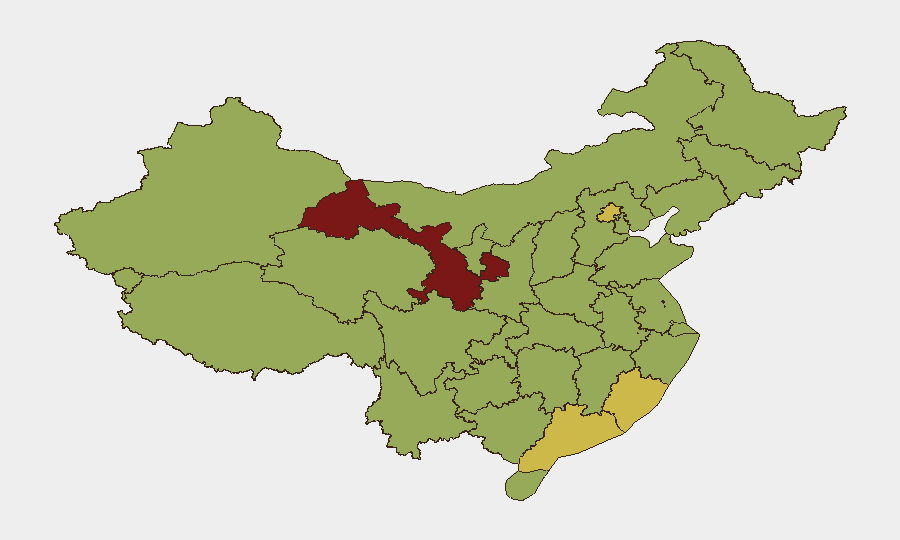
Gansu (82.7) ranks significantly above other regions and likely reflects border security, separatist activity monitoring, or resource-competition risk in China's northwest. Beijing (70.4) and Guangdong (69.9) drive risk through political-military concentration and proximity to Taiwan and strategic maritime zones, respectively. Fujian (60.8), facing Taiwan directly, carries elevated maritime enforcement and cross-strait incident risk. Eastern coastal and major metropolitan regions (Shanghai, Hubei, Jiangsu, Zhejiang) maintain moderate-to-elevated composite scores, partly driven by economic concentration and transit hub status but also by intensified security monitoring and political control.
How GeoBit Would Assist
Security teams operating in China should employ Intel Sweep and multi-language OSINT feeds to track PLA leadership changes, elite factional movements, and internal security directives in real time. Maritime & Aviation tracking combined with AOI Monitoring & Early Warning would provide persistent visibility of Coast Guard operations east of Taiwan and detect changes in enforcement intensity or vessel-interdiction patterns affecting supply chains. Routing & Network Analysis can identify alternative maritime corridors and logistics pathways to mitigate shipping disruption in contested waters.
7-Day Outlook
Expect continued high-level diplomatic messaging and symbolic military posturing (exercises, fleet deployments, promotions) rather than kinetic escalation. Maritime enforcement operations east of Taiwan are likely to persist as a normalized enforcement regime, creating sustained but not acute risk to commercial shipping. Internal PLA reorganization will likely continue to generate leadership signals and policy shifts affecting foreign-engagement protocols and regional military readiness.
Highest-Risk Areas — Ranked
| # | State / Region | Risk |
|---|---|---|
| 1 | Gansu | 82.7 |
| 2 | Beijing | 70.4 |
| 3 | Guangdong Province | 69.9 |
| 4 | Fujian | 60.8 |
| 5 | Shanghai | 58.1 |
| 6 | Hubei | 57.8 |
| 7 | Jiangsu | 56.6 |
| 8 | Zhejiang | 55.2 |
| 9 | Liaoning | 55 |
| 10 | Jiangxi | 54.7 |
| 11 | Sichuan | 54.5 |
| 12 | Jilin | 54 |
Sources
Previous Daily Briefs
A new China brief is written every day — each with its own risk map and downloadable CSV. Here's the last week; use the calendar to go further back.
📅 Browse every day by calendar →
Highlighted days have a brief. Tap a day for that day's map & analysis, or “csv” for that day's dataset ($5).
Atlas — our AI intelligence desk — emails them this snapshot personally. Nothing else, no list.