Situation Summary
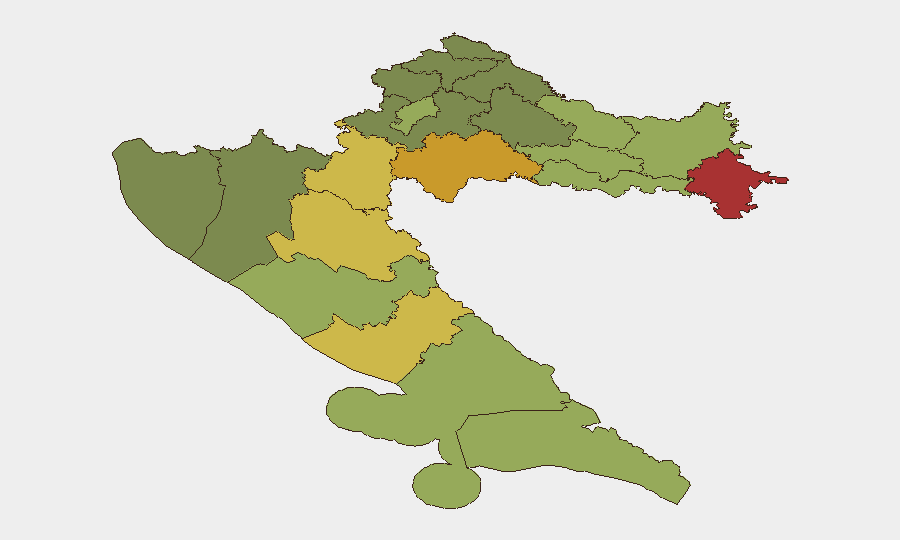
Croatia remains a low-threat environment globally (composite threat score 4), but localized crime, environmental hazards, and ongoing anti-corruption enforcement activity present operational risks for corporate teams in specific regions. Recent incidents span violent crime (fatal police shooting in Krapina), urban fire (Split), environmental contamination (hydrogen sulfide near Rijeka), and traffic accidents, indicating a dispersed pattern rather than systemic instability. The northeastern and central regions (Vukovar-Srijem, Sisak-Moslavina, Karlovac counties) carry substantially elevated sub-national risk scores, driven by post-conflict legacy factors and organized-crime activity. Overall trajectory remains stable with no indicators of civil unrest or terrorism.
Key Developments
- Krapina – fatal police shooting in shopping centre café (4 August, morning). A police officer was killed in a targeted shooting inside a café; state prosecutors have taken the case. Localized security concern; motive under investigation.
- Split – fire in abandoned Radunica building (4 August, evening). 13 firefighters contained a blaze in a derelict structure within one hour; no injuries. Illustrates hazard from unsecured urban infrastructure.
- Split-Dalmatia & Dubrovnik-Neretva counties – anti-corruption raids ongoing (4 August). PNUSKOK (Special Department for Suppression of Corruption & Organised Crime) executed arrests and searches at multiple locations; Split's mayor postponed public events. Suggests heightened law-enforcement activity and potential administrative disruption in the region.
- Kukuljanovo (Rijeka area) – hazardous hydrogen sulfide detected in sewer system (4–5 August). Public health institute confirmed dangerous concentrations near Orada Adriatic industrial plant following citizen reports; police inquiry opened. Environmental and occupational health risk for facility workers and nearby residents.
- Krapina-Zagorje County – mixed crime and safety incidents (past 24 hours, bulletin 4 August). Two road-traffic accidents, four criminal offences (including thefts), and one fire-safety violation (unsafe waste burning in Poljanica Bistrička) recorded in routine police bulletin. Indicates elevated local crime profile.
- Dubrovnik – traffic accident on Lapadska obala (4 August, morning). Electric motorcycle and multiple cars involved; on-scene investigation ongoing. Road-safety disruption and possible congestion in the area.
- Split – minor-on-adult assault on Zajčeva Street (within 24 hours before 4 August). 31-year-old assaulted by minor; video footage circulated on social media. Street-level violent crime with social amplification.
- Adriatic coastal areas – maritime compliance operation "Sigurna plovidba 2026" (early August). 382 vessel inspections conducted, 182 offences identified, €79,000+ in fines issued. Indicates heightened enforcement; charter operators and boaters face increased checks and penalties.
Highest-Risk Areas
Vukovar-Srijem, Sisak-Moslavina, and Karlovac counties drive the sub-national risk profile, with composite scores of 78, 72, and 68 respectively. These northeastern and central regions carry elevated organized-crime and corruption indicators linked to post-conflict legacy factors and transnational smuggling networks. Lika-Senj and Šibenik-Knin counties (scores 65, 62) show similar patterns. By contrast, Zagreb and major coastal centers (Split, Split-Dalmatia) score lower (50, 48), though recent violent crime and corruption investigations in Split and Dubrovnik warrant continued monitoring. Teams with personnel or assets in the top four counties should maintain heightened situational awareness.
How GeoBit Would Assist
OSINT & Intel Sweep capabilities would monitor Croatian police bulletins, media, and Telegram/X channels for emerging crime and corruption activity in real time. AOI Monitoring & Early Warning on Vukovar-Srijem, Sisak-Moslavina, and Karlovac counties would provide persistent alerts on organized-crime indicators and checkpoint activity. Environmental & Health search and satellite imagery analysis would track industrial hazard zones (e.g., Kukuljanovo hydrogen sulfide, Split waste infrastructure) and assess worker exposure risks.
7-Day Outlook
No large-scale security deterioration is forecast. Anti-corruption enforcement activity will likely continue in coastal regions; teams should expect possible short-term disruptions near search/arrest sites. Routine crime (theft, minor assault, traffic incidents) will persist at current baseline levels. Environmental monitoring of industrial zones (Rijeka area) and maritime compliance checks remain active; boaters and logistics operators should anticipate continued inspections.
Highest-Risk Areas — Ranked
| # | State / Region | Risk |
|---|---|---|
| 1 | Vukovar-Srijem County | 78 |
| 2 | Sisak-Moslavina County | 72 |
| 3 | Karlovac County | 68 |
| 4 | Lika-Senj County | 65 |
| 5 | Šibenik-Knin County | 62 |
| 6 | Brod-Posavina County | 58 |
| 7 | Zadar County | 55 |
| 8 | Osijek-Baranja County | 52 |
| 9 | City of Zagreb | 50 |
| 10 | Split-Dalmatia County | 48 |
| 11 | Požega-Slavonia County | 45 |
| 12 | Virovitica-Podravina County | 42 |
Sources
Previous Daily Briefs
A new Croatia brief is written every day — each with its own risk map and downloadable CSV. Here's the last week; use the calendar to go further back.
📅 Browse every day by calendar →
Highlighted days have a brief. Tap a day for that day's map & analysis, or “csv” for that day's dataset ($5).
Atlas — our AI intelligence desk — emails them this snapshot personally. Nothing else, no list.