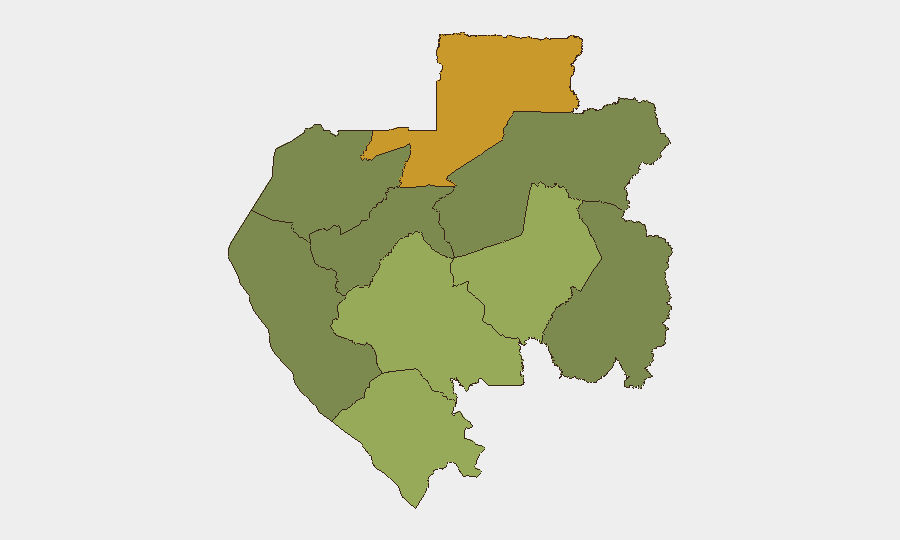
Situation Summary
Gabon remains a low-threat environment (global rank #63, composite score 32) with no tracked security events in the reporting week. The country's stability is underpinned by strong state capacity in Libreville and the Estuaire region, though northern and eastern provinces—particularly Woleu-Ntem and Ogooué-Lolo—show elevated risk profiles. Recent activity has centered on routine infrastructure and labor issues rather than security incidents or civil unrest.
Key Developments
- Libreville, October 2–3: Gasoil shortage triggered rationing and extended queues at multiple service stations, including outlets near Nzeng-Ayong interchange. The Ministry of Petroleum and Gas attributed the disruption to reduced distributor stocks and expected gradual normalization from October 4. Supply-chain delays may affect transport and logistics operations.
- Libreville, October 1: Agents awaiting government-funded positions (APB) suspended their pressure action following a meeting with the health minister. The suspension followed several days of presence outside the ministry; a tripartite commission will review the dispute in late October.
- Libreville, October 1: The African Infrastructure Salon opened as a scheduled sector event. No security implications identified.
No confirmed armed conflict, violent protest, major crime incident, border event, or travel disruption was reported in Gabon during September 29–October 5.
Highest-Risk Areas
Woleu-Ntem Province (risk score 72) and Ogooué-Lolo (58) drive the national risk profile and warrant heightened monitoring. Both are remote, forested regions with limited state presence, weaker law enforcement capacity, and historical exposure to cross-border movement and resource-extraction disputes. Ngounié (48) and Nyanga (42) provinces present moderate-to-secondary risk; together, these four provinces account for the majority of GeoBit's sub-national concern. By contrast, Estuaire Province (15)—which includes the capital and primary economic centers—remains the lowest-risk zone and reflects strong institutional control. Organizations with personnel or assets in the north and east should maintain heightened awareness despite the absence of recent active incidents.
How GeoBit Would Assist
Security teams should deploy AOI (Area-of-Interest) Monitoring & Early Warning on Woleu-Ntem and Ogooué-Lolo to detect emerging civil unrest, cross-border activity, or resource-related incidents before they escalate. OSINT Fusion & Corroboration across local news, radio SIGINT, and Telegram/X channels will provide real-time visibility into labor actions, transport disruptions, and commodity shortages (as exemplified by this week's fuel crisis) that may affect duty-of-care obligations or supply chains. Routing & Network Analysis should be applied to identify alternative transport corridors if northern or eastern provinces experience temporary instability or infrastructure failure.
7-Day Outlook
No significant escalation is anticipated in the near term. The resolution of the APB labor dispute and normalization of fuel supply should reduce friction in Libreville through mid-October. Monitoring of Woleu-Ntem and Ogooué-Lolo should remain routine but active, as these provinces have not generated reportable events in the past week and present no immediate trigger for elevated alert status.
Highest-Risk Areas — Ranked
| # | State / Region | Risk |
|---|---|---|
| 1 | Woleu-Ntem | 72 |
| 2 | Ogooué-Lolo Province | 58 |
| 3 | Ngounié Province | 48 |
| 4 | Nyanga Province | 42 |
| 5 | Haut-Ogooué Province | 35 |
| 6 | Moyen-Ogooué Province | 28 |
| 7 | Ogooué-Maritime Province | 25 |
| 8 | Estuaire Province | 15 |
| 9 | Ogooué-Ivindo | 0 |
Sources
Previous Weekly Briefs
A new Gabon brief is written every Monday, covering the week — each with its own risk map and downloadable CSV. Use the calendar to go further back.
- September 28, 2026
- September 21, 2026
- September 14, 2026
- September 7, 2026
- September 1, 2026
- August 30, 2026
- August 28, 2026
📅 Browse past briefs by calendar →
Highlighted days have a brief. Tap a day for that day's map & analysis, or “csv” for that day's dataset ($5).
Atlas — our AI intelligence desk — emails them this snapshot personally. Nothing else, no list.