Situation Summary
Georgia remains a moderate-risk environment (global rank #89, composite threat score 18) with civil unrest as the primary driver. Recent developments include ongoing pro-European protests in Tbilisi with police use of force, school security incidents in the U.S. state of Georgia, and infrastructure disruptions (flooding, gas-line damage, and railway fires on the Georgia-Azerbaijan corridor). No active armed conflict or mass-casualty events are reported, but political tensions, protest activity, and routine crime remain elevated in key urban and border-adjacent regions.
Key Developments
- Tbilisi, August 13–15 – Pro-European political protests continued with security force responses (tear gas and water cannons); multiple detentions reported following marches demanding release of political prisoners. This reflects ongoing civil unrest in the capital and sustained police engagement.
- Tbilisi metro stations (Rustaveli and Vaja-Pshavela), August 15 – Heavy rainfall caused street flooding and a damaged gas line on Chikovani Street, prompting local utility response. Infrastructure vulnerability to weather may affect commuter transit and service reliability.
- Shamkir Station (Georgia-Azerbaijan border region), August 12 and 14 – Georgia-Baku cargo train caught fire twice in four days with no immediate casualties reported; fire services responded both times. Disruptions to key transport corridor warrant monitoring for operational/supply-chain impacts.
- Gulguła village, August 13 – Local residents protested against a landfill approximately 3 km away, demanding closure and relocation due to odour and sanitary concerns. Environmental grievances and community unrest in rural areas remain a secondary civil-order issue.
- U.S. state of Georgia (Jackson and Hall County schools), August 15 – Automated AI-generated bomb threats prompted school evacuations and district-wide closures; no explosives located. While false-alarm, demonstrates emerging cyber-enabled threat vector affecting critical civilian infrastructure.
- Warner Robins High School (U.S. state of Georgia), August 12–13 – A ninth-grade student was shot in the leg by another student in a school bathroom; one student was arrested on felony charges. Reflects ongoing school security incidents and violent-crime risk in Georgia's education system.
Highest-Risk Areas
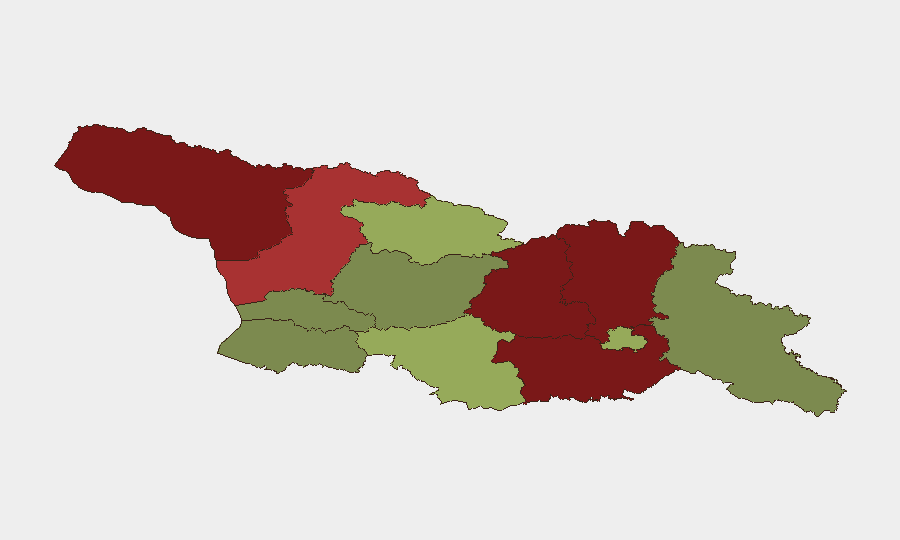
The Autonomous Republic of Abkhazia (risk 95) and the Shida Kartli region (risk 88) dominate sub-national threat rankings, driven by proximity to active disputes, border instability, and limited state presence. Lower Kartli (risk 85) and Mtskheta-Mtianeti (risk 82) follow, all reflecting concentration of conflict-legacy risk, disputed-territory dynamics, and weak governance in Georgia's occupied or contested zones. By contrast, Tbilisi (risk 45), while home to active protest movements and police engagement, ranks well below these northern and eastern regions, indicating that urban civil unrest carries lower composite risk than territorial and border-adjacent vulnerabilities. Organizations with operations or personnel in Abkhazia, South Ossetia-adjacent areas, or the buffer zones should prioritize conflict-monitoring and alternative-route planning.
How GeoBit Would Assist
Security teams should deploy AOI Monitoring & Early Warning on Tbilisi protest sites and border checkpoints to detect escalation or police responses in real time. Conflict & Military capability and battle mapping would track any movement or activity in disputed territories (Abkhazia, South Ossetia, Tskhinvali region). Routing & Network Analysis and alternative route/journey planning would mitigate risks from transport-corridor disruptions (e.g., rail fires, flooding) and civil unrest closures, ensuring safe and timely movement of personnel and cargo.
7-Day Outlook
Protest activity in Tbilisi is expected to remain daily and routine but subject to sporadic police response. Infrastructure disruptions (weather-related flooding, utility damage) may continue through the rainy season. Border-region security dynamics remain unpredictable; organizations should maintain heightened awareness of any escalation in disputed territories and reinforce contingency communications with remote teams.
Highest-Risk Areas — Ranked
| # | State / Region | Risk |
|---|---|---|
| 1 | Autonomous Republic of Abkhazia | 95 |
| 2 | Shida Kartli | 88 |
| 3 | Lower Kartli | 85 |
| 4 | Mtskheta-Mtianeti | 82 |
| 5 | Samegrelo-Upper Svaneti | 78 |
| 6 | Samtskhe-Javakheti | 48 |
| 7 | Tbilisi | 45 |
| 8 | Racha-Lechkhumi and Kvemo Svaneti | 42 |
| 9 | Kakheti | 38 |
| 10 | Autonomous Republic of Adjara | 35 |
| 11 | Imereti | 32 |
| 12 | Guria | 28 |
Sources
Previous Daily Briefs
A new Georgia brief is written every day — each with its own risk map and downloadable CSV. Here's the last week; use the calendar to go further back.
- August 16, 2026
- August 15, 2026
- August 14, 2026
- August 12, 2026
- August 11, 2026
- August 10, 2026
- August 9, 2026
📅 Browse every day by calendar →
Highlighted days have a brief. Tap a day for that day's map & analysis, or “csv” for that day's dataset ($5).
Atlas — our AI intelligence desk — emails them this snapshot personally. Nothing else, no list.