Situation Summary
Iraq remains the 15th-highest-threat country globally, driven primarily by ongoing insurgency activity and now compounded by a high-profile anti-corruption and counter-militia operation spanning Baghdad and the southern governorates. The past 24–48 hours have seen intensified security operations in the capital, including mass arrests of officials, cash seizures, and tightened Green Zone controls, alongside covert raids targeting Iran-aligned armed factions and smuggling networks. A drone alert near the U.S. Embassy has briefly elevated threat perception in central Baghdad. The national security posture remains volatile, with multiple concurrent operations creating checkpoints, travel delays, and elevated arrest risk for those in affected areas.
Key Developments
- Baghdad Green Zone – nocturnal raids and detention surge (ongoing, last 48 hours). Iraqi security forces under PM Ali al‑Zaidi have conducted multiple overnight raids on officials' homes and offices across Baghdad, recovering millions of dollars and quantities of gold. Detainee count has risen to approximately 70. Enhanced checkpoints and movement controls now in effect around state institutions and foreign missions, increasing friction risk.
- Eastern Baghdad and southern Iraq – Operation Dawn Strike (covert track, active through this week). Elite Army, Counter Terrorism Service, and Special Division units raided faction headquarters and residences of figures linked to Tehran and oil-smuggling networks. Operation described as at "halftime" with follow-on actions continuing, creating elevated friction risk with Iran-aligned militias.
- Baghdad International Airport and city access – tightened screening and deployment (continuing effects, 24–48 hours). Heightened controls and elite-force presence persist around the airport and main city entry/exit points, linked to counter-corruption operations. Travelers should expect increased screening and possible route delays.
- U.S. Embassy vicinity – drone alert and security escalation (last 24–48 hours). A drone alert triggered heightened security measures near the U.S. Embassy in the Green Zone. Social media claims of an "attack" circulated; authorities remain in assessment phase. Temporary elevation of threat level for diplomatic and foreign personnel in central Baghdad.
- Mass cash and asset seizures across Baghdad neighborhoods (continuing, last 1–2 days). Coordinated raids have resulted in confiscation of millions of dollars, gold, and large quantities of dinars from officials. Video documentation of seizures indicates ongoing activity. Risk of spontaneous protests by political factions or detainee supporters.
- National political signaling – Iraq reiterates neutrality stance (latest media cycle). President Nizar Amede stated Iraq will not serve as a staging ground for operations against Iran or Washington, and that "Gulf security is Iraq's security." Frames Iraq's exposure to regional spillover risks amid wider Gulf and Iran-related tensions.
Highest-Risk Areas
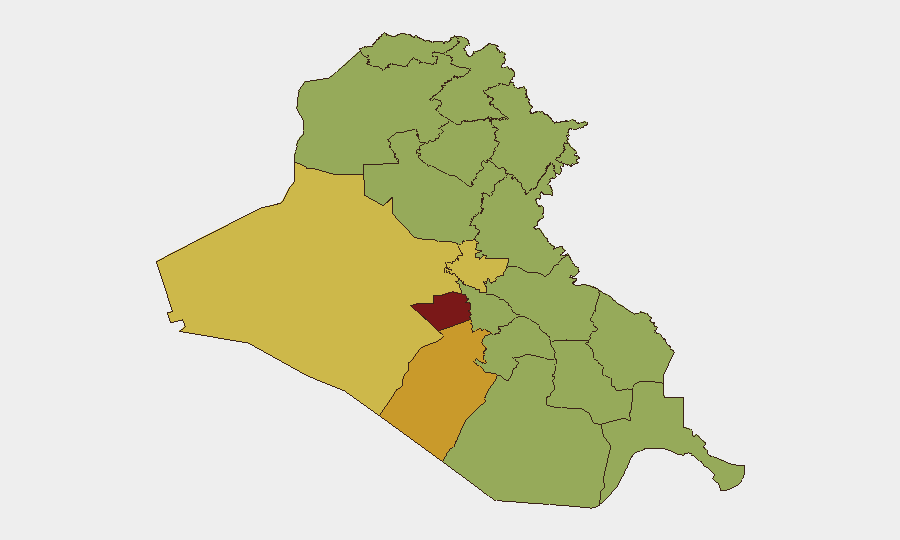
Karbala (88.5) dominates the sub-national ranking, followed by Al-Najaf (71.1), Al-Anbar (68.4), and Baghdad (68.4). The southern governorates—Al-Najaf, Wasit, Al-Qadisiyah, Dhi Qar, Al-Muthanna, Maysan, and Al-Basra—cluster at mid-range scores (58.5) and reflect both residual insurgency presence and Iran-aligned militia activity linked to smuggling networks now under active counter-operations. Baghdad's elevation is driven by the current anti-corruption crackdown and drone-alert incidents; Karbala's high score suggests sustained sectarian or militia tensions. Al-Anbar remains volatile due to historic insurgent strongholds.
How GeoBit Would Assist
Security teams should deploy AOI Monitoring & Early Warning on Baghdad's Green Zone, airport, and southern governorate focal points to track checkpoint patterns and detention activity in real time. Intel Sweep and OSINT fusion (X/Twitter, Telegram, local media) will track militia statements, protest signals, and official counter-operations announcements. Network & Actor Analysis can map Iran-aligned faction movements and arrest patterns to anticipate retaliation or localized unrest, while Routing & Network Analysis enables real-time alternative-route planning around closure zones.
7-Day Outlook
The anti-corruption operation is expected to continue at current intensity through the coming week, with ongoing raids, arrests, and asset seizures likely to persist in Baghdad and the south. Political factions may stage counter-protests or public statements, raising ambient civil-unrest risk. Drone activity around diplomatic compounds may recur, and travel delays at the airport and city access points should be anticipated.
Highest-Risk Areas — Ranked
| # | State / Region | Risk |
|---|---|---|
| 1 | Karbala | 88.5 |
| 2 | Al-Najaf Governorate | 71.1 |
| 3 | Al-Anbar Governorate | 68.4 |
| 4 | Baghdad Governorate | 68.4 |
| 5 | Babil Governorate | 58.5 |
| 6 | Wasit Governorate | 58.5 |
| 7 | Al-Qadisiyah Governorate | 58.5 |
| 8 | Dhi Qar Governorate | 58.5 |
| 9 | Al-Muthanna Governorate | 58.5 |
| 10 | Maysan Governorate | 58.5 |
| 11 | Al-Basra Governorate | 58.5 |
| 12 | Saladin Governorate | 58.5 |
Sources
Previous Daily Briefs
A new Iraq brief is written every day — each with its own risk map and downloadable CSV. Here's the last week; use the calendar to go further back.
📅 Browse every day by calendar →
Highlighted days have a brief. Tap a day for that day's map & analysis, or “csv” for that day's dataset ($5).
Atlas — our AI intelligence desk — emails them this snapshot personally. Nothing else, no list.