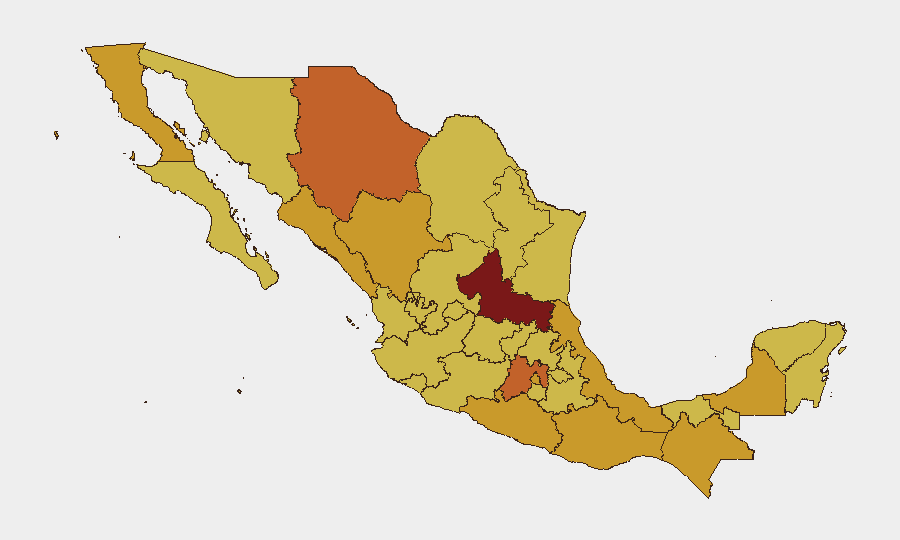
Situation Summary
Mexico remains at elevated composite threat level (#5 globally, score 100) with 536 tracked events, driven primarily by insurgency-related activity and armed group operations across multiple northern and central states. San Luis Potosí, Chihuahua, and the State of Mexico form a high-risk cluster with composite scores 73.9–100, reflecting persistent cartel violence, territorial disputes, and state capacity constraints. Mexico–US bilateral tensions have intensified following the July 8–10 death of Mexican national Lorenzo Salgado Araujo during a U.S. ICE operation in Houston, prompting Mexico's announcement of criminal and civil action; this friction adds diplomatic strain to an already volatile security environment. The country is simultaneously hosting large-scale World Cup operations (100,000+ security personnel deployed), which may create both operational pressure on law enforcement and localized security gaps.
Key Developments
- Mexico City / Multi-City (2026-07-12): Mexican authorities deployed approximately 100,000 security personnel across World Cup host cities and 7,500 police around Mexico City stadium; this represents a planned major security posture rather than response to an acute threat, but does concentrate resources and may reduce capacity for routine counter-cartel operations elsewhere.
- Houston–Mexico Border (2026-07-10): Mexico formally escalated response to the July 8 death of citizen Lorenzo Salgado Araujo in U.S. ICE custody, announcing intent to pursue criminal charges and civil action against U.S. authorities; this marks a rare formal diplomatic escalation and signals potential complications for cross-border law enforcement cooperation.
- National Level (2026-07-11): An assassination event was recorded within Mexico's territory; details on location and actors remain unclear from available signals, but assassination activity represents elevated organized crime or political violence severity.
- National Level (2026-07-11): Authorities launched a formal investigation into a business-related incident; specific sector and location not yet clarified, but business investigations often signal either narco-trafficking supply-chain disruption or extortion enforcement.
- National Level (2026-07-12): Conventional military force deployment was recorded, presumably in support of public security operations; specific deployment location and scale not yet confirmed.
- Political-Administrative (2026-07-11, 2026-07-10): Public statements by a mayor challenged community positions, and separate disapproval was issued by an Army spokesman; these suggest local governance friction or military–civilian coordination issues, possibly linked to security operations.
Highest-Risk Areas
San Luis Potosí (score 100) remains Mexico's single highest-risk sub-national zone, likely reflecting cartel consolidation and territorial competition. Chihuahua (73.9) and the State of Mexico (73.4) follow, with Veracruz, Sinaloa, Durango, and Chiapas clustered tightly between 72–72.8, indicating a broad northern and central corridor of sustained armed-group activity. This geographic pattern reflects known cartel operational zones and routes; Mexico City itself (71.1) registers elevated threat despite being capital, consistent with persistent organized crime presence, extortion networks, and occasional inter-cartel violence in peripheral zones.
How GeoBit Would Assist
Corporate security teams in Mexico would leverage AOI Monitoring & Early Warning to watch high-risk states (San Luis Potosí, Chihuahua, Veracruz) for escalation signals, combined with Intel Sweep and X/Twitter OSINT to detect emerging armed-group statements, cartel disputes, or checkpoint activity in real time. Network & Actor Analysis would map cartel and state-security relationships to forecast localized safe corridors and high-risk zones by municipality. Routing & Network Analysis would provide alternative travel and supply-chain routes avoiding conflict hotspots, especially relevant during the World Cup security surge when conventional routes may be congested or monitored.
7-Day Outlook
Threat levels will likely remain elevated through the World Cup event window, as security concentration in major cities may create temporary operational vacuums in peripheral zones exploited by armed groups. Mexico–U.S. diplomatic friction over the Salgado incident may persist and potentially complicate intelligence-sharing, affecting cross-border security effectiveness. Watch for any escalation of assassinations or territorial occupation events in the San Luis Potosí–Chihuahua corridor as indicators of cartel power-struggle intensification.
Highest-Risk Areas — Ranked
| # | State / Region | Risk |
|---|---|---|
| 1 | San Luis Potosí | 100 |
| 2 | Chihuahua | 73.9 |
| 3 | State of Mexico | 73.4 |
| 4 | Veracruz | 72.8 |
| 5 | Sinaloa | 72.4 |
| 6 | Durango | 72 |
| 7 | Chiapas | 71.4 |
| 8 | Baja California | 71.3 |
| 9 | Mexico City | 71.1 |
| 10 | Campeche | 71 |
| 11 | Guerrero | 71 |
| 12 | Oaxaca | 71 |
Sources
Previous Daily Briefs
A new Mexico brief is written every day — each with its own risk map and downloadable CSV. Here's the last week; use the calendar to go further back.
📅 Browse every day by calendar →
Highlighted days have a brief. Tap a day for that day's map & analysis, or “csv” for that day's dataset ($5).
Atlas — our AI intelligence desk — emails them this snapshot personally. Nothing else, no list.