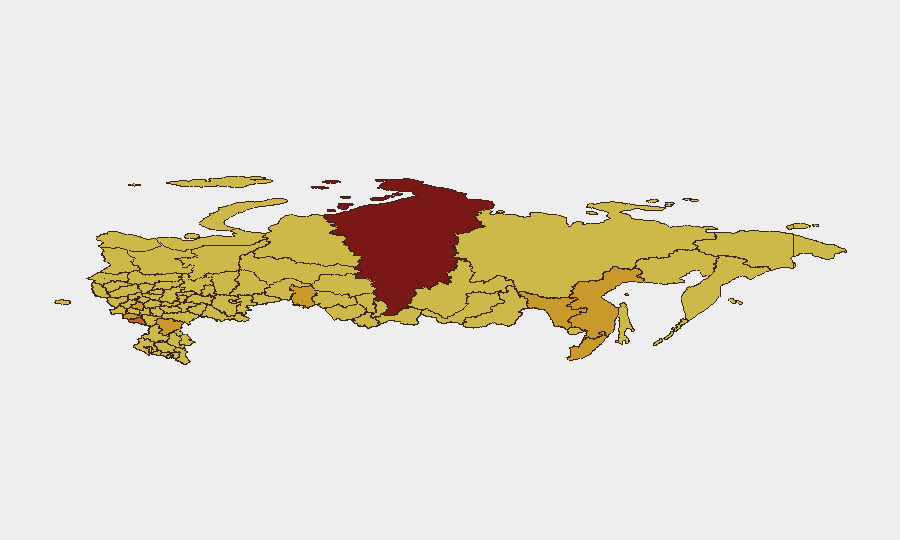
Situation Summary
Russia remains the third-highest global threat environment with 1,181 tracked events and a composite threat score of 100. The security posture is characterized by sustained military operations against Ukraine, elevated international tensions with Western powers, and domestic institutional friction. Moscow and Krasnoyarsk Krai drive overall risk, with Moscow at maximum composite threat level (100), indicating concentrated vulnerability across corporate, diplomatic, and critical-infrastructure sectors. The trajectory shows no de-escalation; threat activity is sustained and multidirectional.
Key Developments
- Kyiv and nationwide Ukraine (overnight, late June–early July 2026): Russia conducted one of the largest coordinated missile and drone campaigns of the war, deploying approximately 70 missiles (including 24 Iskander ballistic and ~50 cruise missiles) and nearly 500 attack drones across Ukraine. Kyiv sustained 21–27 confirmed fatalities and ~90–100 injured across 30+ locations; Kharkiv, Sumy, Dnipro, Zaporizhzhia, and Cherkasy regions also struck. Four hypersonic Zircon missiles were employed.
- Russian Ministry of Defense public statement (2026-07-02): Moscow officially framed the overnight strikes as retaliation for recent Ukrainian long-range drone attacks on Russian oil refineries and fuel infrastructure, signaling continuation of a tit-for-tat targeting cycle focused on energy and civilian infrastructure.
- UK–Russia diplomatic friction (2026-07-02): Britain issued public disapproval and a separate public statement regarding Russia, indicating ongoing Western diplomatic pressure and messaging escalation.
- Russia–U.S. threat messaging (2026-07-02): Russian officials issued direct threats toward the United States, contributing to elevated interstate rhetorical tension.
- Domestic institutional discord (2026-06-30): Russian authorities recorded multiple disapproval statements from Russian nationals or entities, and one conventional military force incident within Russia itself, suggesting internal friction alongside external operations.
- Moldovan investigation (2026-06-30): Chisinau initiated or escalated an investigation into Russian activity, reflecting spillover security concern in the immediate region.
- Russia–Ukraine bilateral threat cycle (2026-07-02, 2026-07-01): Mutually escalating threat statements between Russia and Ukraine indicate no cessation of rhetorical or operational hostilities.
Highest-Risk Areas
Moscow (risk 100) and Krasnoyarsk Krai (90.8) command the greatest vulnerability due to concentration of federal authority, critical energy infrastructure, international diplomatic presence, and cyber-targeting exposure. Saint Petersburg, Belgorod Oblast, and Volgograd Oblast (all 71–74 range) face elevated risk from proximity to Ukraine, border instability, and military logistics concentration. Belgorod and border-adjacent regions (Kursk, Amur) carry compounded risk from cross-border military activity and potential spillover. Krasnoyarsk's ranking likely reflects energy-sector criticality and infrastructure vulnerability. Risk is distributed across both administrative heartland and military-operations zones.
How GeoBit Would Assist
Security teams with personnel or assets in Russia should employ Intel Sweep and global event feeds with multi-language OSINT (X/Telegram/YouTube) to monitor Russia-specific developments in real time, supplemented by entity and network analysis to track official statements and factional messaging. AOI Monitoring & Early Warning on high-risk sub-nationals—particularly Moscow, Krasnoyarsk, and border oblasts—enables persistent threat detection and automated alerting. Regime-stability and conflict search capabilities support scenario planning and duty-of-care assessment as interstate tensions and internal institutional friction evolve.
7-Day Outlook
Escalatory trajectory is expected to continue through the coming week, with Russia likely maintaining or intensifying strikes on Ukrainian infrastructure and Western diplomatic pressure persisting. Domestic friction signals suggest potential for secondary incidents in Russia's interior, though public visibility remains limited. Corporate operations should assume elevated operational risk and communications disruption across high-risk zones, particularly Moscow and critical-infrastructure regions.
Highest-Risk Areas — Ranked
| # | State / Region | Risk |
|---|---|---|
| 1 | Moscow | 100 |
| 2 | Krasnoyarsk Krai | 90.8 |
| 3 | Saint Petersburg | 74.2 |
| 4 | Belgorod Oblast | 74.2 |
| 5 | Volgograd Oblast | 71.9 |
| 6 | Kursk Oblast | 71.7 |
| 7 | Primorsky Krai | 71.6 |
| 8 | Omsk Oblast | 71.4 |
| 9 | Amur Oblast | 71.3 |
| 10 | Tula Oblast | 71.1 |
| 11 | Khabarovsk Krai | 71 |
| 12 | Samara Oblast | 70.8 |
Sources
Previous Daily Briefs
A new Russia brief is written every day — each with its own risk map and downloadable CSV. Here's the last week; use the calendar to go further back.
📅 Browse every day by calendar →
Highlighted days have a brief. Tap a day for that day's map & analysis, or “csv” for that day's dataset ($5).