Situation Summary
Uruguay maintains relative stability with a composite threat score of 6/100 globally (rank #127), reflecting low baseline risk for organized violence, civil unrest, and major crime compared to regional peers. Live multi-source monitoring over the last 24–48 hours confirms no verified acute security incidents, infrastructure disruptions, or civil-unrest triggers across the country. Administrative and diplomatic events involving the United States are noted in signal logs but do not indicate operational security degradation. The security environment remains consistent with Uruguay's historical profile as a lower-threat jurisdiction in the Southern Cone.
Key Developments
- 2026-07-19 · Administrative Sanctions (Uruguay vs. United States): Formal diplomatic or regulatory action initiated; specific operational impact and scope remain under clarification via secondary sources.
- 2026-07-19 · Administrative Sanctions (Uruguay vs. United States): Second sanction event on the same date suggests bilateral regulatory or policy escalation; no confirmed effect on commercial, travel, or personnel security.
- 2026-07-19 · Official Rejection (Uruguayan Authority): Public policy or proposal rejection issued; contextual details require further open-source confirmation.
- 2026-07-17 · Arrest/Detention (Criminal): Single custody event logged; no indication of systemic enforcement surge or broader public-order disruption.
- 2026-07-17 · Arrest/Detention (Prison Authority): Custodial action; isolated incident with no confirmed connection to organized crime activity or facility security breakdown.
No reports of armed confrontation, civil unrest, forced displacement, or infrastructure attack within the last 24–48 hours. Older signal noise (July 13–16, including armed incidents in Montevideo neighborhoods and threats to Interior Ministry officials) remains below the acute-incident threshold for current briefing but informs baseline risk persistence in the capital.
Highest-Risk Areas
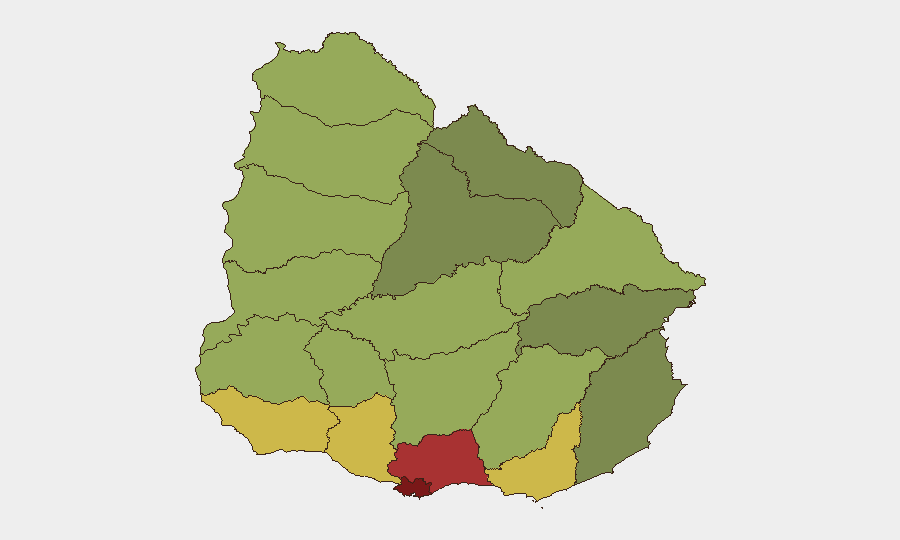
Montevideo (composite score 92) dominates the national risk profile, accounting for the majority of organized-crime activity, armed assault, and homicide in Uruguay. Canelones (78) and Maldonado (68) follow, with Canelones showing persistent gang-related violence and Maldonado reflecting transient criminal networks linked to drug trafficking and property crime. Border departments—Artigas, Salto, Paysandú, and Río Negro—maintain elevated but secondary risk, driven by contraband networks and occasional cross-border violence. Risk is heavily concentrated in urban centers and departmental capitals; rural and peripheral zones remain substantially lower-threat.
How GeoBit Would Assist
Security teams operating in or supporting personnel in Uruguay should deploy AOI (Area-of-Interest) Monitoring & Early Warning on Montevideo and Canelones to detect shifts in gang activity, detention events, or street violence before operational impact. OSINT Fusion & Corroboration and multi-language X/Twitter, Telegram, and YouTube intelligence enable real-time tracking of public statements, administrative actions, and grassroots threat signals that may presage localized unrest or enforcement activity. Conflict & Crime Search capabilities allow rapid baseline mapping of neighborhood-level risk variation within Montevideo to inform travel routing, site security posture, and duty-of-care protocols.
7-Day Outlook
No major escalation is anticipated over the next seven days. Administrative events with the United States warrant monitoring for potential second-order effects on visa, trade, or investment policy, but no immediate operational security impact is projected. Routine baseline crime and disorder in Montevideo and Canelones will likely persist; teams should maintain standard urban-security protocols in those areas and continue passive monitoring for any expansion of enforcement or civil unrest signals.
Highest-Risk Areas — Ranked
| # | State / Region | Risk |
|---|---|---|
| 1 | Montevideo | 92 |
| 2 | Canelones | 78 |
| 3 | Maldonado | 68 |
| 4 | San José | 64 |
| 5 | Colonia | 62 |
| 6 | Soriano | 58 |
| 7 | Río Negro | 56 |
| 8 | Salto | 54 |
| 9 | Artigas | 52 |
| 10 | Paysandú | 50 |
| 11 | Florida | 48 |
| 12 | Flores | 46 |
Sources
Previous Daily Briefs
A new Uruguay brief is written every day — each with its own risk map and downloadable CSV. Here's the last week; use the calendar to go further back.
📅 Browse every day by calendar →
Highlighted days have a brief. Tap a day for that day's map & analysis, or “csv” for that day's dataset ($5).
Atlas — our AI intelligence desk — emails them this snapshot personally. Nothing else, no list.