Situation Summary
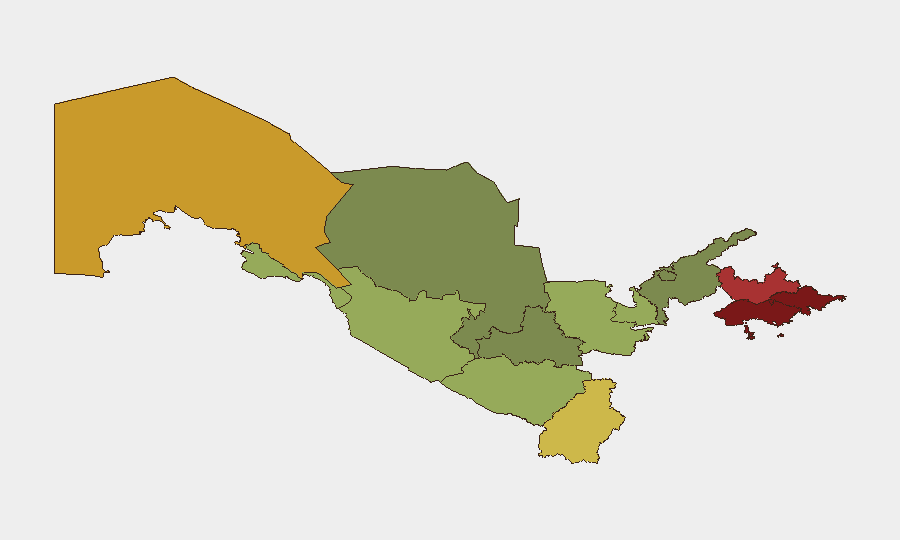
Uzbekistan remains at low global threat ranking (151st; score 9) with no tracked major security incidents, but sub-national risk is sharply concentrated in the Fergana Valley—Andijan, Fergana, and Namangan regions account for the highest regional threat scores (88, 82, 78 respectively). The past week saw routine law-enforcement activity (counterfeiting, narcotics interdiction, cybercrime arrests) and one minor civil-order matter, with no escalation in violence, protest activity, or cross-border instability. The security trajectory remains stable but geographically uneven.
Key Developments
- Tashkent, 7 October: A metro train halted mid-departure from Shakhristan station due to technical malfunction; 1985-built rolling stock was removed for inspection and replaced by reserve capacity, indicating aging infrastructure in the capital's metro system.
- Tashkent & Andijan Region, 7 October: State Security Service arrested a suspect with approximately 297 million soums in counterfeit currency intended for half-value sale; ongoing investigation into wider distribution network.
- Hairatan border crossing, Surkhandarya Region, 8 October: Uzbek customs interdicted ~50 kg of hashish and opium concealed in 98 packages in a commercial lorry transiting from Afghanistan; criminal investigation opened with organizers still at large.
- Olmazor District, Tashkent, 7 October: Authorities initiated inquiry into allegations of violence and bodily injury involving a minor in an unregistered religious marriage; protection order issued.
- Akhangaran District, Tashkent Region, 7 October: Five recreational mountaineers became lost after dark; emergency services located and escorted them to safety after several hours.
- Tashkent, 8 October: Blogger Sirojiddin Adilov convicted and sentenced to four years' imprisonment on extortion and fraud charges; Human Rights Watch raised concerns regarding procedural fairness and freedom of expression implications.
- Uzbekistan nationwide, 7 October: State security authorities announced deployment of surveillance cameras and facial-recognition systems to identify individuals engaged in inappropriate sexual conduct in public spaces; violations subject to fines or up to 15 days administrative detention.
- Uzum Market e-commerce platform, 8 October: Temporary service outage during scheduled systems maintenance; impact confined to brief disruption of online retail access.
Highest-Risk Areas
The Fergana Valley (Andijan, Fergana, Namangan) dominates the sub-national risk profile, collectively representing the nation's highest-threat concentrations (scores 88, 82, 78). These northeastern regions have historically hosted cross-border militant networks, narcotics trafficking, and informal extremist recruitment. Karakalpakstan (72) and Surxondarya (65) present secondary concern zones linked to Afghan border permeability and drug-transit activity. The capital and central regions (Samarqand, Navoiy, Bukhara, Navoiy) remain substantially lower-risk, reflecting stronger state capacity and lower militant activity.
How GeoBit Would Assist
Security teams with personnel or assets in Uzbekistan would benefit from Intel Sweep and OSINT fusion to monitor narcotics-trafficking patterns and extremist-recruitment signals in the Fergana Valley in real time. AOI Monitoring & Early Warning with persistent watch on border crossings (Hairatan, Fergana-Tajikistan) and transport hubs would enable rapid alerts to duty-of-care teams when trafficking interdictions or security operations escalate. Network & Actor Analysis tied to cross-border militant and criminal organizations would provide contextual intelligence on threat trajectories and exposure risk by region and sector.
7-Day Outlook
No major escalation is anticipated in the near term; law-enforcement activity remains routine and localized. However, the persistent narcotics flow through Afghan border crossings and concentrated regional instability in the Fergana Valley warrant sustained monitoring for any uptick in militant recruitment or trafficking-related violence that could affect travel corridors and commercial operations.
Highest-Risk Areas — Ranked
| # | State / Region | Risk |
|---|---|---|
| 1 | Andijan Region | 88 |
| 2 | Fergana Region | 82 |
| 3 | Namangan Region | 78 |
| 4 | Republic of Karakalpakstan | 72 |
| 5 | Surxondaryo Region | 65 |
| 6 | Qashqadaryo Region | 58 |
| 7 | Sirdaryo Region | 55 |
| 8 | Jizzakh Region | 48 |
| 9 | Xorazm Region | 45 |
| 10 | Bukhara Region | 42 |
| 11 | Navoiy Region | 38 |
| 12 | Samarqand Region | 35 |
Sources
Previous Weekly Briefs
A new Uzbekistan brief is written every Monday, covering the week — each with its own risk map and downloadable CSV. Use the calendar to go further back.
- October 5, 2026
- September 28, 2026
- September 21, 2026
- September 14, 2026
- September 7, 2026
- September 3, 2026
- September 2, 2026
📅 Browse past briefs by calendar →
Highlighted days have a brief. Tap a day for that day's map & analysis, or “csv” for that day's dataset ($5).
Atlas — our AI intelligence desk — emails them this snapshot personally. Nothing else, no list.