Situation Summary
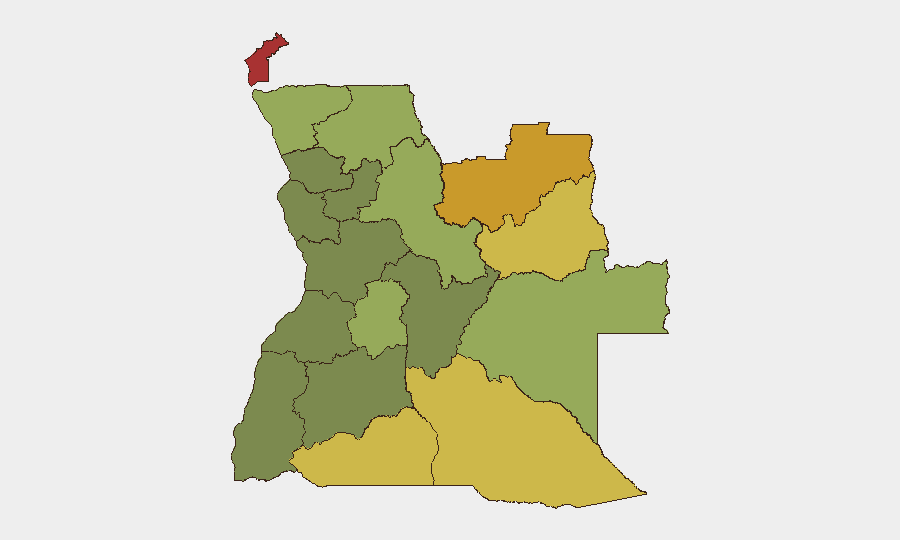
Angola remains a moderate global security concern (rank #49, composite score 40) with a stable political and military environment, though fragmented by significant regional disparities. The past week recorded routine but elevated incident volumes—33 deaths nationwide from mixed causes (traffic, homicide, accidents), 142 crimes detained, and sustained cross-border trafficking pressures—without major escalation or infrastructure disruption. Security risk is heavily concentrated in the northeastern and eastern border provinces (Cabinda, Lunda Norte/Sul, Cuando Cubango), where organized crime, illicit mining, and transnational trafficking dominate. The security trajectory remains flat; baseline crime and traffic mortality persist, but no acute political, conflict, or public-order crisis is evident.
Key Developments
- Angola, nationwide — 17–18 October 2026: Civil-protection authorities recorded 33 deaths and 27 serious injuries over the weekend from road crashes, homicides, electrocutions, fires, falls and drownings. Fires were reported across eight provinces including Luanda, Cunene, Huambo, and Lunda Sul.[2]
- Luanda Province — 17–18 October 2026: Police reported 14 traffic crashes causing 7 deaths, 18 injuries and approximately 4 million kwanzas in material damage.[2]
- Angola, nationwide — 17–18 October 2026: Authorities recorded 142 crimes (128 common, 14 traffic-related), detained 230 suspects, seized 4 vehicles and 378 motorcycles, and sanctioned 942 motorists for road-code violations.[2]
- Luanda — 15 October 2026: President João Lourenço identified cross-border crime, trafficking, piracy, terrorism and illicit arms flows as continuing security priorities, confirming political and military stability at the national level.[1]
- Angola, nationwide — 15 October 2026: Authorities reported seizure of 1,866,743 litres of fuel in smuggling operations; illegal mining and vandalism of public assets remain ongoing concerns.[1]
- Angola's regional security architecture — 17 October 2026: Angola joined a Southern African intelligence-sharing and coordinated-operations mechanism targeting drug trafficking, organized crime, kidnapping, vehicle theft, human trafficking and migrant smuggling.[5]
- Angola — 19 October 2026: Cybersecurity research cited Angola as among Africa's most heavily targeted countries for cyberattacks, with organizations averaging 5,967 attacks per week, reportedly up 96% year-on-year.[9]
Highest-Risk Areas
Cabinda Province (risk 78) and Lunda Norte Province (risk 72) dominate Angola's threat landscape, driven by ongoing organized crime, illicit diamond and mineral extraction, cross-border smuggling networks, and limited state enforcement capacity in remote areas. The contiguous eastern border zone—including Lunda Sul (68), Cuando Cubango (64), and Cunene (62)—forms a continuous high-risk corridor where transnational trafficking, fuel smuggling, vehicle theft, and weapons flows remain endemic. These provinces' remoteness, porous borders with the Democratic Republic of Congo and Zambia, and weak infrastructure create persistent ungoverned spaces exploitable by criminal and trafficking organizations. Risk declines significantly south and west toward Luanda and coastal regions, where state presence and policing capacity are stronger.
How GeoBit Would Assist
Security teams monitoring Angola should employ AOI Monitoring & Early Warning on Cabinda and Lunda provinces to detect trafficking spikes and organized-crime activity, coupled with Network & Actor Analysis to map criminal organization reach and cross-border supply chains. Intelligence & OSINT (multi-language search, Telegram/web monitoring, entity extraction) would track fuel smuggling, arms flows, and human trafficking signals in real time. Routing & Network Analysis supports duty-of-care teams planning secure travel corridors avoiding high-risk provinces and identifying alternative logistics routes away from trafficking hotspots.
7-Day Outlook
No acute escalation or policy shift is expected in the near term. Baseline crime, traffic mortality, and cross-border trafficking will likely persist at current volumes. Attention should remain on regional intelligence-sharing mechanisms and their operational effectiveness in reducing transnational organized crime.
Highest-Risk Areas — Ranked
| # | State / Region | Risk |
|---|---|---|
| 1 | Cabinda Province | 78 |
| 2 | Lunda Norte Province | 72 |
| 3 | Lunda Sul Province | 68 |
| 4 | Cuando Cubango Province | 64 |
| 5 | Cunene Province | 62 |
| 6 | Moxico Province | 58 |
| 7 | Zaire Province | 54 |
| 8 | Huambo Province | 50 |
| 9 | Uíge Province | 48 |
| 10 | Malanje Province | 42 |
| 11 | Bié Province | 35 |
| 12 | Huíla Province | 32 |
Sources
Previous Weekly Briefs
A new Angola brief is written every Monday, covering the week — each with its own risk map and downloadable CSV. Use the calendar to go further back.
- October 13, 2026
- October 6, 2026
- September 29, 2026
- September 22, 2026
- September 15, 2026
- September 8, 2026
- September 2, 2026
📅 Browse past briefs by calendar →
Highlighted days have a brief. Tap a day for that day's map & analysis, or “csv” for that day's dataset ($5).
Atlas — our AI intelligence desk — emails them this snapshot personally. Nothing else, no list.