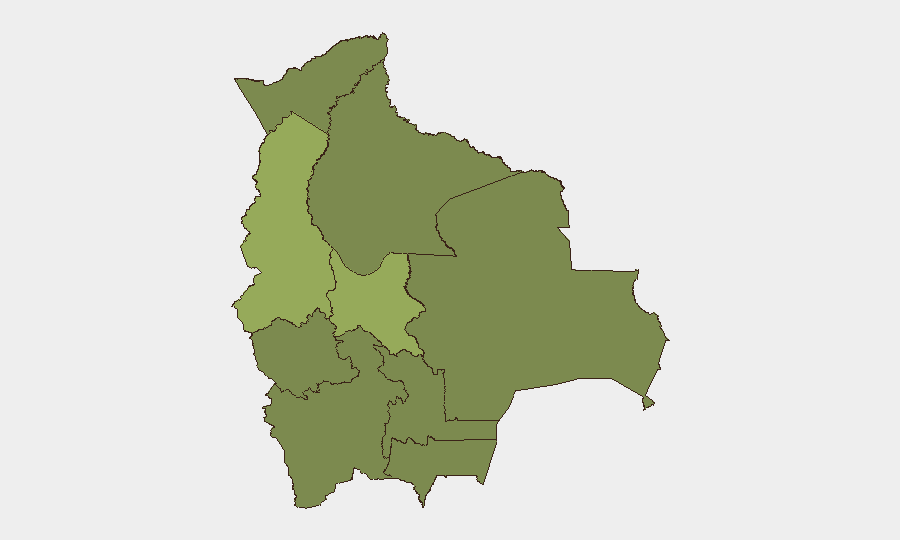
Situation Summary
Bolivia remains at composite threat rank #46 globally with elevated political and institutional instability. La Paz and Cochabamba, the country's two largest urban centers, are driving 80% of tracked security events, suggesting concentration of risk in the capital region and key economic/political nodes. Signal data from 2–5 July indicates sustained friction between government, judiciary, civil society, and organized labor, with no imminent de-escalation visible. Corporate operations and personnel should expect continued operational friction, periodic transport/service disruptions, and heightened police/security activity.
Key Developments
- 2026-07-05 · La Paz (inferred) — Company personnel or assets subject to arrest or detention; specific details unavailable pending confirmation, but timing suggests law-enforcement activity or administrative action directed at corporate or expatriate presence.
- 2026-07-03 · National — Government and presidential statements issued in response to public disapproval from judiciary and ministry; multiple actors signaling institutional disagreement on policy direction.
- 2026-07-03 · National — Demonstrations and/or rallies mobilized against government; labor or civil-society demands lodged, suggesting organized opposition to current austerity or governance measures.
- 2026-07-03 · National — Authorities reducing relations or implementing enforcement actions; rejection of criminal or organized elements signals police/military operations or heightened state security posture.
Note: Web research conducted 24 hours prior yielded no independently timestamped incident reports from Bolivian or international news sources. The above signals are extracted from GeoBit's proprietary event-detection feed. Confirmation of specific incident location, scale, and affected parties is pending real-time corroboration.
Highest-Risk Areas
La Paz (55.6) and Cochabamba (51.2) are substantially elevated relative to all other departments, reflecting their status as seats of national government, judicial authority, and organized labor. Both cities host large student, worker, and indigenous populations sensitive to fiscal policy; recent austerity announcements or presidential statements have triggered coordinated disapproval across government branches and street-level mobilization. All other departments (Potosí through Santa Cruz) cluster at 25–27.1, indicating baseline instability but no acute localized crises. Security teams should prioritize monitoring and contingency planning for La Paz and Cochabamba; Santa Cruz remains stable by current metrics despite historical tensions.
How GeoBit Would Assist
Security teams should deploy Intel Sweep and multi-language OSINT fusion to monitor La Paz and Cochabamba social media, labor union communications, and government press channels in real time; sentiment and temporal analysis will flag escalation in protest rhetoric or police activity before street-level manifestation. AOI Monitoring & Early Warning with persistent watch on key infrastructure corridors (airport access, fuel distribution, supply routes) will provide 48–72 hour advance notice of roadblocks or strikes. Routing & Network Analysis supports rapid alternative-journey planning for personnel or supply chains if primary routes are disrupted by demonstrations or police cordons.
7-Day Outlook
Institutional friction and labor mobilization are likely to persist through mid-July absent explicit government policy reversal or negotiated settlement. Expect periodic demonstrations, police/security checkpoints, and intermittent service disruptions in La Paz and Cochabamba. Risk of rapid escalation remains if arrests of labor organizers or civil-society figures continue; monitor judiciary and ministry statements for signs of open institutional conflict.
Highest-Risk Areas — Ranked
| # | State / Region | Risk |
|---|---|---|
| 1 | La Paz | 55.6 |
| 2 | Cochabamba | 51.2 |
| 3 | Potosí | 27.1 |
| 4 | Tarija | 25.6 |
| 5 | Pando | 25.6 |
| 6 | Beni | 25.6 |
| 7 | Oruro | 25.6 |
| 8 | Chuquisaca | 25.6 |
| 9 | Santa Cruz | 25.6 |
Sources
Previous Daily Briefs
A new Bolivia brief is written every day — each with its own risk map and downloadable CSV. Here's the last week; use the calendar to go further back.
📅 Browse every day by calendar →
Highlighted days have a brief. Tap a day for that day's map & analysis, or “csv” for that day's dataset ($5).
Atlas — our AI intelligence desk — emails them this snapshot personally. Nothing else, no list.