Situation Summary
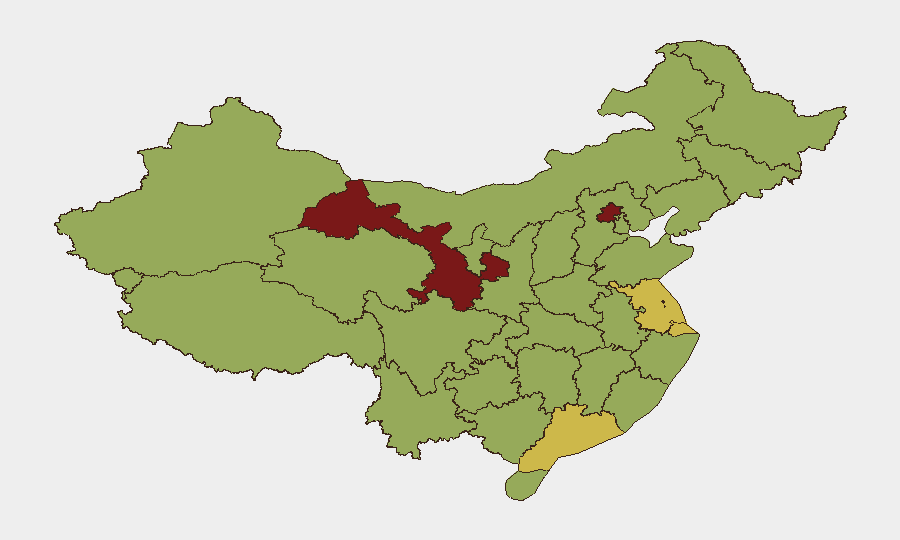
China remains a moderate-risk environment (Global Rank #19, composite score 75) with no major acute security incidents reported in the past 24–48 hours inside the country itself. The primary security drivers are structural—heightened diplomatic tension with regional partners (India, Japan), ongoing military posturing in the South China Sea and Taiwan Strait, and recent expansion of state legal mechanisms for political control—rather than active civil unrest or infrastructure failure. Risk concentration remains highest in Gansu and Beijing (both 82.6), reflecting both strategic sensitivity and administrative scrutiny.
Key Developments
- Beijing, Diplomatic Warning – 4–5 July 2026
China's Foreign Ministry issued a formal statement objecting to expanded India–Japan defense cooperation, signaling concern over regional encirclement and shifting security alignments in the Indo-Pacific.
- Beijing, Aviation Incident Fallout – Late Week
A fatal small-plane crash in Beijing has triggered political and administrative review of aviation control and state security mechanisms; no new unrest directly tied to the incident is documented in the last 24–48 hours.
- National, Legal/Political Control Expansion – Recent Days
Chinese authorities have advanced an "ethnic unity" law strengthening transnational legal tools against critics and minority-linked dissent; this represents structural tightening rather than an acute incident.
- Maritime Periphery, Military Escalation – Ongoing
US, Japan, and South Korea have intensified joint maritime drills in disputed waters; coverage recaps continuing patterns of elevated tension rather than a single, clearly time-stamped incident in the last 24–48 hours.
- No Major Domestic Unrest or Infrastructure Alerts – Last 24–48 Hours
Open-source feeds do not document significant protests, civil disorder, violent crime spikes, or infrastructure failures inside China within this window; most reportage reflects broader strategic and legal trends rather than acute incidents.
Highest-Risk Areas
Gansu and Beijing (both 82.6) lead the sub-national ranking, with Beijing's prominence reflecting its role as the diplomatic and administrative center where state-security messaging, political control expansion, and international relations friction converge. Guangdong Province (69.4) and Shanghai (64.8) follow, driven by economic activity, international engagement, and historical sensitivity to political and labor issues. The eastern and central provinces (Jiangsu, Zhejiang, Hunan, Jiangxi, Fujian) cluster in the 54–62 range, suggesting distributed mid-level risk tied to industrial, commercial, and demographic concentration rather than localized acute threats.
How GeoBit Would Assist
Security teams operating in China would benefit from Intel Sweep and multi-language OSINT to monitor state media, local government statements, and social-media signals for early signs of policy changes or localized unrest before they escalate. AOI Monitoring & Early Warning on key cities (Beijing, Shanghai, Guangdong) would provide persistent watch for civil disorder, security operations, or infrastructure disruption. Network & Actor Analysis combined with Sentiment & Temporal Analysis would help teams track shifts in official messaging, diaspora activism, and transnational repression trends that could affect personnel or operations.
7-Day Outlook
No immediate domestic security crisis is forecast; however, the combination of expanded legal tools for political control, elevated military tension on the maritime periphery, and Beijing's heightened diplomatic messaging suggests a security environment favoring caution and scenario planning. Corporate security teams should maintain vigilance on regional military developments (Taiwan Strait, South China Sea) that could rapidly escalate travel or logistics risk, and monitor any escalation of state enforcement activities linked to the new "ethnic unity" law framework.
Highest-Risk Areas — Ranked
| # | State / Region | Risk |
|---|---|---|
| 1 | Gansu | 82.6 |
| 2 | Beijing | 82.6 |
| 3 | Guangdong Province | 69.4 |
| 4 | Shanghai | 64.8 |
| 5 | Jiangsu | 61.7 |
| 6 | Zhejiang | 58.9 |
| 7 | Hunan | 57.7 |
| 8 | Jilin | 54.9 |
| 9 | Heilongjiang | 54.1 |
| 10 | Jiangxi | 54.1 |
| 11 | Fujian | 53.7 |
| 12 | Guangxi | 53.3 |
Sources
Previous Daily Briefs
A new China brief is written every day — each with its own risk map and downloadable CSV. Here's the last week; use the calendar to go further back.
📅 Browse every day by calendar →
Highlighted days have a brief. Tap a day for that day's map & analysis, or “csv” for that day's dataset ($5).
Atlas — our AI intelligence desk — emails them this snapshot personally. Nothing else, no list.