Situation Summary
Croatia remains a low-threat environment globally (rank #136; composite score 7) with no tracked major security incidents as of 08 August 2026. However, recent localized incidents—including a targeted police killing in Krapina, multiple transport accidents, and infrastructure safety concerns—indicate persistent baseline vulnerabilities in law enforcement, public safety, and industrial oversight. Eastern border regions continue to carry disproportionately higher risk profiles, likely reflecting historical tensions and cross-border dynamics. The threat trajectory is stable but warrants close monitoring in high-risk counties and transport corridors.
Key Developments
- Krapina, 05 August 2026 – A police officer was shot dead inside a café at a shopping center; incident assessed as targeted with investigation ongoing. Represents rare violence against uniformed personnel in central Croatia.
- Kukuljanovo (near Rijeka), 05–06 August 2026 – Health authorities detected dangerously high hydrogen-sulfide concentrations in the sewer system near the Orada Adriatic plant; police investigation initiated. Indicates potential industrial safety or environmental breach with occupational risk.
- Primorje-Gorski Kotar County, within last 48 hours – Three serious road accidents on the D8 highway caused major traffic disruption; three people seriously injured. Suggests elevated accident risk on key transport infrastructure.
- Split (Bilice prison), within last 48 hours – A 51-year-old inmate found dead in cell; no foul play suspected by police. Routine custody incident but reflects prison oversight environment.
- Istria, within last 48 hours – Police arrested a 45-year-old Italian national for covert filming of nude minors. Highlights vulnerability to transnational child-exploitation networks at tourist facilities.
- Varaždin, within last 48 hours – Police issued public warning of phishing campaign using fake arrest threats and false child-pornography allegations. Indicates active cybercrime targeting civilians with psychological manipulation tactics.
- Knin, within last 48 hours – Three civil associations filed complaint alleging hate speech and display of Ustaše symbols during VRO Oluja commemoration. Reflects ongoing sensitivity around historical commemoration events and extremist rhetoric.
- Medulin, 05 August 2026 – Small aircraft crashed with four fatalities; no indication of foul play. Standard aviation safety incident.
Highest-Risk Areas
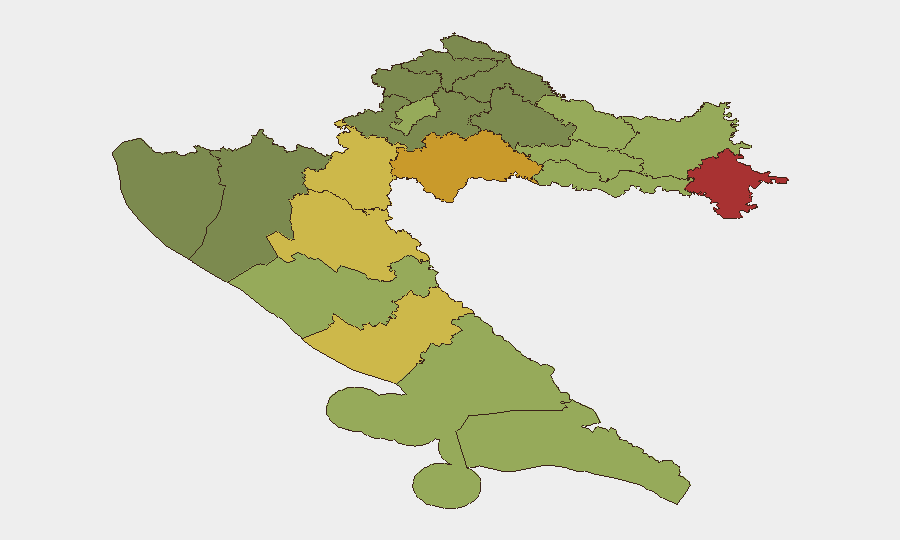
Eastern and southeastern counties—dominated by Vukovar-Srijem (78), Sisak-Moslavina (72), and Karlovac (68)—drive the national risk profile and likely reflect residual instability from the 1990s conflict, cross-border criminal networks, and resource constraints in law enforcement and infrastructure. Mid-tier Adriatic counties (Lika-Senj, 65; Šibenik-Knin, 62) show elevated scores consistent with tourism seasonality, dispersed settlements, and maritime border exposure. Zagreb (50) and Split-Dalmatia (48) remain below the national median despite larger populations, indicating better institutional capacity and security presence in major urban centers.
How GeoBit Would Assist
Intelligence & OSINT (Intel Sweep, X/Telegram monitoring, multi-language search, entity extraction) enable real-time tracking of hate speech, extremist rhetoric, and emerging crime networks flagged in Knin and Varaždin. AOI Monitoring & Early Warning on high-risk counties—particularly Vukovar-Srijem and Sisak-Moslavina—with persistent alert thresholds would trigger notifications of targeting events, border incidents, or organized-crime activity. Network & Actor Analysis on transnational threats (child exploitation, phishing campaigns) and Routing & Network Analysis for alternative journey planning on corridors with high accident or interdiction risk (D8, major urban approaches) directly support duty-of-care planning.
7-Day Outlook
No significant escalation is anticipated in the near term. Baseline risk—localized crime, occupational incidents, and routine accidents—will likely persist. Continued monitoring of Krapina shooting investigation and any memorial or political events in August may reveal secondary security concerns or retaliatory activity; liaison with local law enforcement and event organizers is advisable for organizations with personnel in central or eastern regions.
Highest-Risk Areas — Ranked
| # | State / Region | Risk |
|---|---|---|
| 1 | Vukovar-Srijem County | 78 |
| 2 | Sisak-Moslavina County | 72 |
| 3 | Karlovac County | 68 |
| 4 | Lika-Senj County | 65 |
| 5 | Šibenik-Knin County | 62 |
| 6 | Brod-Posavina County | 58 |
| 7 | Zadar County | 55 |
| 8 | Osijek-Baranja County | 52 |
| 9 | City of Zagreb | 50 |
| 10 | Split-Dalmatia County | 48 |
| 11 | Požega-Slavonia County | 45 |
| 12 | Virovitica-Podravina County | 42 |
Sources
Previous Daily Briefs
A new Croatia brief is written every day — each with its own risk map and downloadable CSV. Here's the last week; use the calendar to go further back.
📅 Browse every day by calendar →
Highlighted days have a brief. Tap a day for that day's map & analysis, or “csv” for that day's dataset ($5).
Atlas — our AI intelligence desk — emails them this snapshot personally. Nothing else, no list.