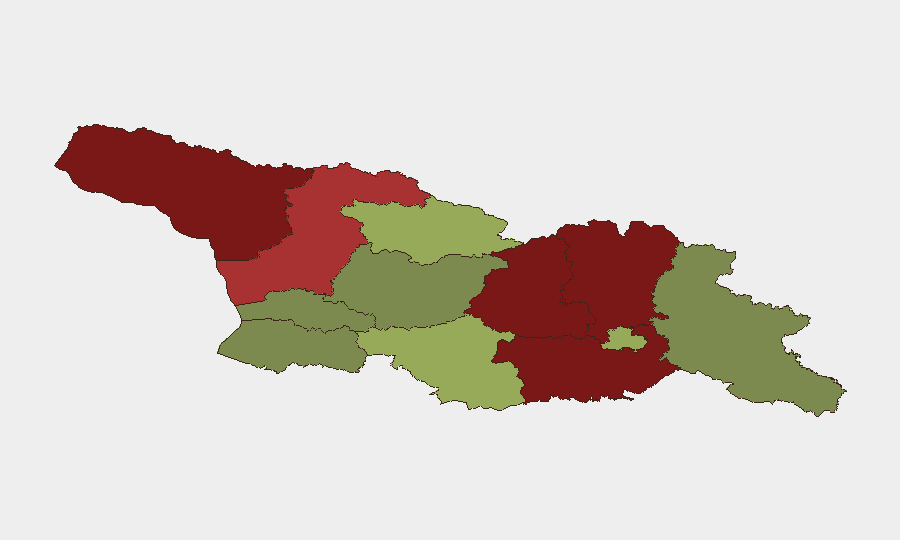
Situation Summary
Georgia remains a low-to-moderate threat environment globally (rank #89, composite score 18), but sub-national risk is highly polarized: the Autonomous Republic of Abkhazia and the South Ossetia-adjacent regions (Shida Kartli, Lower Kartli, Mtskheta-Mtianeti) carry significantly elevated risk (scores 82–95), driven by occupation, border tensions, and arbitrary detention of civilians, while central Tbilisi and southwestern regions present substantially lower risk (32–45). Over the past 48 hours, political protests have continued in central Tbilisi, a small animal-rights demonstration occurred near government buildings, and reports of fuel-supply tensions with occupied Abkhazia reflect ongoing geo-political friction. The broader trend remains one of contained civil unrest and recurring protest activity rather than acute security breakdown.
Key Developments
- Tbilisi, central district | 17 August 2026 – Evening political protests continued in the central Tbilisi area around parliament, with several hundred to approximately 2,000 participants reported gathering on a near-daily basis; no clashes or police action reported in the most recent 48-hour window.
- Tbilisi, Government building vicinity | 17 August 2026 – A small animal-rights protest took place demanding regulation of stray-dog killings and clearer animal-welfare policy; described as a "new action" and assessed as low direct security risk.
- Tbilisi area | 15 August 2026 – Heavy rainfall caused street flooding and damaged a gas line near Rustaveli and Vaja-Pshavela metro stations; utility response was initiated, with potential for temporary service disruption in public transit.
- Administrative Boundary Line (ABL), near Tskhinvali region | 14–16 August 2026 – Georgia's State Security Service announced the release and return of a Georgian citizen detained by Russian occupation forces near the Tskhinvali region since December 2025; the report reflects ongoing border-area detention risk for locals near the ABL.
- Political economy | 17 August 2026 – Opposition figures in Tbilisi demanded explanations from authorities regarding fuel shipments to Russian-backed Abkhazia, signaling domestic political tension over economic linkages to occupied territories; no discrete protest or confrontation reported.
Highest-Risk Areas
Abkhazia (rank 95) and the three central regions bordering it—Shida Kartli (88), Lower Kartli (85), and Mtskheta-Mtianeti (82)—account for the majority of Georgia's sub-national threat. These areas are proximate to or directly affected by Russian military occupation, de-facto administration, and arbitrary detention of civilians, and experience periodic clashes and border incursions. Tbilisi itself (rank 45) remains significantly safer than these regions, though recurring political protests pose crowd-management and operational-disruption risks for businesses and resident expatriate communities. Southwestern and coastal regions (Samtskhe-Javakheti, Imereti, Guria, Adjara) present the lowest risk profiles (28–48).
How GeoBit Would Assist
Security teams operating in Georgia would use AOI Monitoring & Early Warning to track Tbilisi protest activity and border-area incidents near Abkhazia and South Ossetia in real time, coupled with Intel Sweep and X/Twitter & Telegram OSINT to detect escalation signals or new protest calls before they materialize. Network & Actor Analysis and sentiment analysis of Georgian-language and Russian regional media would flag emerging political or operational tensions (e.g., fuel-supply disputes, detention announcements) early enough to inform duty-of-care decisions. GIS & Spatial Analysis and Routing & Network Analysis enable security teams to map safe corridors for personnel movement and identify real-time alternative routes around Tbilisi if protests swell or infrastructure damage occurs.
7-Day Outlook
Tbilisi's political protest cycle is expected to continue at current levels (evening gatherings, low violence), with possible larger crowds on weekends. Border-area detention risks and fuel-supply friction with Abkhazia remain chronic background tensions unlikely to generate acute incidents within seven days absent a significant political shock. Infrastructure resilience (flooding, utility damage) may warrant temporary route adjustments for corporate operations in the capital.
Highest-Risk Areas — Ranked
| # | State / Region | Risk |
|---|---|---|
| 1 | Autonomous Republic of Abkhazia | 95 |
| 2 | Shida Kartli | 88 |
| 3 | Lower Kartli | 85 |
| 4 | Mtskheta-Mtianeti | 82 |
| 5 | Samegrelo-Upper Svaneti | 78 |
| 6 | Samtskhe-Javakheti | 48 |
| 7 | Tbilisi | 45 |
| 8 | Racha-Lechkhumi and Kvemo Svaneti | 42 |
| 9 | Kakheti | 38 |
| 10 | Autonomous Republic of Adjara | 35 |
| 11 | Imereti | 32 |
| 12 | Guria | 28 |
Sources
Previous Daily Briefs
A new Georgia brief is written every day — each with its own risk map and downloadable CSV. Here's the last week; use the calendar to go further back.
- August 17, 2026
- August 16, 2026
- August 15, 2026
- August 14, 2026
- August 12, 2026
- August 11, 2026
- August 10, 2026
📅 Browse every day by calendar →
Highlighted days have a brief. Tap a day for that day's map & analysis, or “csv” for that day's dataset ($5).
Atlas — our AI intelligence desk — emails them this snapshot personally. Nothing else, no list.